
Gus van Sant makes respectable return in 1970s hostage thriller ‘Dead Man’s Wire’
At the heart of gay director Gus van Sant’s “Dead Man’s Wire,” two men are trapped inside an apartment. It may as well be a cave, but they can connect to the outside world via the media. Television serves up images of violence, through John Wayne Westerns. Radio delivers the soothing, velvety voice of DJ … Read More
 Mark
Mark
0
63
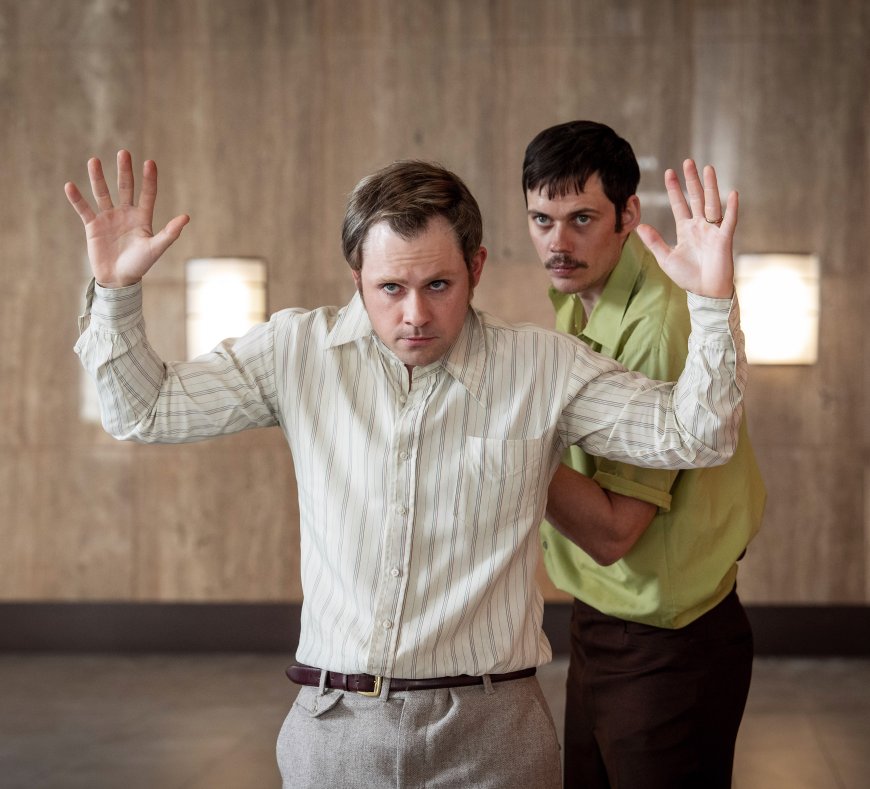
At the heart of gay director Gus van Sant’s “Dead Man’s Wire,” two men are trapped inside an apartment. It may as well be a cave, but they can connect to the outside world via the media. Television serves up images of violence, through John Wayne Westerns. Radio delivers the soothing, velvety voice of DJ Fred Temple (out actor Colman Domingo), blowing cigarette smoke into the microphone while introducing R&B records. One of these men is a kidnapper, the other his hostage. Despite these differences, their relationship is the one true emotional connection in “Dead Man’s Wire.”
On the desolate morning of Feb. 8, 1977, Tony Kitsis (Alexander Skarsgard) drives to the office of Meridian Mortgage Company. He carries a large paper box taped shut. It turns out to contain his gun, which he uses to take executive Richard (Dacre Montgomery) hostage. Richard’s dad M. L. (Al Pacino) owns the company. He’s the kind of man who becomes furious because his burrito has been cut in halves instead of thirds. Tony’s angry at the company because he bought a large plot of land, intending to open a mall there, but he ended up defaulting on the mortgage. He says that Meridian sabotaged his plan. With Richard as his hostage, Tony takes him back to his home.
Before “Dead Man’s Wire” premiered at the Venice Film Festival last fall, I wondered if van Sant, who’s now in his 70s, had retired. With “Mala Noche” and “My Own Private Idaho,” he helped establish the New Queer Cinema movement. Yet he’s also capable of making relatively anonymous medium-budget films, like “Good Will Hunting,” before returning to the experimentation of “Gerry.” He hasn’t really made an impact since “Milk,” released in 2008. Since “Don’t Worry, He Won’t Get Far On Foot,” made in 2017, van Sant just dropped out of sight. Although “Dead Man’s Wire” won’t displace anyone’s memories of his best films, it’s a respectable return.
Music cushions the 1977 setting, with selections from Donna Summer, Yes, Deodato, and Roberta Flack. Gil Scott-Heron’s “The Revolution Will Not Be Televised” plays as the film winds down, which suits its themes. “Dead Man’s Wire” alludes to the grit of New Hollywood — particularly Sidney Lumet’s “Dog Day Afternoon” — but the populist appeal Tony holds seems attuned to both the setting and present. He holds the outlaw glamour of Luigi Mangione. (Skarsgard is younger and much more handsome than the real Tony, seen in news clips.) Radio listeners call in to express their identification with his struggle.
A concern with the media is present throughout “Dead Man’s Wire,” but it's somewhat underbaked. A subplot shows a Black reporter, Linda, using Tony’s case to fight to be seen as a journalist who can break important stories, but she remains secondary. When the TV news crew films Tony, “Dead Man’s Wire” cuts to extremely crude video images. Questioned about the possibility of murder taking place live on air, the station manager glibly says “we’ll pay the fine,” since they would benefit so much from the ratings boost. Radio is portrayed much more positively, as a tissue connecting Indianapolis. The entire city is shown listening to Fred’s show and taking his thoughts seriously.
There’s a sadomasochistic dynamic to Tony and Richard’s captivity. Some of this simply comes from the sight of Richard with a wire around his neck connected to Tony’s gun while also wearing handcuffs. Although there’s never a hint that the two men are attracted to each other, their time spent together seems like one of the most intense moments of their lives, for both. They can’t help smelling each other. Tony gets insight into Richard’s childhood after hearing from his greedy father. Vast class differences make it impossible for anything positive to come from this.
“Dead Man’s Wire” is meat-and-potatoes cinema. It would’ve seemed fairly ordinary were it released in the ‘70s. Yet with the passage of time, its identification with poor people seems more remarkable, especially since it places the wealthy on its periphery. Tony isn’t a hero: Skarsgard’s sweaty, increasingly furious performance places him on the edge of losing control. The actor resists letting the audience get a handle on his character. Yet he hangs on to a degree of politeness towards Richard, even while threatening his life. With enough money, as Richard’s father demonstrates, you don’t even have to make the attempt to convince anyone you have good intentions.
“Dead Man’s Wire” | Directed by Gus van Sant | Row K Entertainment | Opens January 9th at the Angelika