
Tom of Finland: Touko Laaksonen’s Life, Art, Stamps and Legacy
Tom of Finland was Touko Laaksonen (1920 to 1991). His 1957 debut, Kake, Finland’s 2014 stamps, the 2017 biopic, MoMA holdings and the foundation today.
 Mark

Tom of Finland was the pen name of Touko Valio Laaksonen, a Finnish illustrator born May 8, 1920, who died Nov. 7, 1991. His pencil drawings of muscled loggers, bikers, sailors and cops, usually in tight denim or black leather and often mid-romp, became the template for a confident, joyful gay masculinity that still shapes gay nightlife and fashion.
He started in a 1950s American mail-order muscle magazine and ended up in the permanent collections of New York’s Museum of Modern Art, Helsinki’s Kiasma and the Museum of Contemporary Art in Los Angeles, according to This Is Finland, a site produced by Finland’s Ministry for Foreign Affairs. Laaksonen never hid what his pictures were for. “I consistently represent masculine beauty. Of course I do exaggerate the muscles and genitals, for this is what makes it a dream,” he said, in words Kiasma quoted for its 2023 retrospective. Tom of Finland at a Glance FactDetailReal nameTouko Valio LaaksonenBornMay 8, 1920, Kaarina, FinlandDiedNov. 7, 1991, Laakso Hospital, HelsinkiFirst publishedSpring 1957 cover of Physique PictorialBest-known characterKake, the leatherman of 26 comics (1968 to 1986)FoundationTom of Finland Foundation, co-founded with Durk Dehner in Los Angeles, 1984StampsPosti sheet issued Sept. 8, 2014Film“Tom of Finland” (2017), directed by Dome KarukoskiPartnerVeli “Nipa” Mäkinen, together 28 yearsSwipe horizontally to view all columns. Touko Laaksonen’s Early Life in Kaarina and Helsinki
Laaksonen grew up in a teacher’s family in Kaarina, near Turku, and moved to Helsinki in autumn 1939 to study at the Helsinki School of Sales and Advertising, the City of Helsinki’s MyHelsinki guide says. Music came first in his plans. “I imagined becoming a good pianist and composer,” he once said, as the guide quotes him.
War got there first. He was called up in spring 1940, weeks after the Winter War ended, and served in air defense in Helsinki, first at Suomenlinna and later at Pitäjänmäki. His crew shot down a Soviet plane, and he received the Cross of Liberty medal, according to the city guide.
The war also fed the fantasy. He found Finnish uniforms baggy next to those of the German soldiers stationed in Finland, and he later had anonymous sex with Wehrmacht soldiers, critic Jarrett Earnest wrote in a 2024 New York Review of Books essay. “They had the sexiest uniforms!” Laaksonen said, in a quote Earnest cites. He added that the “whole Nazi philosophy, the racism and all that, is hateful to me, but of course I drew them anyway.”
He later turned against those images. “They thought I was a Nazi,” he told artist Nayland Blake in 1988, according to the same essay, and he said he’d tried to pull the drawings with Nazi insignia out of circulation.
He also worked as a restaurant pianist in Helsinki, longest at the Palace hotel, and in the late 1950s joined the ad agency Liikemainonta, later McCann Helsinki, where he became artistic director. He met Veli “Nipa” Mäkinen, a former operetta dancer and later maître d’, in summer 1953. They lived together for 28 years, MyHelsinki says, and in 1969 moved into a flat at Tehtaankatu 7 in Ullanlinna. How ‘Physique Pictorial’ Turned Touko Into Tom
In 1956, Laaksonen mailed drawings to Physique Pictorial, the Los Angeles magazine Bob Mizer had started in 1951. He signed them simply “Tom.” His first published drawing ran on the cover of the spring 1957 issue: “a smiling, shirtless lumberjack” balanced on a floating log, Earnest wrote in the New York Review of Books. By that winter, more drawings ran under the name “Tom of Finland.”
Physique Pictorial ran no fully nude images until 1969, Earnest noted.
Tom’s men got bolder over the decades. Bikers, cops, sailors and soldiers replaced the wholesome outdoorsmen, and the scenes moved into group sex and leather S&M. The grins stayed. He wanted his drawings “to show gay men being happy and positive about who they were,” he said, in a passage Earnest quotes.
That attitude is the thing curators point to now. “The fantasy situations depicted by Tom of Finland project a world of enjoyment and pride,” Kiasma wrote in 2023, an image that “then and now opposes conceptions of non-normative or non-confirming identities bearing guilt or shame.” Kake, Leather and the Tom of Finland Look
His most famous creation is Kake, a mustached leatherman who rides his motorcycle around the world having very explicit, very happy sex. The 26 Kake episodes ran from 1968 to 1986, and Taschen collects them in “Tom of Finland: The Complete Kake Comics,” edited by Dian Hanson.
Reproductions spread far past the magazines. Bootleg copies became bar decor, and men began dressing like the drawings, helping set up the macho “clone” style of the 1970s, the NYRB essay argues. The look lives on in today’s gay tribes like bears and leather daddies and the hanky code that grew up in the same bars. Finland’s 2014 Tom of Finland Stamps
Finland put him on its mail on Monday, Sept. 8, 2014. Itella Posti, the national postal service, released a stamp sheet using two of his drawings, from 1978 and 1979, designed by Timo Berry, Posti announced. “It was interesting to dive into Tom’s exceptionally lusty, masculine and black-and-white graphic world,” Berry said in the release.
Collectors went for them hard. Pre-orders reached 178 countries, with Sweden, Britain, the United States and France leading foreign demand, Posti said on release day. Posti’s webstore crashed in April 2014 “under the weight of 70,000 pre-orders,” This Is Finland reported, calling it “the most popular stamp set in the history of the Finnish Postal Service.”
The foundation initiated the stamps, This Is Finland says. “Tom stands for all tolerance today, beyond homosexuality,” Susanna Luoto, the foundation’s representative in Finland, said in the same article.
His art later turned up on Finlayson bed linen and as an emoji on This Is Finland’s Finland emoji set, released just before same-sex marriage became legal there on March 1, 2017, the site says. The 2017 ‘Tom of Finland’ Movie Starring Pekka Strang
Dome Karukoski’s biopic “Tom of Finland,” starring Pekka Strang as Laaksonen, opened in Finnish theaters on Feb. 24, 2017. It opened that year’s Göteborg Film Festival in Sweden, Cineuropa reported, and won the FIPRESCI critics’ prize there, according to its U.S. distributor, Kino Lorber. Aleksi Bardy wrote and produced it for Helsinki Filmi.
Finland’s Oscar committee picked it as the country’s foreign-language film submission. “It is a beautiful portrait of one of the most internationally famous Finns, a wonderfully designed and shot period piece,” the committee said, Cineuropa reported. “What has surprised me is that his story is news to so many people,” Karukoski said in the same report. Where to See Tom of Finland Art: MoMA, Kiasma and More
Museums that once wouldn’t touch him now collect him. MoMA’s online collection lists five Tom of Finland drawings, including “Untitled (Peter Berlin).” SFMOMA lists 14 works, most of them early 1960s drawings. LACMA holds “Standing Man in Uniform,” a 1983 pencil drawing given by the Tom of Finland Foundation.
Photographer Jack Shear, who owns a 1967 drawing, makes the art-world case plainly. “When you look at the drawings themselves you see what a great draftsman and storyteller he was in the tradition of old master drawings,” he said in Earnest’s New York Review of Books essay. YearExhibitionVenue1976First major exhibitionHamburg, Germany2013‘Bob Mizer and Tom of Finland’MOCA Los Angeles2019‘Camp: Notes on Fashion’ (group show)Metropolitan Museum of Art, New York2023‘Over the Rainbow’ (group show)Centre Pompidou, Paris2023‘Tom of Finland: Bold Journey’ (retrospective)Kiasma, Helsinki, April 28 to Oct. 29Swipe horizontally to view all columns.
The Hamburg date comes from Discover Los Angeles. The 2013, 2019 and 2023 shows are listed in the NYRB essay, and Kiasma’s own announcement covers “Bold Journey,” which Kiasma said established him “as a major figure in 20th century contemporary art and visual culture.” Gayety’s guide to camp covers the Met show. Tom of Finland Foundation and the Echo Park House
In his later years, Laaksonen split his time between Finland and Los Angeles. He first came to the city in 1978 for a solo show, and Durk Dehner invited him to use his Echo Park house as a studio and home, the Los Angeles Conservancy says. Laaksonen worked from a combined bedroom and studio on the third floor of 1421 Laveta Terrace.
“In 1984, the nonprofit Tom of Finland Foundation (ToFF) was established by Durk Dehner and his friend Tom,” the foundation says. It describes itself as “dedicated to protect, preserve, document and educate the public about erotic art and erotic artists,” and it runs an annual art and culture festival and a contest for emerging erotic artists.
Los Angeles named the house a Historic-Cultural Monument in November 2016, the Conservancy says. The foundation holds more than 1,000 original Tom of Finland works plus more than 8,000 pieces by 800 other LGBTQ+ artists, according to a July 2025 release for FXLK PLAY, its first group show of artists who had held residencies at the house. The release named Edward Cella as the foundation’s CEO.
The organization has also changed shape. Dehner left the board in January 2025, and the foundation was weighing a move to “safeguard its collections for long-term care, accessibility, and security,” Los Angeles magazine reported in April 2025, after the January wildfires redrew fire hazard maps to include the house. Cella told the magazine the landmark was being “loved to death.” The foundation’s current booking page still offers small-group tours of TOM House.
Laaksonen died at Laakso Hospital in Helsinki on Nov. 7, 1991. His ashes were scattered in the memorial grove at Hietaniemi Cemetery, MyHelsinki says.
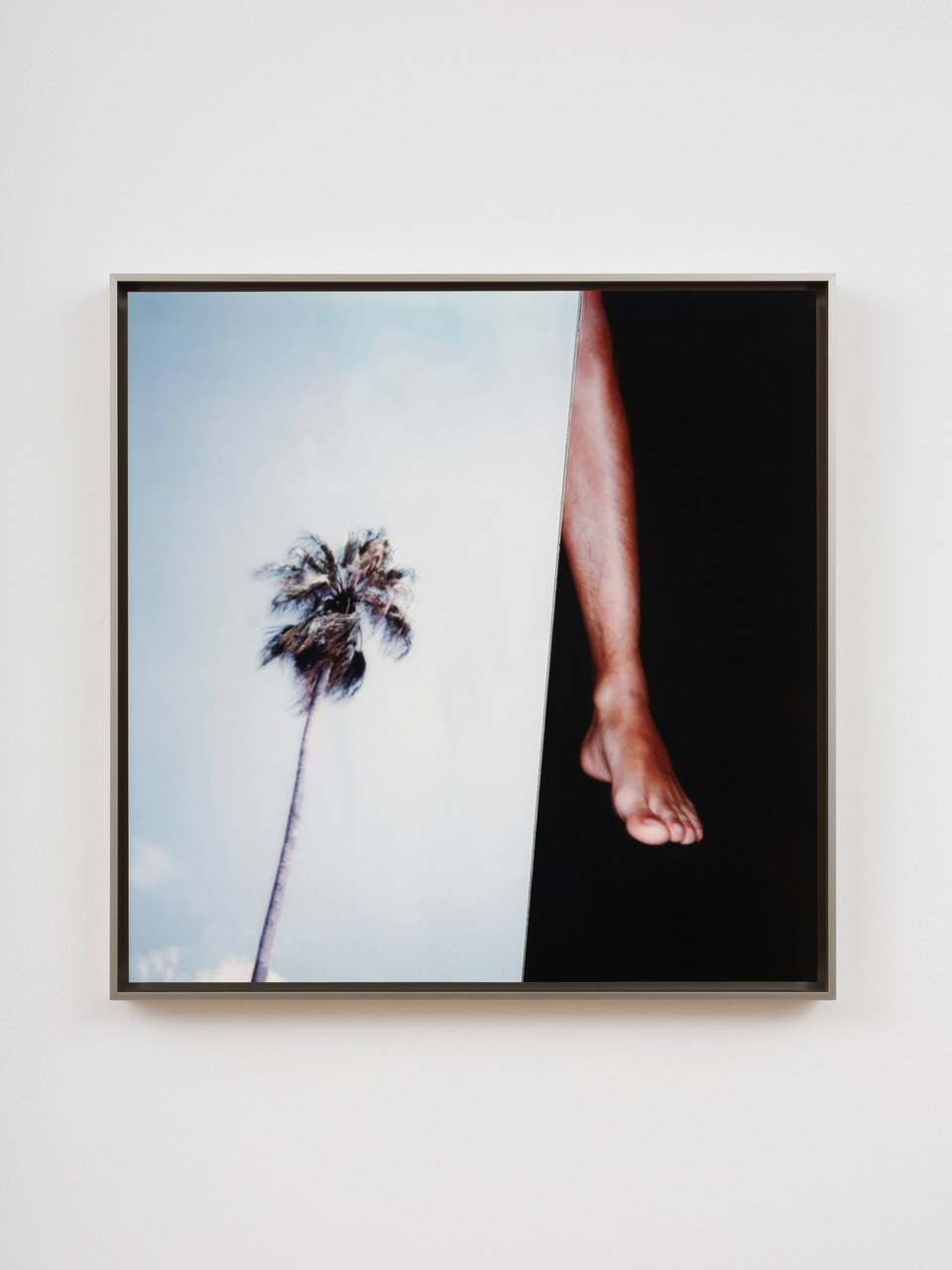 Stuart Sandford’s Polaroid Collage XXII (2020), featured in the Tom of Finland Foundation’s ‘FXLK PLAY’ exhibition. Photo: Stuart Sandford.
Tom of Finland FAQ
What was Tom of Finland’s real name?
Touko Valio Laaksonen. His drawings first ran in Physique Pictorial in 1957, signed “Tom,” and soon appeared as “Tom of Finland.” When did Tom of Finland die, and how old was he?
He died Nov. 7, 1991, in Helsinki, at 71. Who plays Tom of Finland in the movie?
Pekka Strang plays Touko Laaksonen in Dome Karukoski’s 2017 film “Tom of Finland.” Is Tom of Finland’s art in museums?
Yes. MoMA, SFMOMA, LACMA, MOCA Los Angeles and Kiasma all hold his work. What are the Tom of Finland stamps?
A 2014 Finnish stamp sheet featuring two of his drawings from 1978 and 1979, designed by Timo Berry and issued by Posti on Sept. 8, 2014. Who was Tom of Finland’s partner?
Veli “Nipa” Mäkinen, a dancer turned restaurant maître d’. They lived together in Helsinki for 28 years. Can you visit the Tom of Finland House?
Yes. The foundation’s current booking page lists small-group tours on Fridays and Saturdays at 2 p.m. Tours last about one to one-and-a-half hours. Check available dates and reserve before visiting.