
Trinidad and Tobago’s Gay Sex Law Is Unconstitutional, Privy Council Rules
London’s Privy Council ruled unanimously that Trinidad and Tobago’s buggery and serious indecency laws can’t be used against consenting adults. A final order is pending.
 Mark
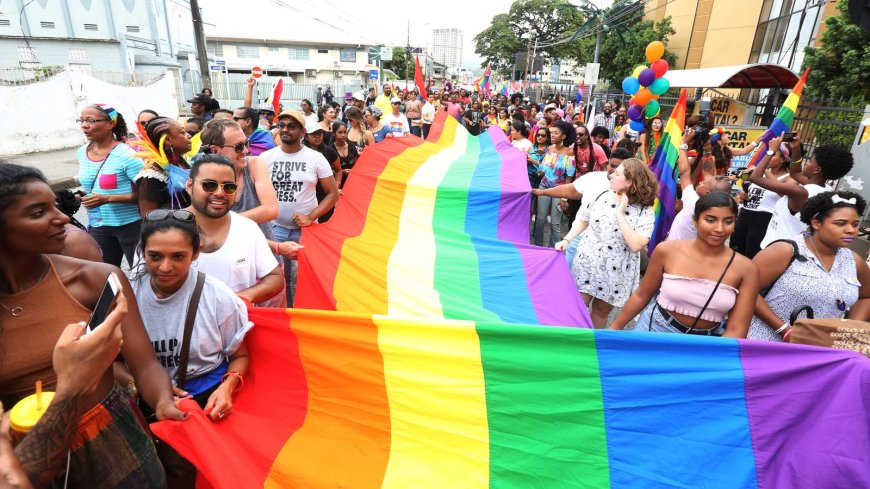
Trinidad and Tobago’s gay sex law can’t be used against consenting adults anymore. The Judicial Committee of the Privy Council in London ruled on Nov. 10, and all five judges sided with activist Jason Jones. Their judgment says sections 13 and 16 of the Sexual Offences Act 1986 “must be interpreted subject to the Constitution so as to make it clear that they do not apply to criminalise private, consensual sexual relations between adults of the same sex.”
Jones is 62. He was born in Trinidad and lives in Britain now.
“These laws never reflected who we are as a people and a nation: diverse, multiracial, and secular,” he said after the ruling, according to the Trinidad Guardian. “They told LGBTQ+ people that we were criminals in our own country. That message ends today.”
Section 13 is the buggery law, and a 2012 amendment set its maximum at 25 years in prison, the judgment notes. How Jason Jones Beat the Savings Clause in London
Nobody gets another appeal. The Privy Council is Trinidad and Tobago’s final court.
“Laws which seek to criminalise such activities cannot be justified,” Lord Sales said as he announced the decision, Reuters reported.
Sales sat with Lord Reed, Lord Briggs, Lord Burrows and Lady Rose on the panel, which heard arguments on July 8.
The fight turned largely on the constitution’s savings clause. It shields laws that were already on the books before the republic’s 1976 constitution.
Justice Devindra Rampersad of the High Court ruled for Jones in 2018. In March 2025, a split Court of Appeal decided the clause protected the colonial-era version of the law. Sex between men stayed a crime, though the buggery penalty dropped to five years. Justice of Appeal Vasheist Kokaram dissented.
At the July hearing, the state’s lawyer, Peter Knox KC, stood by that reasoning. “As long as you can trace the old provision to a new provision, then that is a re-enactment with modification,” Knox said, the Trinidad Guardian reported.
The Privy Council didn’t buy it.
Parliament passed the act in 1986, the same year the U.S. Supreme Court upheld Georgia’s sodomy law in Bowers v. Hardwick. The court’s press summary calls the act “a new and comprehensive regime for Trinidad and Tobago.” New law gets no cover from the savings clause.
The attorney general also argued the sections simply re-enacted “traditional laws of long standing.” The judges called that case “very weak.”
“The mere fact that a repressive law has survived from colonial times so as to be ‘traditional’ in that sense plainly could not furnish a legitimate objective,” they wrote.
The AG’s side, they added, “has not adduced any evidence” to back it up. What the Ruling Means for Gay Men in Trinidad and Tobago
There’s no final order yet. The judges want written submissions first.
Their provisional view is that Rampersad’s 2018 order should stand. It rewrote section 13 so buggery means sex without consent, and it amended section 16 too.
“In particular, it makes clear that there is no criminality where the parties are consenting adults,” the judgment says.
Jones’s lawyer, former Attorney General Anand Ramlogan SC, wants more. He asked the court to delete both sections outright. The judges said that may not be open to him, since Jones never appealed Rampersad’s order, but they’ll let him try.
Any wider cleanup of the statute book, they wrote, “is for the legislature not the judiciary.”
Ramlogan called the decision a “landmark victory for gay rights, equal dignity and respect for private and family life in Trinidad and Tobago,” the BBC reported. The BBC said it’s the first time the Privy Council has decided a case on decriminalizing same-sex intimacy.
His firm, Freedom Law Chambers, put out a release quoted by CNC3. “Gay rights form part of the wider struggle for human rights. Every person is entitled to the protection of the Constitution, regardless of their sexual orientation,” the release said. Jamaica, Grenada and Other Caribbean Laws Still on the Books
The ruling binds Trinidad and Tobago alone. Still, the judges pointed to recent decisions in Belize, Antigua and Barbuda, St. Kitts and Nevis, Barbados, Dominica and Saint Lucia, and said “the trend is clear.”
“The decision is going to be binding in Trinidad and Tobago,” Ria Mohammed, director of the Caribbean Centre for Human Rights, told CNN.
For other countries that also use the Privy Council, she said, “it is unlikely that a case from a different jurisdiction would be decided in a different way.”
Jamaica, Guyana, Grenada and Saint Vincent and the Grenadines still criminalize sex between men, CNN reported, citing the Human Dignity Trust. Not all of them send appeals to London.
Before the ruling, Jones told CNN the 1986 law was his own country’s doing. “This is no longer blaming Henry VIII and the British. This is our own homegrown homophobia,” he said.
He isn’t calling it finished. “Whilst I welcome this judgment, it does not, however, address the main issues of human rights and equality for LGBTQ+ people which have been denied using British colonial era laws across the Commonwealth and beyond,” he said, the Trinidad Guardian reported.
“Let this victory be the rallying call to accelerate the fight for full equality and rights for all people, everywhere.”