
7 LGBTQ films to watch at the MIX NYC Festival
This year’s MIX NYC Festival, Nov. 19-21 at BAM Rose Cinema and Dixon Place, showcases two features and nearly two dozen shorts that depict LGBTQ sexuality. The strong program by new and returning experimental filmmakers gives room for expression of desire, fetishes, and sexuality. Here is a rundown of seven films screening on this year’s … Read More
 Mark
0
4
This year’s MIX NYC Festival, Nov. 19-21 at BAM Rose Cinema and Dixon Place, showcases two features and nearly two dozen shorts that depict LGBTQ sexuality. The strong program by new and returning experimental filmmakers gives room for expression of desire, fetishes, and sexuality. Here is a rundown of seven films screening on this year’s opening night.
[caption id="attachment_65647" align="aligncenter" width="700"] Maja Čule's “Electronic Witches”[/caption]
“Electronic Witches” (BAM Rose Cinema, Nov. 19 at 6:30 p.m.) is an engaging feature by writer/director Maja Čule. This episodic film concerns Neda (Nora Vorfi), a trans Croatian in New York. Moving into a new apartment, Neda asks her neighbor, Yuanna (Andrea Sears), to borrow her internet access in exchange for taking photographs of her. Neda soon contacts her father (Milivoj Beader) back in Croatia but also finds “electronic witches” online who tell Neda their fortune, and that “everything will be OK.” The film is very quotidian as Neda goes to work, meets another neighbor, Yu (Misako Yamagishi), for soup, and worries about money, which prompts them to sublet a room in their apartment. Čule maintains a low-key vibe peppered with snippets of videos as well as various scenes, such as Neda on her building’s rooftop, that emphasize the ideas of connection and isolation. When they meet an attractive stranger (Liam Lindig) in a bar, the possibility of romance hangs in the air. “Electronic Witches” is an affable drama about finding one’s place in the world, and Nora Vorfi is appealing as Neda.
The shorts program “Throbbing Hearts and Unzipped Zippers” (BAM Rose Cinemas, Nov. 19 at 9:00 pm) includes six international films that give visibility and validation to the sexuality on display. The filmmakers are provoking emotional reactions by engaging with taboos or topics that often go undiscussed and asking viewers to confront their feelings.
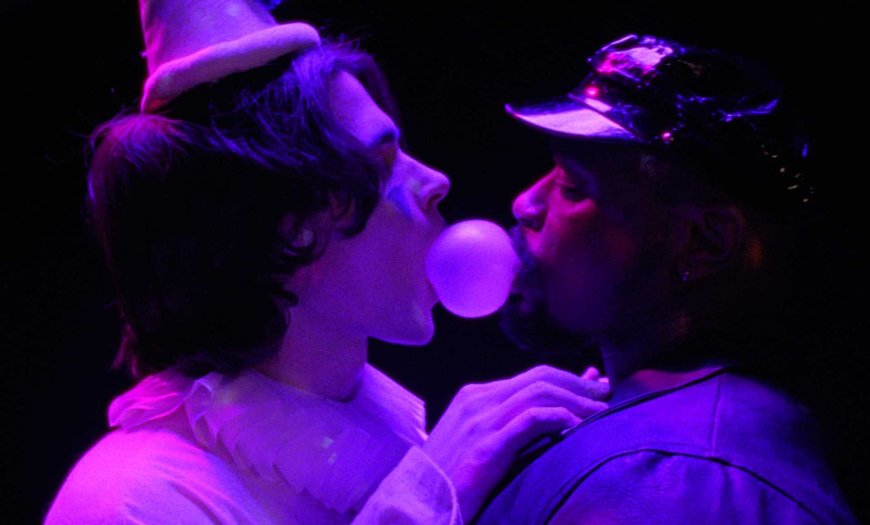
Director Ian Michael McDonald’s fabulous short, “Paint & Leather” presents a wordless romance between the title characters, Paint (Nick Grigolia) and Leather (Davi Stefond) who meet in a gay bar. Paint is initially being harassed by a trio of guys, but when Leather flirts with him, it leads to them connecting — first on the dance floor and then at the urinals. Things gets more intense from there, but McDonald’s film charms with its fake cityscape and Leather’s cardboard house. Stylishly made — the film shifts into black and white during key scenes — and very sexy, the biggest drawback about “Paint & Leather” is that it isn’t longer.
“Sakucosas” by Sakura Ardila Ortiz presents a riveting monologue (accompanied by still photos and text) delivered by the filmmaker. After explicit photos of her webcam sex work taken for an exhibition were toned down, Ortiz launches into an impassioned discussion of kink shaming using the works of literature from the poop fetish in the Marquis de Sade’s “Salo” to Torrey Peters’ trans/sissy dynamic in “Detransition, Baby.” Ortiz offers her own fetishes in the film to normalize them, ending “Sakucosas” with a powerful, unbroken shot of her reading her work in order to give herself an erection in real time.
[caption id="attachment_65648" align="aligncenter" width="700"]
 TT Takemoto's "Swing Swish Sway."MIX NYC[/caption]
“Swing Swish Sway,” directed by TT Takemoto, is an experimental collage of images — from animals to a paintbrush to women’s bodies — that are meant to recall lesbian activist Rose Bamberger. This wordless short uses music, sounds, and editing to create emotional connection.
Cristóbal Guerra’s hypnotic short, “Muerde Sin Miedo,” shot on 16mm, opens with a handsome young man “seeking love and danger” at a cruising area in a forest by a river. His death is tied to the recounted history of the Taínos of Borikén (Puerto Rico) killing the White man (Spanish colonizer Diego Salcedo) by drowning him. A third storyline had three queer men hooking up in a river before re-enacting Salcedo’s killing. Guerra’s layered film uses gay desire to reflect on memory — of touch, of history, of place — and the meanings ascribed to each.
[caption id="attachment_65646" align="aligncenter" width="700"]
 Rom Sheratzky’s "Follow Back."MIX NYC[/caption]
“Follow Back” is Rom Sheratzky’s fascinating and personal meditation on desire. A lonely master’s student who recently arrived in Frankfurt, Rom becomes obsessed with Marco, who hosts a livestream on YouTube from his balcony. Rom becomes determined to meet this stranger, and spends hours outside Marco’s apartment — running, standing, planting flowers, and even taking a date as well as his professor — just to be on Marco’s livestream. Is Marco gay or even aware of Rom’s efforts to connect? Rom scrutinizes Marco’s social media accounts for clues. What transpires is arguably creepy, as “Follow Back” shows the extreme lengths Rom will go to be noticed by Marco. This is a powerful short about infatuation, obsession, and longing.
[caption id="attachment_65645" align="aligncenter" width="700"]
 “Morpheus and Charon."MIX NYC[/caption]
“Morpheus and Charon” has Zito (Bayard Tonelli) lip synching “By a Waterfall” with his partners Morfeu (Marco Canonici) and Caronte (Tony Reis) by a pool. The throuple, all sporting blue eyeshadow, are adorable in their maillots as they perform songs. Their musical number continues in the bedroom where they have a threesome — but is it all a dream? “Morpheus and Charon” reveals that Zito is being cared for by his partners who bathe and diaper him. Balancing campiness, eroticism, and eldercare this Brazilian short is ultimately bittersweet.
The four other programs screening at MIX NYC were not available for preview. “Portrait of the Father at 71” (Nov. 20, 6:30 pm, Dixon Place) is director Diego Semerene’s feature, which has the director’s father watching his own performance as his son’s lovers in a film they made together two decades ago.
The shorts program “Blurry Bloodlines” (Nov. 20, 9:00 pm, Dixon Place) features five films — two that feature archival materials, two about dance, and a world premiere of a documentary short about filmmaker María José Maldonado’s aunt, a trans femme who was part of New York City culture in the 1990s.
The Shorts program “Is It Really Easier to Imagine the End of the World than the End of Capitalism?” (Nov. 21, 6:30 pm, Dixon Place) showcases five films that address topical issues of capitalism, climate change, resistance, and mental health.
The festival closes with “‘An Opening Changes Everything’: Queer Portals” a collection of shorts about orifices, trans bodies, prosthetics, group sex, fisting, and Jack Smith’s apartment.
For tickets and more information, visit https://www.mixnyc.org/
“MIX NYC” | Nov. 19-21 at BAM Rose Cinema and Dixon Place
Maja Čule's “Electronic Witches”[/caption]
“Electronic Witches” (BAM Rose Cinema, Nov. 19 at 6:30 p.m.) is an engaging feature by writer/director Maja Čule. This episodic film concerns Neda (Nora Vorfi), a trans Croatian in New York. Moving into a new apartment, Neda asks her neighbor, Yuanna (Andrea Sears), to borrow her internet access in exchange for taking photographs of her. Neda soon contacts her father (Milivoj Beader) back in Croatia but also finds “electronic witches” online who tell Neda their fortune, and that “everything will be OK.” The film is very quotidian as Neda goes to work, meets another neighbor, Yu (Misako Yamagishi), for soup, and worries about money, which prompts them to sublet a room in their apartment. Čule maintains a low-key vibe peppered with snippets of videos as well as various scenes, such as Neda on her building’s rooftop, that emphasize the ideas of connection and isolation. When they meet an attractive stranger (Liam Lindig) in a bar, the possibility of romance hangs in the air. “Electronic Witches” is an affable drama about finding one’s place in the world, and Nora Vorfi is appealing as Neda.
The shorts program “Throbbing Hearts and Unzipped Zippers” (BAM Rose Cinemas, Nov. 19 at 9:00 pm) includes six international films that give visibility and validation to the sexuality on display. The filmmakers are provoking emotional reactions by engaging with taboos or topics that often go undiscussed and asking viewers to confront their feelings.
Director Ian Michael McDonald’s fabulous short, “Paint & Leather” presents a wordless romance between the title characters, Paint (Nick Grigolia) and Leather (Davi Stefond) who meet in a gay bar. Paint is initially being harassed by a trio of guys, but when Leather flirts with him, it leads to them connecting — first on the dance floor and then at the urinals. Things gets more intense from there, but McDonald’s film charms with its fake cityscape and Leather’s cardboard house. Stylishly made — the film shifts into black and white during key scenes — and very sexy, the biggest drawback about “Paint & Leather” is that it isn’t longer.
“Sakucosas” by Sakura Ardila Ortiz presents a riveting monologue (accompanied by still photos and text) delivered by the filmmaker. After explicit photos of her webcam sex work taken for an exhibition were toned down, Ortiz launches into an impassioned discussion of kink shaming using the works of literature from the poop fetish in the Marquis de Sade’s “Salo” to Torrey Peters’ trans/sissy dynamic in “Detransition, Baby.” Ortiz offers her own fetishes in the film to normalize them, ending “Sakucosas” with a powerful, unbroken shot of her reading her work in order to give herself an erection in real time.
[caption id="attachment_65648" align="aligncenter" width="700"] TT Takemoto's "Swing Swish Sway."MIX NYC[/caption]
“Swing Swish Sway,” directed by TT Takemoto, is an experimental collage of images — from animals to a paintbrush to women’s bodies — that are meant to recall lesbian activist Rose Bamberger. This wordless short uses music, sounds, and editing to create emotional connection.
Cristóbal Guerra’s hypnotic short, “Muerde Sin Miedo,” shot on 16mm, opens with a handsome young man “seeking love and danger” at a cruising area in a forest by a river. His death is tied to the recounted history of the Taínos of Borikén (Puerto Rico) killing the White man (Spanish colonizer Diego Salcedo) by drowning him. A third storyline had three queer men hooking up in a river before re-enacting Salcedo’s killing. Guerra’s layered film uses gay desire to reflect on memory — of touch, of history, of place — and the meanings ascribed to each.
[caption id="attachment_65646" align="aligncenter" width="700"] Rom Sheratzky’s "Follow Back."MIX NYC[/caption]
“Follow Back” is Rom Sheratzky’s fascinating and personal meditation on desire. A lonely master’s student who recently arrived in Frankfurt, Rom becomes obsessed with Marco, who hosts a livestream on YouTube from his balcony. Rom becomes determined to meet this stranger, and spends hours outside Marco’s apartment — running, standing, planting flowers, and even taking a date as well as his professor — just to be on Marco’s livestream. Is Marco gay or even aware of Rom’s efforts to connect? Rom scrutinizes Marco’s social media accounts for clues. What transpires is arguably creepy, as “Follow Back” shows the extreme lengths Rom will go to be noticed by Marco. This is a powerful short about infatuation, obsession, and longing.
[caption id="attachment_65645" align="aligncenter" width="700"] “Morpheus and Charon."MIX NYC[/caption]
“Morpheus and Charon” has Zito (Bayard Tonelli) lip synching “By a Waterfall” with his partners Morfeu (Marco Canonici) and Caronte (Tony Reis) by a pool. The throuple, all sporting blue eyeshadow, are adorable in their maillots as they perform songs. Their musical number continues in the bedroom where they have a threesome — but is it all a dream? “Morpheus and Charon” reveals that Zito is being cared for by his partners who bathe and diaper him. Balancing campiness, eroticism, and eldercare this Brazilian short is ultimately bittersweet.
The four other programs screening at MIX NYC were not available for preview. “Portrait of the Father at 71” (Nov. 20, 6:30 pm, Dixon Place) is director Diego Semerene’s feature, which has the director’s father watching his own performance as his son’s lovers in a film they made together two decades ago.
The shorts program “Blurry Bloodlines” (Nov. 20, 9:00 pm, Dixon Place) features five films — two that feature archival materials, two about dance, and a world premiere of a documentary short about filmmaker María José Maldonado’s aunt, a trans femme who was part of New York City culture in the 1990s.
The Shorts program “Is It Really Easier to Imagine the End of the World than the End of Capitalism?” (Nov. 21, 6:30 pm, Dixon Place) showcases five films that address topical issues of capitalism, climate change, resistance, and mental health.
The festival closes with “‘An Opening Changes Everything’: Queer Portals” a collection of shorts about orifices, trans bodies, prosthetics, group sex, fisting, and Jack Smith’s apartment.
For tickets and more information, visit https://www.mixnyc.org/
“MIX NYC” | Nov. 19-21 at BAM Rose Cinema and Dixon Place