Fifteen minutes of family: An exhibition of Andy Warhol’s Polaroids
It is nearly impossible to view a figure like Andy Warhol in a fresh light. Yet that is the goal of “Andy Warhol: Family Album,” an exhibition at the Whitney Museum of American Art. The show is comprised of 732 Polaroid photographs taken by or of Andy Warhol from 1972 to 1973 that capture his … Read More
 Mark
Mark
0
32
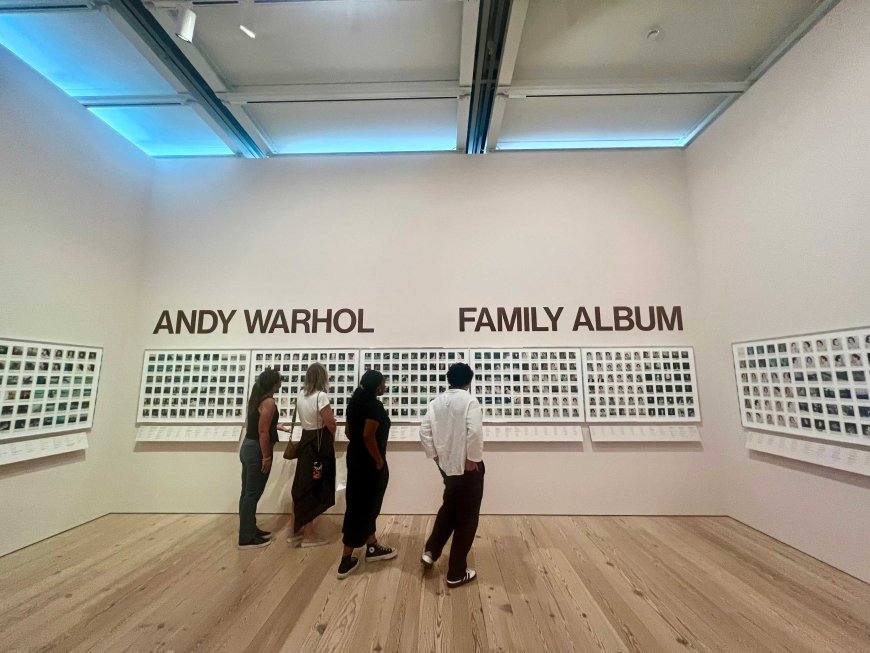
It is nearly impossible to view a figure like Andy Warhol in a fresh light. Yet that is the goal of “Andy Warhol: Family Album,” an exhibition at the Whitney Museum of American Art. The show is comprised of 732 Polaroid photographs taken by or of Andy Warhol from 1972 to 1973 that capture his immediate world of collaborators, celebrities, and friends.
The eccentric artist known as the king of pop art was the consummate connecter. Through his studio, a multimedia art-making hub called “The Factory,” he brought personalities together, most of them white and many wealthy, but also unknowns he plucked from obscurity to assemble an ever-shifting chosen family of sorts. Beyond The Factory, he carried a camera with him at all times, selectively photographing individuals, groups, and scenes. This exhibition is drawn from one of six Holson brand photo albums that Warhol kept as a personal archive. The litany of creative mavericks and behind-the-scenes powerbrokers pictured is legion. There is the filmmaker Federico Fellini, fashion designers Yves St. Laurent and Karl Lagerfeld, the art-dealing couple Samuel and Luella Maslon, and on and on. We see a fair share of what today would be termed “nepo babies,” children of accomplished or pedigreed people whose surnames and social ties gave them shortcuts to prominence they would vastly extend through individual effort and talent: jewelry designer Paloma Picasso, writer Thadée Klossowski, jeweler Attilio Codognato, to name a few. There are also portraits and candids of fierce self-inventors who have gone on to build eponymous empires in the worlds of art and fashion, such as Diane von Furstenberg. And, there is a sprinkling of “unidentified” subjects, faces snapped in the moment. Taken together, what these champagne-life snapshots lay bare is an aesthetics of aspiration of which Warhol was chief curator.
But the show’s own aspiration is to showcase the private Warhol, the places where and confidants with whom he let his mask down. Interspersing the predominant shots of over-the-top people in fanciful settings are calmer, unassuming scenes of Warhol’s home in Montauk, N.Y., his travels in Europe, and snapshots of his beloved dachshund, Archie.
[caption id="attachment_65004" align="aligncenter" width="568"] Andy Warhol with his dachshund, Archie, 1973.Exhibition photo taken by Nicholas Boston[/caption]
Jed and Jay Johnson were among his closest associates. The fraternal twin brothers came from a broken family in California. At 19 they set off on a cross-country journey of self-discovery bound for Montreal, but Canadian border officials turned them away near Buffalo, N.Y., so they went to New York City. Good-looking and gay, they very quicky got absorbed into Andy Warhol’s demimonde of quirky acolytes and protégés known as the “Warhol Superstars.” Jed became Warhol’s lover for 12 years. The exhibition features multiple Polaroids of the Johnson brothers, together, separate or in the company of Warhol and others. Several of the ones of Jed evince Warhol’s admiration of his physicality, such as “Jed brought the sun,” dated Nov. 1, 1973, of a bare-chested Jed, partly shadowed in silhouette on the threshold of a balcony overlooking a serene body of water with Archie at his side. Other Superstars in the show include Brigid Berlin, Joe Dallesandro, and Ultra Violet.
[caption id="attachment_65006" align="aligncenter" width="657"]
Andy Warhol with his dachshund, Archie, 1973.Exhibition photo taken by Nicholas Boston[/caption]
Jed and Jay Johnson were among his closest associates. The fraternal twin brothers came from a broken family in California. At 19 they set off on a cross-country journey of self-discovery bound for Montreal, but Canadian border officials turned them away near Buffalo, N.Y., so they went to New York City. Good-looking and gay, they very quicky got absorbed into Andy Warhol’s demimonde of quirky acolytes and protégés known as the “Warhol Superstars.” Jed became Warhol’s lover for 12 years. The exhibition features multiple Polaroids of the Johnson brothers, together, separate or in the company of Warhol and others. Several of the ones of Jed evince Warhol’s admiration of his physicality, such as “Jed brought the sun,” dated Nov. 1, 1973, of a bare-chested Jed, partly shadowed in silhouette on the threshold of a balcony overlooking a serene body of water with Archie at his side. Other Superstars in the show include Brigid Berlin, Joe Dallesandro, and Ultra Violet.
[caption id="attachment_65006" align="aligncenter" width="657"] Diane von Furstenberg in multiple, 1973.Exhibition photo taken by Nicholas Boston[/caption]
Of the 732 Polaroids in “Family Album,” only five picture Black people. All of them were taken at the same event in 1973, a reception attended by cast members of the Broadway musical, “Raisin,” adapted from playwright Lorraine Hansberry’s “A Raisin in the Sun,” about the challenges of an African American family in 1950s Chicago. Warhol photographed lead actress Virginia Capers, who the following year won a Tony Award for her performance, and 12-year-old actor Ralph Carter, who went on to play the role of Michael Evans in the popular family-centered sitcom “Good Times.”
[caption id="attachment_65005" align="aligncenter" width="654"]
Diane von Furstenberg in multiple, 1973.Exhibition photo taken by Nicholas Boston[/caption]
Of the 732 Polaroids in “Family Album,” only five picture Black people. All of them were taken at the same event in 1973, a reception attended by cast members of the Broadway musical, “Raisin,” adapted from playwright Lorraine Hansberry’s “A Raisin in the Sun,” about the challenges of an African American family in 1950s Chicago. Warhol photographed lead actress Virginia Capers, who the following year won a Tony Award for her performance, and 12-year-old actor Ralph Carter, who went on to play the role of Michael Evans in the popular family-centered sitcom “Good Times.”
[caption id="attachment_65005" align="aligncenter" width="654"] Ralph Carter, 1973.Exhibition photo taken by Nicholas Boston[/caption]
A third unidentified woman is pictured. Apart from these images and a number of striking portraits of Bianca Jagger, who is Latina of Guatemalan origin, Warhol’s social circle was in this period almost uniformly monochromatic. One of his earliest Superstars was the model Donyale Luna, the first Black woman to grace a cover of Vogue magazine (the March, 1966, issue of British Vogue), but she presented herself as racially indeterminate, neither Black nor white. Hint to the Whitney: Warhol’s friendships with non-white people would be a great theme to explore from among the museum’s extensive Warhol collection.
Andy Warhol: Family Album | Whitney Museum of American Art | Running through Oct. 19, 2026
Nicholas Boston, Ph.D., is a professor of media sociology at Lehman College of the City University of New York (CUNY). Follow him on X @DrNickBoston and Instagram @Nick_Boston_in_New York
Ralph Carter, 1973.Exhibition photo taken by Nicholas Boston[/caption]
A third unidentified woman is pictured. Apart from these images and a number of striking portraits of Bianca Jagger, who is Latina of Guatemalan origin, Warhol’s social circle was in this period almost uniformly monochromatic. One of his earliest Superstars was the model Donyale Luna, the first Black woman to grace a cover of Vogue magazine (the March, 1966, issue of British Vogue), but she presented herself as racially indeterminate, neither Black nor white. Hint to the Whitney: Warhol’s friendships with non-white people would be a great theme to explore from among the museum’s extensive Warhol collection.
Andy Warhol: Family Album | Whitney Museum of American Art | Running through Oct. 19, 2026
Nicholas Boston, Ph.D., is a professor of media sociology at Lehman College of the City University of New York (CUNY). Follow him on X @DrNickBoston and Instagram @Nick_Boston_in_New York
Andy Warhol with his dachshund, Archie, 1973.Exhibition photo taken by Nicholas Boston[/caption]
Jed and Jay Johnson were among his closest associates. The fraternal twin brothers came from a broken family in California. At 19 they set off on a cross-country journey of self-discovery bound for Montreal, but Canadian border officials turned them away near Buffalo, N.Y., so they went to New York City. Good-looking and gay, they very quicky got absorbed into Andy Warhol’s demimonde of quirky acolytes and protégés known as the “Warhol Superstars.” Jed became Warhol’s lover for 12 years. The exhibition features multiple Polaroids of the Johnson brothers, together, separate or in the company of Warhol and others. Several of the ones of Jed evince Warhol’s admiration of his physicality, such as “Jed brought the sun,” dated Nov. 1, 1973, of a bare-chested Jed, partly shadowed in silhouette on the threshold of a balcony overlooking a serene body of water with Archie at his side. Other Superstars in the show include Brigid Berlin, Joe Dallesandro, and Ultra Violet.
[caption id="attachment_65006" align="aligncenter" width="657"] Diane von Furstenberg in multiple, 1973.Exhibition photo taken by Nicholas Boston[/caption]
Of the 732 Polaroids in “Family Album,” only five picture Black people. All of them were taken at the same event in 1973, a reception attended by cast members of the Broadway musical, “Raisin,” adapted from playwright Lorraine Hansberry’s “A Raisin in the Sun,” about the challenges of an African American family in 1950s Chicago. Warhol photographed lead actress Virginia Capers, who the following year won a Tony Award for her performance, and 12-year-old actor Ralph Carter, who went on to play the role of Michael Evans in the popular family-centered sitcom “Good Times.”
[caption id="attachment_65005" align="aligncenter" width="654"] Ralph Carter, 1973.Exhibition photo taken by Nicholas Boston[/caption]
A third unidentified woman is pictured. Apart from these images and a number of striking portraits of Bianca Jagger, who is Latina of Guatemalan origin, Warhol’s social circle was in this period almost uniformly monochromatic. One of his earliest Superstars was the model Donyale Luna, the first Black woman to grace a cover of Vogue magazine (the March, 1966, issue of British Vogue), but she presented herself as racially indeterminate, neither Black nor white. Hint to the Whitney: Warhol’s friendships with non-white people would be a great theme to explore from among the museum’s extensive Warhol collection.
Andy Warhol: Family Album | Whitney Museum of American Art | Running through Oct. 19, 2026
Nicholas Boston, Ph.D., is a professor of media sociology at Lehman College of the City University of New York (CUNY). Follow him on X @DrNickBoston and Instagram @Nick_Boston_in_New York