
Angelina Jolie’s war and trauma drama ‘Without Blood’ stumbles on structure
True to its name, bi director Angelina Jolie’s “Without Blood” forges a path from murder to peace and healing. Adapted from Alessandro Balicco’s novel, its structure stumbles all over itself. Its characters are still trapped by the past, even if they don’t always realize it, but the film’s editing mangles their story. Overly pretty, yellow-tinged … Read More
 Mark
Mark
0
34
True to its name, bi director Angelina Jolie’s “Without Blood” forges a path from murder to peace and healing. Adapted from Alessandro Balicco’s novel, its structure stumbles all over itself. Its characters are still trapped by the past, even if they don’t always realize it, but the film’s editing mangles their story. Overly pretty, yellow-tinged cinematography turns violent trauma into a perfume ad. An overactive score doesn’t allow the audience any breathing room to think. If “Without Blood” had potential, the script needed a few more drafts to allow it to emerge.
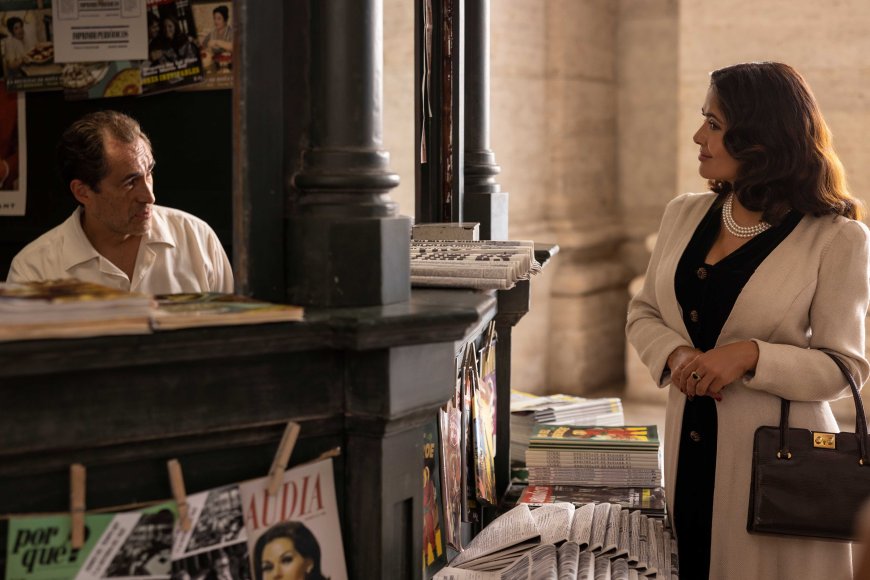
“Without Blood” starts in the past. Nina, a young girl, hides under a floorboard as three men barge into her family’s home. Their country, which goes unnamed, is in the midst of a war. In the course of this home invasion, her father (Alfredo Herrera) and brother (Alessandro D’Antonuo) are killed, but she lives through the siege. Hiding beneath a floorboard, her brother’s blood drips onto her foot. On a relaxed afternoon about 50 years later, a middle-aged Nina (Salma Hayek Pinault) walks into a plaza and speaks to Tito (Demian Bichir), who operates a kiosk there. She asks him to sit down with her for a drink. Their lives turn out to be deeply intertwined: he participated in the murder of her family members. Once they start speaking, Nina and Tito’s conversation reveals how different their memories of her life are. She recalls being forced into marriage to a count at 14. Tito sees it from another perspective: The count planned to kill her but spared her life
“Without Blood” looks like two entirely different films forced together. Thanks to soulful performances from Bichir and Hayek Pinault, the present-day story has a real pull. Tito looks as though he’s tried to move on by acting as mild-mannered as possible. No one who saw him selling newspapers would suspect his past. Over the course of his conversation with Nina, he comes to realize how much their lives were forever altered by his actions. Both actors capture a spirit of midlife sadness. Nina is angrier, walking around with a burden of trauma.
The real problem lies with the flashbacks. When “Without Blood” moves forward to the meeting between Nina and Tito, it continues returning to this material. As storytelling, it’s appallingly unimaginative. The film would actually be more dramatic if it simply consisted of a conversation between the two. As they recite their lives to each other, “Without Blood” leaps back in time to illustrate it. Fundamentally, “Without Blood” mashes up a Western and chamber drama, suggesting it doesn’t trust talk alone to carry its story.
Although Jolie’s still better known as an actor, “Without Blood” is her sixth film as a director. Since splitting up with Brad Pitt, she’s pursued her own interests. Her interest in war has manifested in three previous films: “In the Land of Blood and Honey,” “Unbroken,” and “First They Killed My Father.” Certain aspects of “Without Blood” appear to be dictated by the demands of co-production. Although Hayek Pinault and Bichir are Mexican, they speak to each other in English. “Without Blood” was shot in Italy, with few exteriors that could mark it.
Most troublingly, war becomes an imaginary yet universal conflict. The specifics that led to violence against Nina’s family are elided. Tito says he committed it out of an idealistic desire to improve the world. She tells him it’s no better off. Given the casting, it’s hard not to see “Without Blood” as a film about violence in Mexico. Despite this coding, any connection to real history and the conditions which produced it is elided. It’s conflict without politics, which becomes meaningless. The notion of two people having such divergent options about the events they lived through is stripped of any resonance, turned into abstractions that could offend no one and say nothing.
“Without Blood” | Directed by Angelina Jolie | Brainstorm Media | Opens Sept. 18th at the Village East