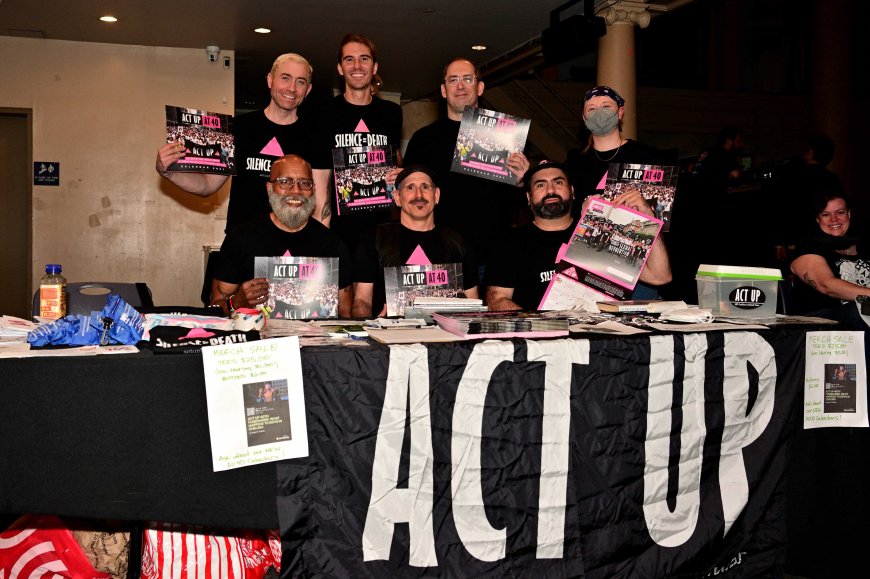
ACT UP’s 40th anniversary fundraiser commemorates decades of activism and a pursuit for justice
Ryan Foster Casey had just begun their first semester of college in 2006, at 18 years old, when their life was abruptly changed. “I fell out of a five story window, and I don’t know how,” Casey explains, repeating variations of the perplexing phrase throughout the night. Dressed in leopard print bell-bottom pants, their dirty … Read More
 Mark
0
2
Ryan Foster Casey had just begun their first semester of college in 2006, at 18 years old, when their life was abruptly changed.
"I fell out of a five story window, and I don't know how," Casey explains, repeating variations of the perplexing phrase throughout the night. Dressed in leopard print bell-bottom pants, their dirty blonde hair waving, they commanded the marble stage inside of Judson Memorial Church's third floor on Sunday, Nov. 15, projecting with just their voice, no microphone in site, throughout the hall, to the backdrop of walls covered in fabrics depicting queer ancestors, like Sylvia Rivera, Audre Lorde, and Marsha P. Johnson.
Two decades years after the harrowing event took place, Casey performed their autobiographical choreopoem, "What Happens to Boys in Chelsea," during a fundraiser ahead of the AIDS Coalition to Unleash Power's (ACT UP) 40th anniversary. The 45-minute epic is composed of 28 poems strung together, which the artist has been workshopping for the past eight years.
[caption id="attachment_65805" align="aligncenter" width="700"] Casey performs their autobiographical choreopoem, "What Happens to Boys in Chelsea."Donna Aceto[/caption]
The work of political theater follows a caricature of Casey's younger self in 2006 after waking up to discover they had been thrown out of a building at 1 a.m. on a Wednesday morning on West 24th Street, completely unaware of how the night's events unfolded.
Ten years later in 2016, at 28 years old, they sought answers. The ballad brings the viewer along as they search for an official police report from the NYPD's Freedom of Information Law Unit, which they believe should be dismantled due to the barrier they say they and countless others have faced to recovering records. It's interwoven with their recovery in the immediate aftermath, which brought them from the halls of St. Vincent's Hospital to Italy and back to where the action all began in a whirlwind of emotions and captivating theatrics.
"The play is an attempt to honor queer history and the evolution of homophobia from the early '80s to 2006," Casey told Gay City News. The AIDS crisis is interwoven throughout the work, they explained, most explicitly referenced through the role St. Vincent's played in housing a large ward for patients.
[caption id="attachment_65808" align="aligncenter" width="700"]
 Ryan Foster Casey's "What Happens to Boys in Chelsea" is composed of 28 poems strung together.Donna Aceto[/caption]
They hoped their performance would inspire people to action, as ACT UP's work continues onward. "It's sort of a sentiment of being persistent and being determined to act up and fight back."
Casey performed the play in the same space where, decades ago, ACT UP members gathered to mourn the passing of friends and loved ones who died of AIDS. Judson was the site of political funerals held by the group, including for activist Mark Lowe Fisher on Nov. 2, 1992.
"For me, it's a dream come true to be celebrating the fierce activism of 40 years of these folks working together," Rev. Micah Bucey, Judson's senior minister, told Gay City News at the end of the night, recalling that he grew up studying the group's history.
[caption id="attachment_65806" align="aligncenter" width="700"]
 Ryan Casey with Rev. Micah Bucey, Judson's senior minister.Donna Aceto[/caption]
Not only did Judson provide space for funerals and memorials, it was also "an experimental site for early AIDS medications," he added. "It was a congregation that deeply knew that the only way that we can be people of faith in the world is to continue to support queer people."
"There were so many memorials here that every time I come in this church, I feel ghosts," said Eric Sawyer, a founding member of ACT UP, during a conversation between him and Casey following the performance.
[caption id="attachment_65807" align="aligncenter" width="700"]
 Eric Sawyer, founding member of ACT UP.Donna Aceto[/caption]
ACT UP's work isn't done, and it's now more important than ever for people to engage in activism, Sawyer said, pointing to cuts to HIV/AIDS funding globally, including to the President's Emergency Plan for AIDS Relief (PEPFAR).
"A majority of the work that we fought for 40 years is pretty much dismantled," he said.
A meeting at the LGBT Community Center in the West Village on March 12, 1987 led to the formation of ACT UP, with the group holding its first action two weeks later on March 24 to protest the profiteering drug company Burroughs Wellcome, which sold the first approved AIDS treatment drug for $8-10,000 annually.
Next year, the anniversary will provide an opportunity to "understand whose shoulders we stand on," said Casey, who joined ACT UP two years ago at the start of the second Trump administration and was outraged by the government's cuts to healthcare. "I'm excited [for] people to recognize our history."
"We chose to fight like hell to get our rights and to get drugs so that people could live," Sawyer concluded, in a final call for action. "If you can take to the streets it's the best way."
Casey performs their autobiographical choreopoem, "What Happens to Boys in Chelsea."Donna Aceto[/caption]
The work of political theater follows a caricature of Casey's younger self in 2006 after waking up to discover they had been thrown out of a building at 1 a.m. on a Wednesday morning on West 24th Street, completely unaware of how the night's events unfolded.
Ten years later in 2016, at 28 years old, they sought answers. The ballad brings the viewer along as they search for an official police report from the NYPD's Freedom of Information Law Unit, which they believe should be dismantled due to the barrier they say they and countless others have faced to recovering records. It's interwoven with their recovery in the immediate aftermath, which brought them from the halls of St. Vincent's Hospital to Italy and back to where the action all began in a whirlwind of emotions and captivating theatrics.
"The play is an attempt to honor queer history and the evolution of homophobia from the early '80s to 2006," Casey told Gay City News. The AIDS crisis is interwoven throughout the work, they explained, most explicitly referenced through the role St. Vincent's played in housing a large ward for patients.
[caption id="attachment_65808" align="aligncenter" width="700"] Ryan Foster Casey's "What Happens to Boys in Chelsea" is composed of 28 poems strung together.Donna Aceto[/caption]
They hoped their performance would inspire people to action, as ACT UP's work continues onward. "It's sort of a sentiment of being persistent and being determined to act up and fight back."
Casey performed the play in the same space where, decades ago, ACT UP members gathered to mourn the passing of friends and loved ones who died of AIDS. Judson was the site of political funerals held by the group, including for activist Mark Lowe Fisher on Nov. 2, 1992.
"For me, it's a dream come true to be celebrating the fierce activism of 40 years of these folks working together," Rev. Micah Bucey, Judson's senior minister, told Gay City News at the end of the night, recalling that he grew up studying the group's history.
[caption id="attachment_65806" align="aligncenter" width="700"] Ryan Casey with Rev. Micah Bucey, Judson's senior minister.Donna Aceto[/caption]
Not only did Judson provide space for funerals and memorials, it was also "an experimental site for early AIDS medications," he added. "It was a congregation that deeply knew that the only way that we can be people of faith in the world is to continue to support queer people."
"There were so many memorials here that every time I come in this church, I feel ghosts," said Eric Sawyer, a founding member of ACT UP, during a conversation between him and Casey following the performance.
[caption id="attachment_65807" align="aligncenter" width="700"] Eric Sawyer, founding member of ACT UP.Donna Aceto[/caption]
ACT UP's work isn't done, and it's now more important than ever for people to engage in activism, Sawyer said, pointing to cuts to HIV/AIDS funding globally, including to the President's Emergency Plan for AIDS Relief (PEPFAR).
"A majority of the work that we fought for 40 years is pretty much dismantled," he said.
A meeting at the LGBT Community Center in the West Village on March 12, 1987 led to the formation of ACT UP, with the group holding its first action two weeks later on March 24 to protest the profiteering drug company Burroughs Wellcome, which sold the first approved AIDS treatment drug for $8-10,000 annually.
Next year, the anniversary will provide an opportunity to "understand whose shoulders we stand on," said Casey, who joined ACT UP two years ago at the start of the second Trump administration and was outraged by the government's cuts to healthcare. "I'm excited [for] people to recognize our history."
"We chose to fight like hell to get our rights and to get drugs so that people could live," Sawyer concluded, in a final call for action. "If you can take to the streets it's the best way."