Grindr’s CEO Took On WallStreetBets, Gay Jokes and All
George Arison took r/wallstreetbets’ questions a day after Grindr’s earnings, from growing up gay in Soviet Georgia to PrEP math and ‘We love our tops and bottoms.’
 Mark
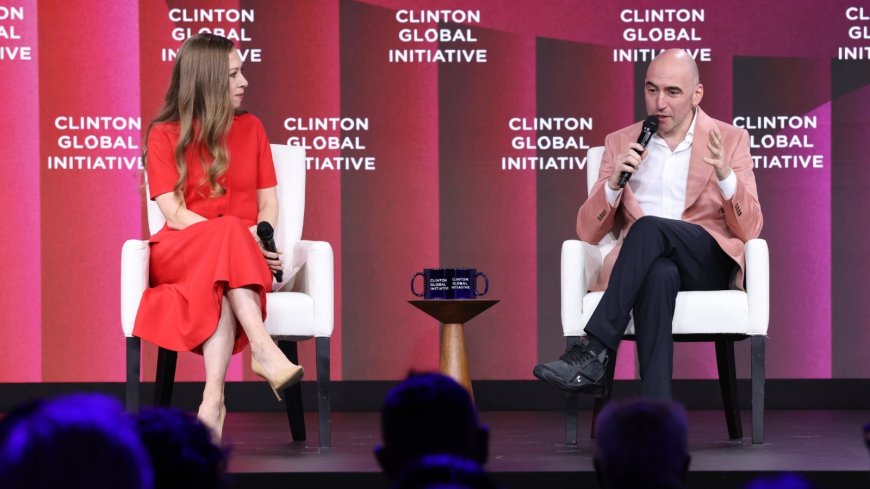
One of the top comments in George Arison’s Reddit AMA was a wisecrack: “This is going about as well as expected.” The Grindr CEO wrote back, “This is fun :)”
He seemed to mean it. Arison spent Friday, Nov. 6, on r/wallstreetbets, home of meme stocks and loss porn, a day after Grindr’s third-quarter earnings. He posted more than 40 answers from u/GrindrOfficial. On Saturday, he confirmed on X they were his.
“Why did you pick wallstreetbets for your AMA?” one user asked. “This is where the magic happens,” he answered. Why George Arison Brought Grindr to r/wallstreetbets
One user asked whether he was cool with “wsb style gay jokes.” Arison’s answer: “I mean, don’t be an asshole, but I’m game and trying to meet you guys where you’re at.”
That idea stuck with him. “My takeaway is to meet people where they are,” he posted on X the next morning. “If you want to explain what you are building, why it matters, and how you think about the business, you should show up in the places where people are already having the conversation.”
“Top-line or bottom-line growth?” one user asked. “We love our tops and bottoms,” he wrote. Another tacked an inflation question onto a Wendy’s dumpster joke: “with the current state of the economy; is $20 still $20?” “I’ve actually never eaten at Wendy’s, so I don’t have an answer for that,” Arison replied, before getting serious: “But no, $20 is not $20. Inflation is terrible, and there’s a massive affordability crisis in this country that our government has ignored since at least 2020.”
Asked whether a team was reviewing his answers, he posted an image with the caption “On the phone with my team, but me rn.” George Arison’s Coming-Out Story, Told to Day Traders
One of his most-upvoted answers came after a user asked whether he actually uses the app or whether it’s just a job. “I knew I was gay pretty early,” he wrote. “I remember being eight or nine, on the swim team, feeling attracted to boys, though obviously I had no idea what that meant.”
He grew up in Soviet Georgia, where being gay was “completely frowned upon and, frankly, illegal.” He moved to Washington, D.C., after college and built a gay life there that he kept apart from his old one until he started telling close friends around 2006. Going back to Georgia in 2003 “was a big wake-up call that there was no way I could be myself there,” he wrote.
“One of the hardest things to come to terms with was whether I could ever have children, because being a dad was an absolute mandatory thing for me,” Arison added. “Today, I am married to my husband and we have our two kids, the twiblings.” Leading Grindr, he said, “is very personal to me.”
And yes, he uses it. “I probably spend a good hour a day in the app, and I also use it to talk to users about what they want us to build next,” he wrote. “Grindr was the primary vehicle through which I met new people when I moved to the Bay Area from DC, so when I say people use it to make friends, I have experienced that very directly myself.” Grindr Wants to Be the ‘Global Gayborhood,’ Not a Dating App
Asked what outsiders get wrong about the company, Arison kept it short. “They think we’re a dating app instead of a social network.”
“Grindr and the other apps are really fundamentally different because Grindr is built as an open-architecture product,” he wrote in another answer. “You go on the app, you see a bunch of people, you can chat with anybody, initiate a conversation when you want, and they can respond or not respond. Obviously, if they do not want to talk to you, they do not respond. But there is no matching requirement.” For a lot of users, he added, it’s “like a rite of passage toward figuring out what it means to be gay.” He claimed Grindr is “responsible for a quarter of gay relationships in the United States” and said 46% of its U.S. users are 18 to 29, citing company data from November 2025.
He also told a story about a “very large financial firm” that refused to work with Grindr because it “was about sex.” His response, he wrote, “was that this is fundamentally homophobic, because what makes me (and our users) different from everyone else is that we are homosexual.”
A user who’d just bought 12 shares asked whether they should feel comfortable with their money. “I can’t tell you how to feel about your money. But we released earnings yesterday and we’ve given really strong guidance for 2027!” Arison wrote. “We also raised our 2026 guidance, to $560 million in revenue and $236 million in Adjusted EBITDA.” Third-quarter revenue rose 22% to $141.4 million, Grindr reported, and Gayety broke down the full quarter on Friday.
Asked whether gay people like AI, he wrote: “Gay people are like everyone else. They have a mixed set of opinions about every topic, including AI, but gay men tend to be early adopters.” Freddie, PrEP and Arison’s Math on 4,000 Fewer HIV Infections
The part of the AMA with the most at stake was HIV. Grindr closed its purchase of Freddie, a PrEP telehealth provider, on Nov. 2, Gayety reported. “Most gay men think about HIV prevention daily, and HIV risk is directly linked to the connections our users make on Grindr, so Freddie will become a major source of profitable growth for us,” Arison wrote.
“Freddie is actively serving 25,000+ patients across Canada and the US. In Canada, it fills nearly 1/3 of all PrEP prescriptions,” he wrote. “From January through September, almost 25% of Freddie’s U.S. patients came through Grindr.” He also said roughly three in four U.S. Grindr users who sign up for Freddie have never used PrEP.
Then he floated a hypothetical. Getting 200,000 people who aren’t on PrEP to start it “would be roughly 4,000 fewer infections in the U.S. among gay and bi men per year,” he wrote. “That would be about a 20% reduction in the total number of infections that we have today.” His husband, he noted in another reply, is a public health doctor who spent decades working on HIV. What Grindr Does Where Being Gay Is Illegal
“What steps does Grindr take to protect chats, images, names, and other data from a potentially hostile government?” one user asked. “We maintain an internal ‘dangerous neighborhoods’ list for countries where gay people face elevated risks, including arrest, blackmail, or violence,” Arison wrote.
“In those locations, distance is off by default; users cannot be viewed from outside the area or searched through Explore/Roam; screenshots of profile photos and chat media are blocked; private video is disabled; and users have unlimited disappearing messages, unsend, post-block reporting, and regular safety reminders,” he wrote. “We also remove third-party ads.” “The unfortunate reality is that in 60 countries around the world, it is still illegal to be gay,” he wrote in a separate answer. Grindr, he said, operates in 190 countries and territories.
Another asked what Grindr and its CEO “do to better communities in terms of philanthropy.” He answered with a business case. “Profit is not separate from the mission. It is what gives us the power to advance it,” he wrote. “I believe profit fuels power, and power fuels the mission.” Edge’s $120-a-Month Price, Ads and the Bots Question
Users came with complaints, too. One asked whether anyone pays $400 a month for Edge, Grindr’s AI-powered premium tier. “We announced yesterday that Edge will launch at $120 a month in the US, and our testing showed strong demand at that price,” Arison wrote. The shareholder letter says Edge opens to early access Nov. 10 and launches globally Nov. 17.
On ads in the paid tier: “Unlimited remains ad-free, but we are letting Unlimited users know that a new product exists; if we are overdoing that, fair feedback.” On bots: “we do not allow them and remove huge numbers, but it is an arms race, and we are investing heavily in making detection better while keeping false positives low.”
A user who said he’d been banned without explanation got an invitation: “DM me on LinkedIn with the email you use to log into Grindr.” And a user who said they won a Grindr hackathon in 2016 and never got their prize money got a promise. “Omg! We will pay your prize immediately,” Arison wrote. “Our team will be in touch via DM.”