
‘Midnight’: A stunning original musical with a Black, queer sensibility
If you go to the theater often enough over enough years, you may at some point get lucky and be a witness to theatrical history being made. Or, if you’d like to experience that right away, you can head down to Manhattan’s Daryl Roth Theater and catch Todrick Hall’s magnificent “Midnight,” a brilliant, soul-stirring musical … Read More
 Mark
0
2
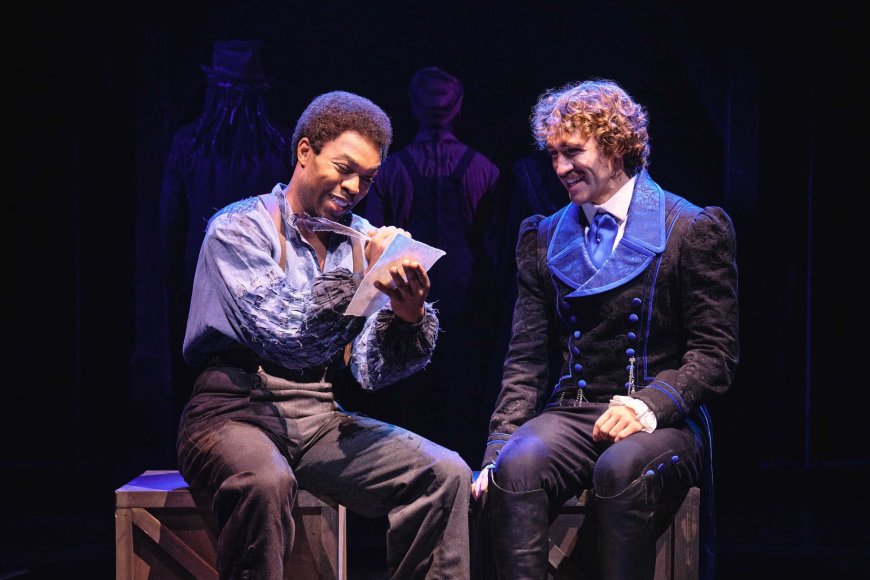
If you go to the theater often enough over enough years, you may at some point get lucky and be a witness to theatrical history being made. Or, if you’d like to experience that right away, you can head down to Manhattan’s Daryl Roth Theater and catch Todrick Hall’s magnificent “Midnight,” a brilliant, soul-stirring musical that sets a new bar for original work — and it’s a very high one indeed. It’s not perfect to be sure, but it surely is engaging and thought-provoking. Plus, you will hear some of the finest singing the New York theater has to offer.
So, why historic? “Midnight” very likely could only be created today. You can see Hall’s influences in everything from Disney fantasy to “Hamilton” to “Les Misérables.” Taken together, and adding a Black, queer sensibility to the show, the result is a mix of styles — and certainly dramaturgy — that seems very much of the moment. Yet somehow it works to create an intellectual and emotional experience that revels in its theatricality.
Hall has taken the daring step of using slavery in the antebellum South as a metaphor for love and connection in our differently, but no less fraught, cultural clashes related to sexuality, race, power, and class. It is a romantasy (to cite the current hot fiction genre) that is not intended to be taken literally but finds in its abstraction a humanity that is at once harrowing and heartfelt. If at times it is difficult to watch for the cruelty and degradation slavery engendered, that seems intentional. When was art ever supposed to be palliative and comforting when it is pointed social criticism?
The fundamental story focuses on an enslaved man named Rail, who on being loaned out to serve at a party, encounters the brothers Richard and Harry. Richard is sympathetic to Rail’s situation, and over the course of several scenes, fall in love. Harry is the opposite, with no respect — indeed, disdain — for any humanity Rail might have. As Richard and Rail’s relationship deepens, they meet clandestinely. In a loving act, Richard gives Rail a pair of shoes, another metaphor, this time for humanizing Rail.
Hall intersperses this with events that more accurately reflect the horrors of slavery — whippings, lynchings, loving relationships between slaves that are wrenched apart by masters. This provides a semi-factual basis and contrast for the fantasy of Richard and Rail’s forbidden love.
In the second act, Hall moves into magical realism. In a poignant moment, Rail trying to make sense of the world, sings, “I wish for them to be us.” And it happens. In the second act, the roles are reversed — the Black characters are the masters, the whites the slaves. Yet, here’s the run: nothing changes in the dynamic between the powerful and the subservient. That’s where the dramatic impact of this piece kicks in. This is the human condition where power dynamics are in play. It’s what author Isabelle Wilkerson details so sharply in her book “Caste.” Somehow, humans always need someone to look down on and vilify as “less than.” The echoes to our current political situation are inescapable.
Hall’s score is rich and varied, with comic songs juxtaposed against heartbreaking ballads. His work in a variety of styles is another element that is a hallmark of contemporary musicals. One of the most compelling is “The Dancing One,” sung by Ethel, who praises her son, who loved to dance, and who, when he was lynched, still looked like he was dancing, though his feet were off the ground. Similarly, “Nothing Like This” expresses the nature of the love between Richard and Rail. Hall is a master at imbuing songs with heightened emotions.
The singing is some of the best you will hear on any stage today. From flawless vocal technique to spectacular acting, the entire company is dazzling.
Hall plays Rail with a depth and complexity that fully explores Rail’s conflicted reality. Jeremy Beloate is Richard, who is every bit Hall’s match and a spectacular singer in his own right. As the emotional center of the piece, these two are well matched and consistently excellent.
Beck Jones’ period-inspired costumes feature a heightened color palette that underscores the fantastical nature of the story, always reminding the audience that what we’re seeing is intended as a kind of fairytale. Morgan Large’s unit set is a sturdy backdrop to the action and looms over it. Special mention must be made of the sound design by Lawrence Schrober. Every note and nuance of the score is perfectly expressed and marvelously balanced.
So, is there a solution to our human failing? At the end of the show, Hall suggests, perhaps naively, that the answer is love, and he ends the show on a hopeful note. It is not a happy ending in the traditional, musical sense, but it does make us want to be better people.
"Midnight" | Daryl Roth Theater | 101 East 15th Street | Tues-Sun 7:30 p.m.; Sat, Sun 2 p.m. | $59-$199.50 at Telecharge | 3 hours, 1 intermission