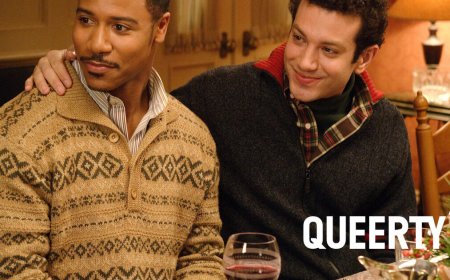
Sixty years before Pillion, this leather boy bromance became an early queer classic
Welcome back to our queer film retrospective, “A Gay Old Time.” In this week’s column, as audiences strap in for the new gay “dom-com” Pillion, let’s revisit 1964’s The Leather Boys, another film about leather-clad bikers that’s considered an early queer cinema classic. This weekend the erotic romantic drama Pillion is finally hitting U.S. theaters. Directed by newcomer […]
 Mark
Mark

Welcome back to our queer film retrospective, “A Gay Old Time.” In this week’s column, as audiences strap in for the new gay “dom-com” Pillion, let’s revisit 1964’s The Leather Boys, another film about leather-clad bikers that’s considered an early queer cinema classic.
This weekend the erotic romantic drama Pillion is finally hitting U.S. theaters. Directed by newcomer Harry Lighton, the film follows Colin (Harry Melling), a meek, shy young man who finds himself in a dom/sub relationship with Ray (Alexander Skarsgård), an alluring older leather biker. Colin then goes on a journey of self-discovery through the world of BDSM and leather, as his relationship with Ray deepens more than either of them expected.
How about we take this to the next level?
Subscribe to our newsletter for a refreshing cocktail (or mocktail) of LGBTQ+ entertainment and pop culture, served up with a side of eye-candy.
Subscribe to our Newsletter today
The movie had a brief qualifying run last year for award season purposes, and became an unexpected critical darling, hitting big across the pond with three BAFTA award nominations. It’s been lauded for its two lead performances and for putting an earnest (almost tender!) spin to what many think of as a rather rough and purely sexual world.
To celebrate it, this week we’ll stay in England just a bit longer, but go back in time roughly 60 years to another movie that tackled the world of hot boys riding bikes, and the bond and desire that can unexpectedly spur between them.
The Set-Up
The Leather Boys is a 1964 British film directed by Sidney J. Furie. It follows newly married couple Dot (Rita Tushingham) and Reggie (Colin Campbell), a pair of young and deeply in love Cockney teenagers whose passion burns too bright, too fast. After coming back from their honeymoon, the two start to slowly grow apart from each other; the self-absorbed Dot is always at parties and social engagements, while Reggie forms a friendship with a local biker group, particularly outgoing Pete (Dudley Sutton).
When Reggie’s grandfather dies, he lets Pete move into his grandmother’s spare room to keep her company. But as Dot becomes increasingly distant towards him and starts a flirtation with another one of his biker friends, Reggie spends more time with Pete, eventually sharing the spare room with him (as well as the bed), raising suspicions of the true nature of their friendship.
Reggie and Dot’s marriage eventually falls apart—in part due to an altercation involving a fake pregnancy—and Reggie agrees to finally go on a road trip to America that he and Pete always planned. However, as he meets up with Pete at their departure dock, he sees him surrounded by a group of friends that are clearly gay. Finally understanding Pete’s true identity, Reggie decides then to let him go, choosing to remain by himself.
Strange Bedfellows

On one hand, the film stands out as a preeminent example of British “kitchen sink realism,” an artistic movement that depicted the domestic everyday struggles of working class Britain (usually the angry youth) with a harsh, realistic narrative and stylistic lens. Movies from these movements were usually very low-budget, made by young up-and-coming filmmakers, with a cast of unknown actors.
But it is also known for its groundbreaking treatment of homosexuality and its leading gay character, portraying him in a positive and empathetic light, while also giving him closure and a place in his community.
The movie doesn’t make it clear that Pete is actually gay until the very last sequence, although it heavily hints at it throughout to plant the seed of suspicion not just for the characters, but on the audience as well. When he and Reggie go to the pier and Reggie decides to hit on a couple of girls at the arcade, Pete could not be less interested in the conversation. And after Reggie spends several nights at his grandmother’s with Pete, and Dot confronts him to let him know that they are coming off as a “couple of queers,” Pete very explicitly does not deny it when Reggie asks about him later.
Who’s In The Sidecar?

However, what feels so groundbreaking about The Leather Boys is that this reveal is not treated as a shock, a plot twist, or a damning character detail that’s supposed to turn us against Pete. Reggie meets up at the pub that Pete suggested before they board the ship to America, and quickly realizes that it’s a gay bar, that the other men there are starting to hit on him, and that Pete is a regular.
Only then does it hit Reggie that everything that Dot was suspicious of—and the signs that he himself doubted earlier—were all true, so he decides to let his friend leave without him. Not out of hate or homophobia, but simply because he understands they are on different life paths. The whole sequence plays out with barely any dialogue, and the final walk in which Reggie and Pete say goodbye and then go their own way has an unexpected weight and poignancy, with remarkable empathy and understanding for its characters.
Unlike other movies at the time, the film does not portray Pete as an isolated, tortured and self-hating man destined to die alone or become a victim. He’s not a cautionary tale. Instead, he’s an amicable, friendly man, well-known and liked by other people, with a place in both the straight circle that Reggie is a part of, but (as it’s revealed in the final sequence) with a circle of queer friends all to his own. As he decides to embark on the ship with them, he is allowed to have a future, which is more than most queer characters at the time were given.
Strap In!

It’s also worth noting the empathy and bittersweet feeling in Reggie as he discovers this. He’s not disgusted or put off by the revelation that his best friend is gay. What weighs on him is the huge disappointment in realizing that the new life that he was envisioning for himself can no longer be, and that he lost the two greatest companions of his life at once. In a way, he is the character that gets his future taken away from him. He is the one left in despair in the end, unsure of what’s coming after. And maybe that’s the most radical thing about this film.
Although The Leather Boys uses its biker gang setting merely as backdrop, rather than fully engaging with its culture, one can see a direct path between this film and Pillion. And while one may have the stark, social realism of mid-century Britain and the other leather uniforms and forest orgies, both follow working class Brit boys trying to figure out what to make of themselves, and turning to a male companion for meaning.
The Leather Boys is streaming on Kanopy, The Roku Channel, and Amazon Prime Video.
Related
Alexander Skarsgård & Harry Melling on Pillion‘s kinky surprises and on-set turn-ons
The stars of ‘Pillion’ take us on one wild ride, so strap in!
Sign up for the Queerty newsletter to stay on top of the hottest stories in LGBTQ+ entertainment, politics, and culture.