The continuing legacy of Father Mychal Judge
At the end of his life, he was Victim 0001. On Sep. 11, 2001, when the towers came down, he was the first casualty. In his last moments, he prayed: “Jesus, please end this right now! God, please end this!” The iconic image of him being carried away from the rubble in a chair, taken … Read More
 Mark
Mark
0
32
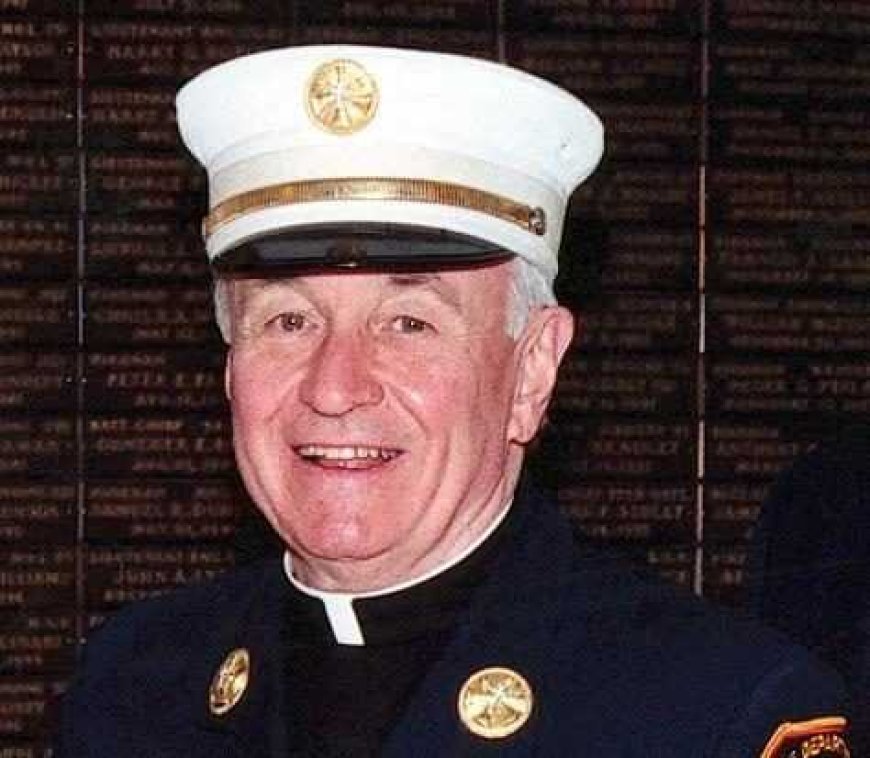
At the end of his life, he was Victim 0001. On Sep. 11, 2001, when the towers came down, he was the first casualty. In his last moments, he prayed: “Jesus, please end this right now! God, please end this!"
The iconic image of him being carried away from the rubble in a chair, taken by photographer Shannon Stapleton, was a modern Pietà, as Father Mychal Judge (OFM) left this life and became an icon, a legend, and (in some quarters) a saint.
He was a native New Yorker, a first-generation Irish-American. He felt a calling to the Church and became a Franciscan friar, wearing their long brown robes. He was also an alcoholic in recovery; chaplain to the New York City Fire Department; a union member (AFSCME Local 299, District Council 37); founder of an AIDS ministry; and a gay man.
In the quarter century since his death, Judge has become larger than life, with the memories overlapping and sometimes contradictory, depending on who is telling the story.
In a Roman Catholic Church that still considers homosexuality “intrinsically disordered," there was and is an effort to portray Judge as celibate. In the current Catholic Weekly, an article about Judge says: “After Father Judge’s death, close friends and associates revealed he was gay — but by all accounts, maintained his vow of celibacy.”
On the 10-year anniversary of 9/11, The National Catholic Reporter wrote: “How come any time anyone talks about Mychal Judge they only want to talk about that subject?” asked Dennis Lynch, a lawyer in Nyack, N.Y., who worked with Judge on reconciling Catholic and Protestant factions in Northern Ireland. Lynch has denied that Judge was gay and argued that gay activists “hijacked the truth” to “advance a particular cause.”
In his priestly life, Judge was known throughout New York City for ministering to unhoused people, immigrants, and the sick. He prayed with them, gave them what money he had, and in a story told by friends, once took off his winter coat to give it to an unhoused woman, saying “she needed it more than I did.”
Judge also worked with the gay Catholic group, Dignity, even when the Cardinal John J. O’Connor, head of the Archdiocese of New York, expelled them from St. Francis Xavier church, at the behest of then-Cardinal John Ratzinger (later Pope Benedict XVI). Judge then welcomed Dignity's AIDS ministry to the Church of St. Francis of Assisi.
Another story, from the documentary film “The Saint of 9/11” tells that when Judge anointed a man who was dying of AIDS, the man asked him, "Do you think God hates me?" Judge picked him up, kissed him, and silently rocked him in his arms.
St. Pat’s for All founder Brendan Fay often tells how Judge made the first contribution to the organization and marched in the first parade. Fay, the Queens-based teacher, activist, and filmmaker, produced and directed “Remembering Mychal” (2021). Fay gladly talks about his great friend, and has an archive of Judge’s correspondence. The film has been screened in New York and other destinations.
Judge’s legacy remains wide-ranging, useful, and controversial.
There have been at least three films and several books written about Judge, including the 2006 documentary “The Saint of 9/11,” directed by Glenn Holsten, co-produced by Fay, and narrated by Sir Ian McKellen.
Some Catholics have called for the canonization of Judge. Pope John Paul II was presented with Judge’s fire helmet. The Orthodox-Catholic Church of America (not a part of the Roman Catholic Church) and the Reformed Catholic Church have proclaimed him a saint. The Archdiocese of New York has not called for his sainthood.
In 2002, the United States Congress passed The Mychal Judge Police and Fire Chaplains Public Safety Officers Benefit Act into law. The law extended federal death benefits to chaplains of police and fire departments, and also marked the first time the federal government extended equal benefits for same-sex couples by allowing the domestic partners of public safety officers killed in the line of duty to collect a federal death benefit.
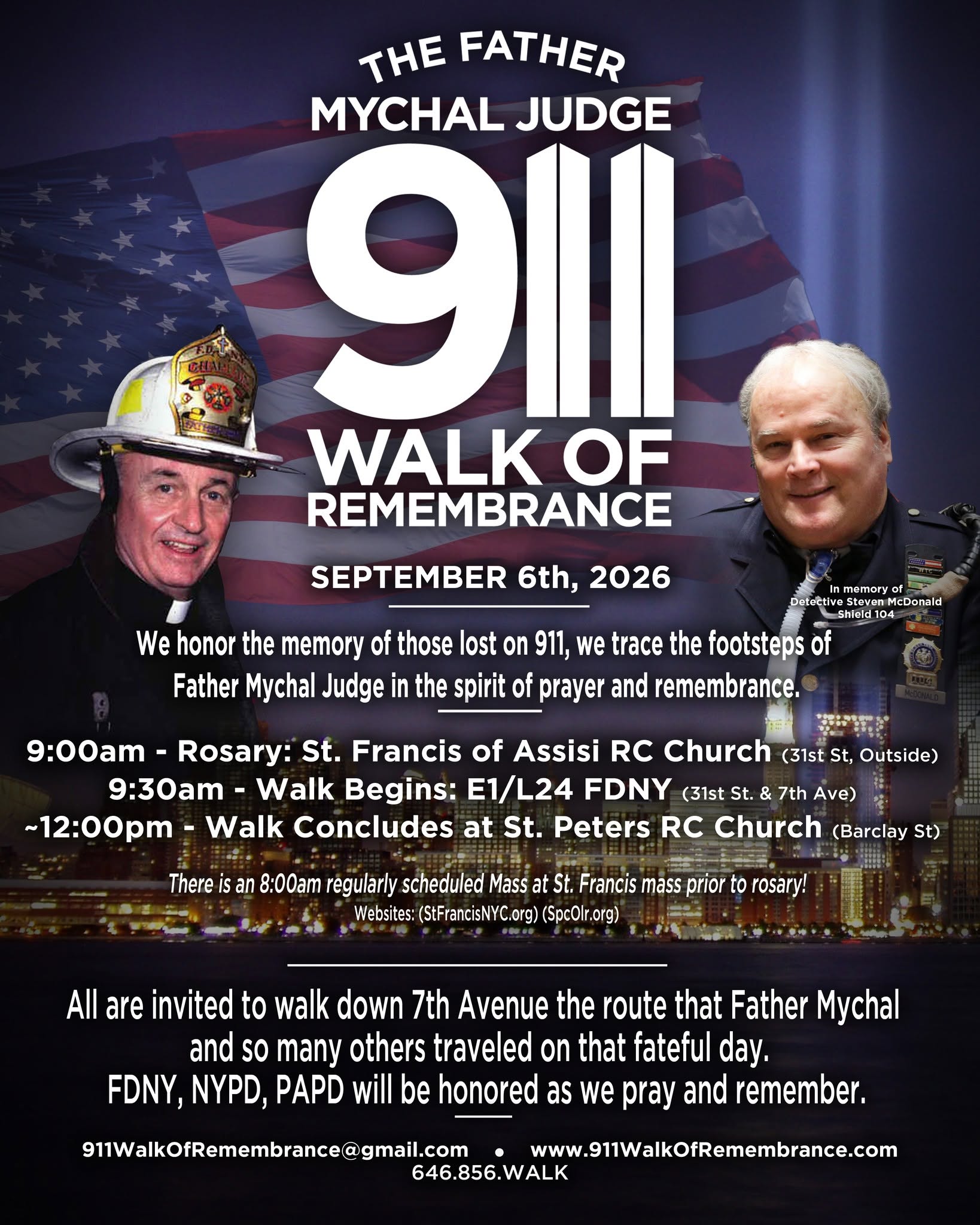
The Father Mychal Judge Walk of Remembrance takes place every year in New York on the Sunday before the 9/11 anniversary. It begins with a Mass at St. Francis Church on West 31st Street (Father Mychal Judge Street), then proceeds to Ground Zero, retracing Judge's final journey.
Last month, the Church of St. Francis of Assisi unveiled and consecrated a newly designed memorial alcove dedicated to the victims of Sept. 11, 2001.
The FDNY and FDNY Foundation released the official trailer for “Remembering Judge” last month. The new short film shares Judge's story and legacy and is being co-released with a second one titled "Resilience," which examines the ongoing health impacts experienced by FDNY members who took part in the rescue and recovery efforts at the World Trade Center site. Both films will have a limited theatrical release at the Firehouse Cinema in Lower Manhattan at 87 Lafayette Street.
Decades later, Judge is still part of New York City. People walk the streets he walked, march for the same causes, and repeat his prayer: “Lord, take me you where want me to go. Let me meet who you want me to meet. Tell me what you want me to say and keep me out of your way.”