Meandering and unfocused, ‘The Queen of Versailles’ collapses under its own weight
For a Broadway musical, fables are not easy to pull off. Two of the most iconic — and successful — musicals of the 20th century bill themselves as such. “Guys and Dolls” and “Gypsy” even include the word in their formal titles. What makes them work as such is the heightened poetic reality of their … Read More
 Mark
Mark
0
44
For a Broadway musical, fables are not easy to pull off. Two of the most iconic — and successful — musicals of the 20th century bill themselves as such. “Guys and Dolls” and “Gypsy” even include the word in their formal titles. What makes them work as such is the heightened poetic reality of their situations — an abstract Damon Runyon New York in the former and a driven stage mother of mythic scale in the latter. In their scope, Nathan Detroit and Mama Rose are not intended to be literal or naturalistic, but in their excess we see human truths and, as with all fables, hopefully learn from them. Plus, it doesn’t hurt that these two shows have two of the best scores of the musical theater with songs that have become standards in the American Songbook.
On the other hand, the new musical “The Queen of Versailles,” though it calls itself a fable about the American Dream, is so bogged down in biography and exposition that there is no chance for Jackie Siegel to become mythic. The story is Siegel’s rise from rags to riches and her efforts to build and rule over the largest private home in the US — a 90,000 square foot residence modeled on the Palace of Versailles — hence the title.
The show is based on a 2012 documentary of the same name. However, while a documentary can engage in dispassionate observation, in theater, characters drive the emotional life of a piece. Lindsey Ferrentino’s book for the stage version hews so closely to the film’s narrative sequence that there is no deeper exploration of Jackie as an extreme example of the chase for riches gone mad. At least, reading between the lines, that’s what seems like the intent of the show. Still, it’s rather a mess. Is Jackie a cautionary tale? A tragedy? Is this an indictment of our consumerist society, or is it a metaphor for hubris? Is she Hercules, who overcomes overwhelming challenges? Or, is she Icarus, who flies too close to the sun and crashes and burns? The book is unclear, so the audience is confused.
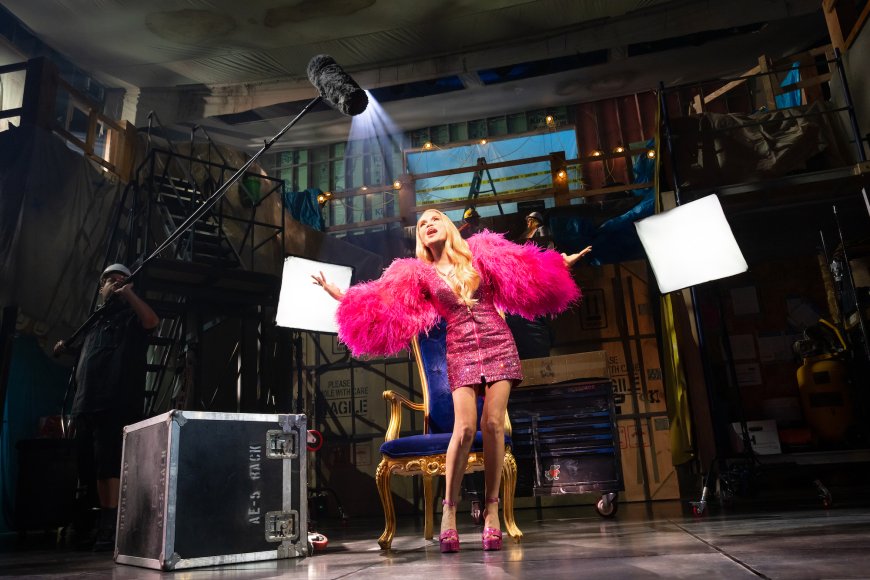
[caption id="attachment_60496" align="aligncenter" width="700"]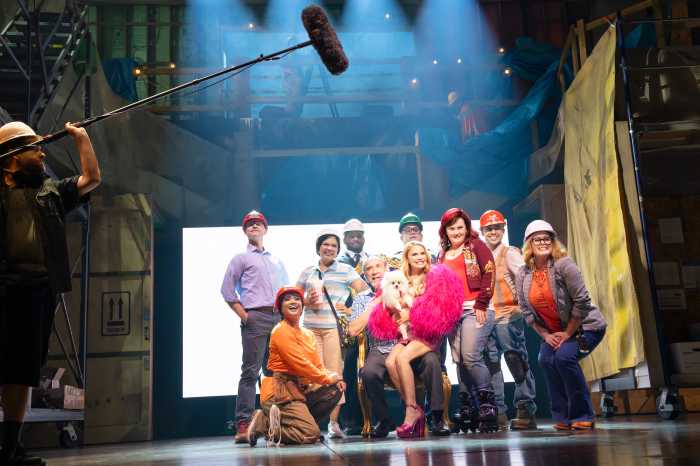 The company of "The Queen of Versailles."Julieta Cervantes[/caption]
Ferrentino has used an 18th Century framing device juxtaposing the court of Louis XIV, who built Versailles as a model for excess but then jumps ahead nearly 80 years to the French Revolution and Marie Antoinette heading to the guillotine. Again, more questions: are we really supposed to feel that Jackie deserves to be executed for her clueless, egotistical selfishness?
There are attempts to contextualize and comment on Jackie’s story. For example, in the second act Jackie and her daughter Victoria return to Jackie’s parents’ home and discover the joys of the simple life. Later, almost like an addict, Jackie can’t pull herself away from her drug of choice: her vision of her own Versailles. Victoria, presumably in response, takes her own life, but that’s sloppily rendered and facile. As song bemoaning that she isn’t pretty and anger at her mother don’t dramatically justify a suicide. Though she’s heartbroken, Victoria’s death doesn’t phase Jackie who redoubles her drive to complete the house (which was almost derailed by the 2008 economic crash) as a tribute to Victoria, driving away everyone else close to her in the process. Like Mama Rose in “Gypsy,” after everyone has abandoned her, Jackie has her own personal crisis in an 11 O’clock number, asking why she did it all. Yet she is no closer to self-knowledge or redemption at the end than she was two-and-a-half hours ago. So, what was this all for?
Worse yet, all of this is set to Stephen Schwartz’s astonishingly mediocre score. The composer of “Wicked,” “Godspell,” and “The Baker’s Wife” (now getting a rare staging at CSC), knows his way around a show tune, but not here. Aside from quoting himself in some short passages, the songs meander into that instantly forgettable realm.
Michael Arden’s direction is almost non-existent, and the choreography by Lauren Yalango-Grant and Christopher Cree Grant is generic and uninspired.
So, what would keep you from wanting to chew your own arm off to escape this trap? Well, even though the songs are lackluster, the voices are some of the best you’ll hear on Broadway. Of course, Kristen Chenoweth sounds spectacular, and she pours herself into the role completely, very nearly overcoming the material at times. The score does let her showcase her full range from Broadway brass to flawless coloratura, it almost makes up for, and enlivens, the music. Members of the ensemble, Pablo David Laucerica and Cassondra James are spectacular. Laucerica opens the show as Louis IV with a song that almost pushes into countertenor range and a clarity of tone that is thrilling. James opens the second act as Marie Antoinette and on her own and in a duet with Chenoweth, she, too, has a magnificent technique, power, and range that is exciting. Of the other principals, Nina White as Victoria is impressive, though her two big numbers are hampered by bathos, she gives them as much complexity as the material allows. Stephen De Rosa (who was so wonderful in “Boop” last season) and Isabel Keating play Jackie’s parents. They are written as the classic second bananas in a musical, but they are both charming and are an effective, if overly obvious, foil to Jackie.
As the curtain blessedly falls, one is left with the idea that while the creators intended to create a powerful fable or social commentary, they seem to have forgotten the most essential element of a fable: the moral. Instead of building a coherent, human lesson, they wander around the story — like Jackie in her unfinished Versailles — creating a show that’s overstuffed and unwieldy.
"The Queen of Versailles" | St. James Theatre | 246 West 44th Street | Tues, Thurs, Fri 7 p.m.; Weds, Sat 2 p.m. & 7:30 p.m.; Sun 3 p.m. through January 4 | Tickets from $88.48 at ATG Tickets | 2 hours, 40 mins, 1 intermission
The company of "The Queen of Versailles."Julieta Cervantes[/caption]
Ferrentino has used an 18th Century framing device juxtaposing the court of Louis XIV, who built Versailles as a model for excess but then jumps ahead nearly 80 years to the French Revolution and Marie Antoinette heading to the guillotine. Again, more questions: are we really supposed to feel that Jackie deserves to be executed for her clueless, egotistical selfishness?
There are attempts to contextualize and comment on Jackie’s story. For example, in the second act Jackie and her daughter Victoria return to Jackie’s parents’ home and discover the joys of the simple life. Later, almost like an addict, Jackie can’t pull herself away from her drug of choice: her vision of her own Versailles. Victoria, presumably in response, takes her own life, but that’s sloppily rendered and facile. As song bemoaning that she isn’t pretty and anger at her mother don’t dramatically justify a suicide. Though she’s heartbroken, Victoria’s death doesn’t phase Jackie who redoubles her drive to complete the house (which was almost derailed by the 2008 economic crash) as a tribute to Victoria, driving away everyone else close to her in the process. Like Mama Rose in “Gypsy,” after everyone has abandoned her, Jackie has her own personal crisis in an 11 O’clock number, asking why she did it all. Yet she is no closer to self-knowledge or redemption at the end than she was two-and-a-half hours ago. So, what was this all for?
Worse yet, all of this is set to Stephen Schwartz’s astonishingly mediocre score. The composer of “Wicked,” “Godspell,” and “The Baker’s Wife” (now getting a rare staging at CSC), knows his way around a show tune, but not here. Aside from quoting himself in some short passages, the songs meander into that instantly forgettable realm.
Michael Arden’s direction is almost non-existent, and the choreography by Lauren Yalango-Grant and Christopher Cree Grant is generic and uninspired.
So, what would keep you from wanting to chew your own arm off to escape this trap? Well, even though the songs are lackluster, the voices are some of the best you’ll hear on Broadway. Of course, Kristen Chenoweth sounds spectacular, and she pours herself into the role completely, very nearly overcoming the material at times. The score does let her showcase her full range from Broadway brass to flawless coloratura, it almost makes up for, and enlivens, the music. Members of the ensemble, Pablo David Laucerica and Cassondra James are spectacular. Laucerica opens the show as Louis IV with a song that almost pushes into countertenor range and a clarity of tone that is thrilling. James opens the second act as Marie Antoinette and on her own and in a duet with Chenoweth, she, too, has a magnificent technique, power, and range that is exciting. Of the other principals, Nina White as Victoria is impressive, though her two big numbers are hampered by bathos, she gives them as much complexity as the material allows. Stephen De Rosa (who was so wonderful in “Boop” last season) and Isabel Keating play Jackie’s parents. They are written as the classic second bananas in a musical, but they are both charming and are an effective, if overly obvious, foil to Jackie.
As the curtain blessedly falls, one is left with the idea that while the creators intended to create a powerful fable or social commentary, they seem to have forgotten the most essential element of a fable: the moral. Instead of building a coherent, human lesson, they wander around the story — like Jackie in her unfinished Versailles — creating a show that’s overstuffed and unwieldy.
"The Queen of Versailles" | St. James Theatre | 246 West 44th Street | Tues, Thurs, Fri 7 p.m.; Weds, Sat 2 p.m. & 7:30 p.m.; Sun 3 p.m. through January 4 | Tickets from $88.48 at ATG Tickets | 2 hours, 40 mins, 1 intermission
The company of "The Queen of Versailles."Julieta Cervantes[/caption]
Ferrentino has used an 18th Century framing device juxtaposing the court of Louis XIV, who built Versailles as a model for excess but then jumps ahead nearly 80 years to the French Revolution and Marie Antoinette heading to the guillotine. Again, more questions: are we really supposed to feel that Jackie deserves to be executed for her clueless, egotistical selfishness?
There are attempts to contextualize and comment on Jackie’s story. For example, in the second act Jackie and her daughter Victoria return to Jackie’s parents’ home and discover the joys of the simple life. Later, almost like an addict, Jackie can’t pull herself away from her drug of choice: her vision of her own Versailles. Victoria, presumably in response, takes her own life, but that’s sloppily rendered and facile. As song bemoaning that she isn’t pretty and anger at her mother don’t dramatically justify a suicide. Though she’s heartbroken, Victoria’s death doesn’t phase Jackie who redoubles her drive to complete the house (which was almost derailed by the 2008 economic crash) as a tribute to Victoria, driving away everyone else close to her in the process. Like Mama Rose in “Gypsy,” after everyone has abandoned her, Jackie has her own personal crisis in an 11 O’clock number, asking why she did it all. Yet she is no closer to self-knowledge or redemption at the end than she was two-and-a-half hours ago. So, what was this all for?
Worse yet, all of this is set to Stephen Schwartz’s astonishingly mediocre score. The composer of “Wicked,” “Godspell,” and “The Baker’s Wife” (now getting a rare staging at CSC), knows his way around a show tune, but not here. Aside from quoting himself in some short passages, the songs meander into that instantly forgettable realm.
Michael Arden’s direction is almost non-existent, and the choreography by Lauren Yalango-Grant and Christopher Cree Grant is generic and uninspired.
So, what would keep you from wanting to chew your own arm off to escape this trap? Well, even though the songs are lackluster, the voices are some of the best you’ll hear on Broadway. Of course, Kristen Chenoweth sounds spectacular, and she pours herself into the role completely, very nearly overcoming the material at times. The score does let her showcase her full range from Broadway brass to flawless coloratura, it almost makes up for, and enlivens, the music. Members of the ensemble, Pablo David Laucerica and Cassondra James are spectacular. Laucerica opens the show as Louis IV with a song that almost pushes into countertenor range and a clarity of tone that is thrilling. James opens the second act as Marie Antoinette and on her own and in a duet with Chenoweth, she, too, has a magnificent technique, power, and range that is exciting. Of the other principals, Nina White as Victoria is impressive, though her two big numbers are hampered by bathos, she gives them as much complexity as the material allows. Stephen De Rosa (who was so wonderful in “Boop” last season) and Isabel Keating play Jackie’s parents. They are written as the classic second bananas in a musical, but they are both charming and are an effective, if overly obvious, foil to Jackie.
As the curtain blessedly falls, one is left with the idea that while the creators intended to create a powerful fable or social commentary, they seem to have forgotten the most essential element of a fable: the moral. Instead of building a coherent, human lesson, they wander around the story — like Jackie in her unfinished Versailles — creating a show that’s overstuffed and unwieldy.
"The Queen of Versailles" | St. James Theatre | 246 West 44th Street | Tues, Thurs, Fri 7 p.m.; Weds, Sat 2 p.m. & 7:30 p.m.; Sun 3 p.m. through January 4 | Tickets from $88.48 at ATG Tickets | 2 hours, 40 mins, 1 intermission