Sweeping exhibition of ragtime history brushes aside LGBTQ contributions and popular drag king
Dr. Nobel Price was a lavender-complected Muppet character on the long-running children’s television program, “Sesame Street.” He was a wonky inventor isolated from society in his laboratory on a remote island. Kermit the Frog, serving as roving reporter for the “Sesame Street News,” was regularly dispatched to Dr. Price’s lair to cover the big reveal … Read More
 Mark
Dr. Nobel Price was a lavender-complected Muppet character on the long-running children’s television program, “Sesame Street.” He was a wonky inventor isolated from society in his laboratory on a remote island. Kermit the Frog, serving as roving reporter for the “Sesame Street News,” was regularly dispatched to Dr. Price’s lair to cover the big reveal of his next genial invention. Trouble is, every time without fail, Kermit had to break the news to the disconnected yet undeterred inventor that his hot innovation already existed. In an episode from 1981, Dr. Price unveiled what he called a “tinkly table,” a big wooden box with a console of keys manipulatable to make music. The Green One informed him that his discovery was known the world over as a piano, and that very many people, he included, knew how to operate it. Kermit then jumped on the keys and played a few bars of “Maple Leaf Rag,” the most well-known hit to come out of ragtime, the late 19th to early 20th century musical genre that underwent a pop culture renaissance in the 1970s.
That Sesame Street episode is a prime example of the cultural amnesia a new exhibition at The Morgan Library and Museum, “Ragtime: Cakewalk in Pianoland,” aims to address. “You hear it,” the show’s introductory wall text announces. “You recognize the tune. You have heard it before. Ragtime is its name. Most who know the name immediately think of piano music. Others associate it with musicals and the American songbook. Yet ragtime encompasses all of this and so much more.”
[caption id="attachment_65968" align="aligncenter" width="700"] Exhibition signage at The Morgan Library and Museum.Nicholas Boston[/caption]
The show thus offers a sweeping historicization of not only ragtime’s heyday, but the influences that came before it and the legacy it left behind. Co-organized by Morgan curators Jesse Erickson and Robinson McClellan, and pianist John Davis, whose “Collection of Musical African Americana” is a contributing source of materials, the exhibition traces the evolution and impact of ragtime through consecutive eras defined by the intersection of musical composition with traditions in dance, namely the cakewalk, and theatrical entertainment, specifically blackface minstrelsy.
Ragtime was the most widely consumed form of American popular music from the 1890s to nearing the end of the First World War. The compositions, colloquially called “rags,” spread commercially via the sale of sheet music, first available in this genre in 1895. Composer and pianist Scott Joplin (1868-1917), known as the “King of Ragtime,” wrote and performed “Maple Leaf Rag,” which was first printed in 1899 by Missouri-based publisher John Stark and Son. The exhibition displays the publishing contract. Joplin secured a royalty of one cent on the twenty-five-cent sale of every copy, an unusually fair arrangement at the time for a Black composer in the white-dominated industry. The piece had healthy sales, enabling Joplin to devote all his time to writing and performing. In addition to over 40 rags, he composed a ballet and two operas. An original score of the opera “Treemonisha” bearing Joplin’s handwritten corrections is wonderfully showcased in the exhibit.
[caption id="attachment_65966" align="aligncenter" width="532"] Scott Joplin, "King of Ragtime."[/caption]
As is the case with a great many foundational genres of American cultural expression, whether marketed or not, ragtime emerged from the exchange, inheritance, and outright theft of aesthetics, beats and gestures back and forth across the perforated line that divided descendants of Africans and descendants of Europeans throughout the nation’s history.
Take the cakewalk. This was a late-19th century African American dance craze that originated on southern plantations where the enslaved entertained themselves by mocking the genteel promenades and formal waltzes of white enslavers, set to music. The dancers would don their best garments and high-step or stroll in couples, parodying conventions of Euro-American paired dancing. The best performers snatched a prize, often a cake. Post-emancipation, the cakewalk attracted mainstream interest, first as entertainment, then appropriation. Ragtime music’s syncopated rhythms became a fitting soundtrack for the dance. The two art forms grew symbiotically, as lyrics in Joplin’s “The Ragtime Dance” attest: “Let me see you do the ragtime dance; Turn left and do the cakewalk prance.”
International tours took cakewalking, like ragtime, to audiences outside the United States. And here is where “Ragtime: Cakewalk in Pianoland” itself turns forgetful. By some accounts, the cakewalk was introduced to France by a Black male duo, Charles Gregory and Jack Brown, with the latter dressing as a woman. According to queer historian Sarah E. Chinn, “the pair’s interpretation of the cake-walk was so well known in Paris that the Lumière brothers, inventors of the first movie projection technology, filmed them dancing…in 1902.” This footage is the oldest known drag performance captured on film, but curiously it is not part of the exhibition. Featured instead is combined footage of two short clips of presumptively opposite-sex cakewalking couples that, while equally precious as the Gregory and Brown film, is chronologically later (1903) and much shorter in length. Such a pity that neither Gregory and Brown’s earlier footage, nor their queer contribution to the ragtime story is included in this exhibition.
A general oversight of the documented LGBTQ+ and gender-bending presence in the ragtime era pervades “Ragtime: Cakewalk in Pianoland.” Absent is mention of figures such as William Dorsey Swann (1860-1925), a formerly enslaved Black gay man, self-proclaimed as the “Queen of Drag,” famed for his cakewalk performances. Or of the ragtime pianist, singer and composer Tony Jackson (1882-1921), also openly gay, whose music and mentorship heavily influenced emerging artists, notably the jazz pioneer Jelly Roll Morton (1890-1941). These and other elisions compromise this show’s professed mission to deliver a capacious understanding of ragtime’s evolution.
[caption id="attachment_65970" align="aligncenter" width="525"] Still from "Cake Walk" and "Comedy Cake Walk," 1903. American Mutoscope and Biograph Company.Photo by Nicholas Boston[/caption]
The exhibition insightfully explores the relationship of blackface minstrelsy to ragtime through the extraordinary career of Ernest Hogan (1865-1909). A comedian, singer-songwriter and stage performer who got his start in “coon songs” – tunes derogating Black people that were performed in blackface by both white and Black actors – Hogan went on to become one of the most artistically and commercially successful ragtime creatives. He is one in a handful of artists to whom aficionados point as being the very originator of ragtime.
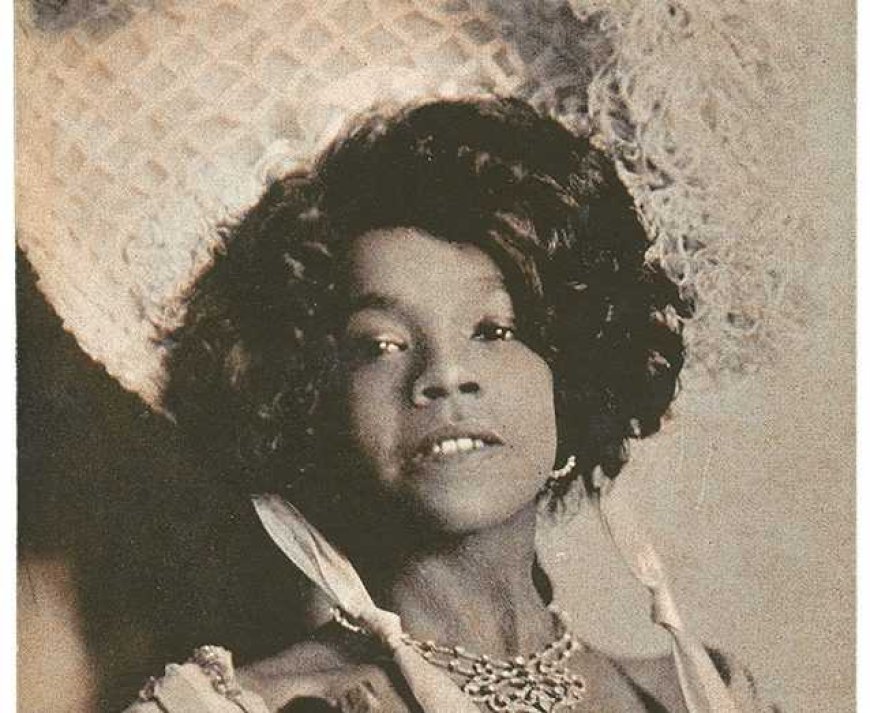
Alongside Hogan, the show discusses the careers of prominent contemporaries and collaborators, among them the vaudeville performer and dancer Aida Overton Walker. She held the title of “Queen of the Cakewalk” and with her husband, comedian George Walker and his acting partner Bert Williams, Overton Walker headlined a number of successful musical theater productions. What the exhibition does not touch on is Overton Walker’s place in the pantheon of male impersonators as an original “drag king.” When her husband died, a determined Overton Walker devised a method to first keep his production alive, then innovate her solo performances. She took on his routines dressed as a man. The move was a hit. A quote from a 1912 theater review in the African American newspaper, The Indianapolis Freeman, states, “When Aida Overton Walker tipped out upon the stage, it was the same big reception she had often received in the Williams and Walker Company…her male creation was so clever and natural of the style of her husband that the audience went wild with enthusiasm.”
The concluding section of “Ragtime: Cakewalk in Pianoland” considers the genre’s afterlife. In 1974, the soundtrack of “The Sting,” the Oscar-winning Hollywood blockbuster starring Paul Newman and Robert Redford, re-popularized Joplin’s music, especially his 1902 number, “The Entertainer,” which spent months on the “Billboard Hot 100.” This and a variety of other cultural references the exhibition presents as legacies of ragtime, from literature to Broadway to children's cartoons to ice-cream-truck and video-game sounds to contemporary visual artworks. None of it outwardly queer.
Ragtime: Cakewalk in Pianoland | The Morgan Library and Museum | Until June 13, 2027
Nicholas Boston, Ph.D., is a professor of media sociology at Lehman College of the City University of New York (CUNY). Follow him on Twitter @DrNickBoston and Instagram @Nick_Boston_in_New York