Before Grindr, Michael Alago Captured Queer Lust One Polaroid at a Time (Exclusive)
In Polaroid Encounters, Michael Alago revisits queer intimacy, masculinity, and a vanished New York.
 Mark
Mark
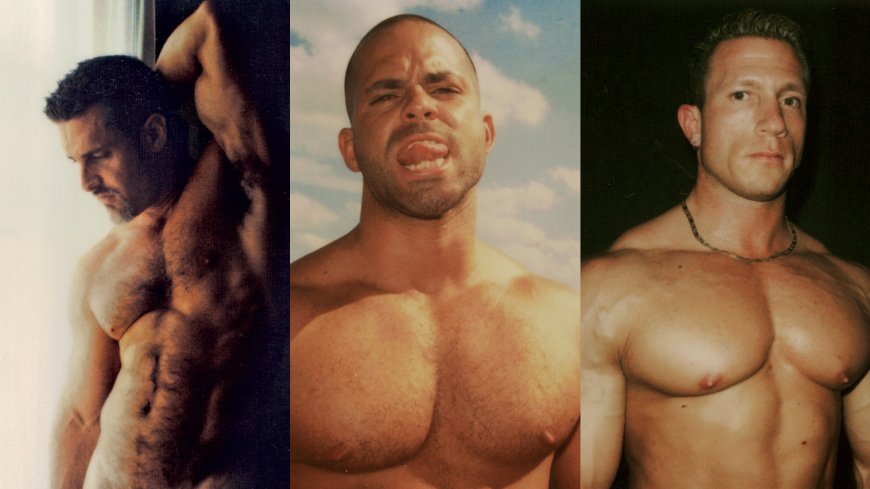
Long before swipes, disappearing messages, and algorithm-fed attraction, there were Polaroids.
There was eye contact. There was nerve. There was walking up to someone because you thought they were beautiful and seeing what happened next.
That spirit runs through Polaroid Encounters: 1998–2009, the newest book from photographer and former music executive Michael Alago, a collection of nearly 200 intimate portraits of men taken across New York, Los Angeles, Dallas, New Orleans, and San Francisco during a distinctly pre-app era of queer life.
The book, released as a limited edition through Shining Life Press, arrives as Alago’s fourth photography monograph following Rough Gods, Brutal Truth, and Beautiful Imperfections. But this one feels especially personal.
When speaking with us, Alago described returning to these images as emotional in ways he didn’t expect.
“I feel happiness finally sharing these Polaroids with the world,” he said. “I also feel a bit of melancholy, wondering what happened to the men from so long ago.” Before Grindr, There Was Courage
Alago’s photographs exist in a world that younger queer audiences may know more through mythology than memory.
Shot between 1998 and 2009, the collection documents encounters with strangers, lovers, bodybuilders, roughnecks, punks, and friends. Some images were taken in gyms, others in apartments, some in moments that feel spontaneous and impossible to recreate.
His approach was direct.
“I never had a problem walking up to a good-looking man and letting them know I was an artist and asking if I could photograph them,” Alago said. “I was young and sweet and the men most of the time said yes.”
That openness wasn’t performative. It was foundational.
Alago grew up openly gay in Hasidic Brooklyn and entered adulthood immersed in New York’s punk scene before becoming one of the music industry’s most influential A&R figures.
“I was never in the closet,” he has said.
When I asked how that shaped the way he moved through spaces like punk and the music business, his answer stayed simple.
“I have always been a fun-loving person, and people responded to me kindly.” The Man Who Signed Metallica Found Another Obsession
For many people, Michael Alago’s name still sparks immediate recognition for a different reason.
At 24, he signed Metallica to Elektra Records.
His career would later include work with White Zombie, John Lydon, Misfits, Cyndi Lauper, and executive-producing Nina Simone’s final album.
Success came quickly, but photography had always existed alongside it.
When asked whether there was ever a moment he stopped and thought, How is this actually my life? Alago laughed at the idea.
“Yes, I have stopped and thought, ‘How is this my life?’ But I have always had great instincts, and I became wildly successful. That success propelled me for 25 years to become the hardest worker I could be.”
Eventually, photography stopped being parallel work and became the main event. Masculinity, Intimacy, And Instant Film
If there’s one thing that links Alago’s portraiture across decades, it’s fascination.
Not with celebrity.
With men.
When I asked what keeps drawing him back to masculinity as a subject, his answer was immediate.
“I am personally fascinated by the scent, the muscles, and the overall sexiness of men.”
Still, Polaroid Encounters never reads as detached voyeurism.
Even at its most provocative, there’s affection underneath.
That intimacy comes from trust.
“I have always had a gentle, kind approach to taking pictures,” he said. “That kindness allowed the men to open up and surrender to the camera.”
The Polaroid format amplified that feeling.
Alago first experimented with cameras in the ’70s and ’80s before becoming attached to instant film.
“I have loved instant film since the day I first discovered it,” he told me. “That one-of-a-kind image felt so unique that it gave both the photographs and the work an impressive and striking quality.”
He still feels that pull today and joked that he’s ready to head back to B&H to pick up the newest instant camera. Robert Mapplethorpe, New York, And What Remains
There’s another artistic thread woven throughout the collection: Robert Mapplethorpe.
Alago first became obsessed after seeing the cover of Patti Smith’s Horses, later cold-calling Mapplethorpe’s studio while working at Elektra.
At first, he got rejected.
Days later, Mapplethorpe called back.
That conversation turned into a friendship that lasted until Mapplethorpe’s death in 1988 and included dinners in the West Village, nights out, and long conversations about art.
The influence stayed with him.
Square frames. Precision. Male beauty without apology.
But Alago’s work feels less controlled and more alive.
Asked whether he views Polaroid Encounters as documentary, erotic, romantic, or something else entirely, he said:
“I always aim for eroticism in my work. I think there is, by default, a documentary element to it because of the specific time frame in which the pictures were taken.”
That may be what gives these photographs their staying power.
They document desire, yes.
But they also preserve a version of queer life that existed before everything became searchable.
One image still stays with him.
“My favorite Polaroid in the book is of Massimo with his eyes closed,” Alago said. “The image feels both tough and tender, very vulnerable.”
And if he could send a message back to himself in 1998?
“Okay kids, please don’t drink and do drugs. It leads nowhere. Don’t you want to wake up clear and focused and make your life happen in a big and brilliant way?”
Maybe that’s what Polaroid Encounters really becomes in the end, not just a collection of men, but a collection of moments Michael Alago was lucky enough to live.