
David Pablo discusses inspiration behind his gay trucker drama ‘On the Road’
The intense Mexican drama, “On the Road” has the gay Veneno (newcomer Victor Prieto Simental in a phenomenal performance), asking the straight Muñeco (Osvaldo Sãnchez Valenzuela) a trucker, for a ride. Veneno, in turn, offers Muñeco, an addict, drugs as well as a percentage of what they get from selling the coke he is carrying … Read More
 Mark
0
58
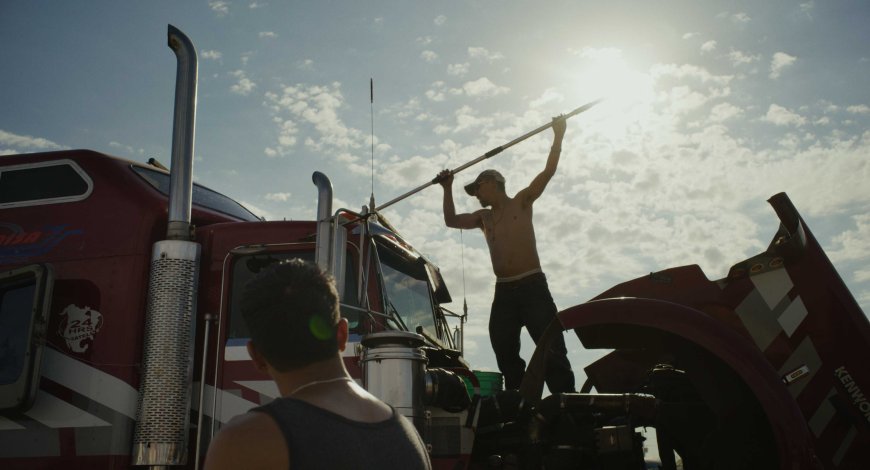
The intense Mexican drama, “On the Road” has the gay Veneno (newcomer Victor Prieto Simental in a phenomenal performance), asking the straight Muñeco (Osvaldo Sãnchez Valenzuela) a trucker, for a ride. Veneno, in turn, offers Muñeco, an addict, drugs as well as a percentage of what they get from selling the coke he is carrying on the road. When their friendship turns intimate, it scrambles Muñeco’s circuits. However, Veneno, who is on the run from a cartel boss, is certainly trouble.
“On the Road” is compelling as the relationship between Veneno and Muñeco unfolds, and the actors have an excellent rapport. But writer/director David Pablos’s film, which won the Queer Lion at last year’s Venice Film Festival, is not a cozy romance. It features moments of grim, gritty realism and savage violence, as well as dreamlike imagery. This tough but mesmerizing road trip, Mexico’s Oscar submission for Best International Film, is a helluva film for adventurous moviegoers.
Pablos spoke with Gay City News about making his impressive gay trucker drama.
What inspired this story and the character of Veneno?
13 years ago, I was in Oaxaca shooting a video for a television documentary series and went to a truck stop. I met truckers and started talking to them and listened to their stories and I was fascinated. I jumped in the truck and saw the world from inside the cab. It is such a masculine world. In Mexico, especially, it has so many unique characteristics. I started to discover the peculiarities — not only about substance abuse, but the difficulty of traveling on the roads in Mexico because of insecurity [e.g., crime]. I started to get obsessed. I thought it would be good idea to have a male love relationship in this context because it is peculiar and very hypermasculine. The premise started with the idea of Veneno, a young man who hides in truck stops because he is running away from something. He feels safe in this place, and he metaphorically finds a father.
Did you know about the gay trucker community, and if not, what research did you do to create such a realistic story?
I talked to many truckers, and I went on the road with one of these truckers and to these road restaurants. It was important to me to experience first-hand what it feels like and these interactions in these places. I did a lot of research with many people mostly around Mexico City and in the outskirts.
There are some gay truckers, but in Mexico, it is rare to find them. Many men, like Muñeco, have had sex with other men, but they don’t identify as gay or bisexual. Once you speak to them, they will tell you they have had sexual encounters with other men and trans women. There is a lot of sex work in the trucker world, and most the sex work is by trans woman.
Can you talk about creating the tone of the film? It feels like a noir, and there are some very striking images, from gasoline being poured on someone, to someone fellating a gun, and more.
A lot of the visual tone of the film comes from the real trucker world. This is something I was fascinated by. There is a lot of neon in the trucks because they are like mobile homes, and an extension of the person. Everyone’s personality is seen on their trucks, and they like to pimp the trucks and have all these lights. It is quite a spectacle when you see all the trucks parked at night. The trucker world gave us an aesthetic. My cinematographer and I stylized some of these visuals, but we tried to keep it grounded. Even the road restaurants can look family friendly, but there are a lot of drugs in most of these places. Other places are like strip clubs. I was fascinated by the variety and the visuals of these places. I took inspiration from Mexican still photographer Yael Martínez. He doesn’t photograph the truck world, but there is something about colors, and saturation of the colors, and the textures of his images that my cinematographer and I really like, so we used his images as reference for the film.
Can you talk about filming the driving scenes? How much of the film did you want to be “on the road”?
It was important to have scenes in the different places in the life of the trucker — the road restaurants, the workshops, the places where there is sex work — in addition to the inside of the truck, where these men spend most of their time. I wanted to show the landscapes of the north of Mexico and Ciudad de Juarez. I grew up in Tijuana, a border city, and I am obsessed with desert and the border wall that separates the U.S. and Mexico. These places give a tone and an atmosphere for the film. Juarez has a lot of truckers. It has a post-apocalyptic feel to it. It is a city in the desert, and it has grown without any structure. There are junkyards, and workshops and repair shops. These places are very beautiful, but also ephemeral. It was also important to capture the life inside the truck. My cinematographer and I talked about being inside the truck as like being in a womb, a place where the men are safe and protected even in the middle of the night. We created that with lighting. We had this very yellow-orange texture to the light. Osvaldo Sãnchez Valenzuela, who plays Muñeco, got his license to drive the truck for the film.
What observations do you have about the ideas of sexuality in this culture?
One of the characters in the film says, “trucking is like fucking.” These are real dialogues truckers told me. They are proud of being truckers, and are like sailors — everywhere they go, they have lovers. Not all the women that work in the road restaurants are sex workers, but they do develop sexual relationships with truckers. As Muñeco says, it is a very lonely world. He says sometimes they need affection. They are open to possibilities, because solitude is difficult to deal with. Most of the sexual encounters happen clandestinely. In some of these encounters, there needs to be some substance — alcohol or drugs — to make them uninhibited. This is what I find fascinating; they don’t think about this that much. They don’t classify their sexuality. They simply live their life like that.
There are some very explicit sex scenes, and the film features a lot of penises. Can you discuss depicting the copious sex and nudity?
Because of the type of film that it is, and the encounters I was portraying, I knew that I couldn’t be timid about sexuality. I had to portray sexuality as it happens for real in clandestinity and how it is expressed in these places. I knew the sex scenes were going to be shot in a very uninhibited way. I was clear about the nudity and sex scenes in the screenplay and when I was casting the film. Part of the discourse of the film is to talk about sex where it is not usually seen, or people don’t realize these things happen because these are machismo places. Some of what is portrayed in the gangster’s palace is real. Homosexuality in the drug world is not mentioned much, but it exists. I heard stories that are really crazy and taboo. People don’t relate homosexuality to cartels, but it was important to portray this diversity in this machismo world.
Likewise, the violence is very graphic. What can you say about depicting the violence in the film?
It is a bloody film. Violence is important in this story. What attracted me was not violence itself, but the violent culture in Mexico that we have been immersed in for many years. Everyday violence has become the norm. It worries me. How do young people in these places grow up seeing life so permeated by violence? Most truckers have been kidnapped or assaulted or had to run from very complicated situations. Violence unites both Veneno and Muñeco’s unsafe worlds. I wanted to normalize violence in this film in the eyes of the trucker and a young man who comes from a part of Mexico that is dangerous. But I didn’t want the violence to be onscreen or be extremely explicit like the sex. Violence happens mostly off screen.
What decisions did you make about the characters’ relationship, which is very complicated?
Even though Veneno is on the run, and could be considered a victim, I don’t think he is a victim at all. He is like a wounded dog, looking for affection. He makes terrible decisions. Veneno is in need of a father, and Muñeco is not there for his wife and children. These men connect through that. Muñeco has sex with Veneno, even though he doesn’t identify as gay. He tries to protect Veneno, knowing that there could be terrible consequences.
How great it is that your horny, violent film about gay truckers was selected as Mexico’s Oscar submission? What does this mean to you?
I am beyond grateful for this. This is not a film you would expect Mexico, a place that is still very conservative, would support. The film premiered here in Mexico a few months ago and we got to #1 on HBO Mexico. It was unexpected and very meaningful. This is not to say there is not homophobia, but people connected with this story beyond the LGBT community. This is exciting for me. The film connects because of the honesty of the characters’ relationship and what happens onscreen between the actors.
When I was making the film in Juarez, I thought: “Who wants to see this film?” Maybe no one? But I want to see this film, and I will shoot it because I want to watch it. It has been beautiful that doing something with conviction has connected with so many people
“On the Road” | Directed by David Pablos | Opening October 28 at the IFC Center | Distributed by Strand Releasing