‘Dreams in Nightmares’: A chosen family vacation for four queer Black friends
Filmmaking is often a form of extraction and exploitation. It can also be an act of kindness. Non-binary director Shatara Michelle Ford’s “Dreams in Nightmares” exemplifies the latter. Dedicated “for all of us,” it forges a road movie about queer Black friendship. Bits and pieces of its ideas have precedents in other films but they … Read More
 Mark
Mark
0
25
Filmmaking is often a form of extraction and exploitation. It can also be an act of kindness. Non-binary director Shatara Michelle Ford’s “Dreams in Nightmares” exemplifies the latter. Dedicated “for all of us,” it forges a road movie about queer Black friendship. Bits and pieces of its ideas have precedents in other films but they haven’t been put together the way Ford does.
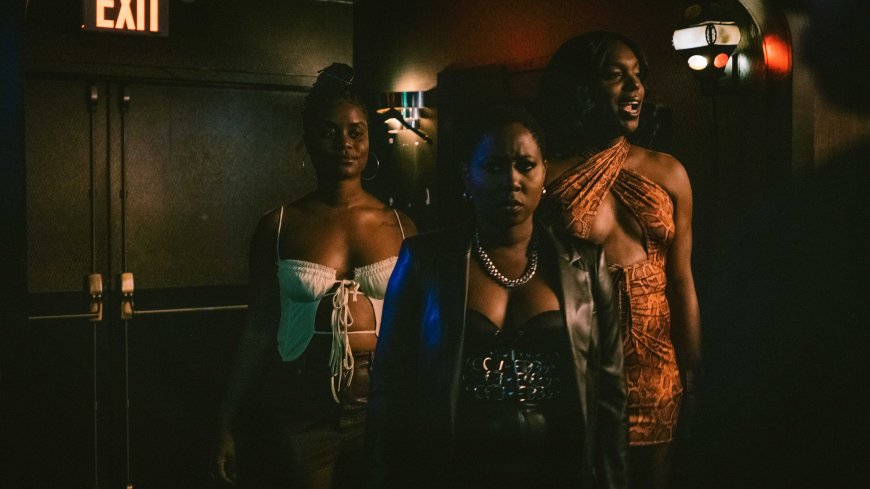
Z (Denée Benton) receives a letter informing her she’s been laid off from her job teaching creative writing. Reece (Charlie Barnett), her partner, sees this as a reason to come closer together. Her friend Tasha (Sasha Compete) has also been fired. Z and Tasha are geographically distant — the former in Los Angeles, the latter in New York — but emotionally close. Tasha’s relationship with her roommate Lauren (Dezi Bing) suffers because Lauren spends her time working unpaid internships and can’t keep up with her share of the bills. Neither of these three women have seen their friend Kel (Mars Storm Rucker), who is non-binary, in months. Kel has vanished with no warning. The group decides to venture out from Brooklyn in search of them, visiting their ex-girlfriend in Iowa City and their parents in Kansas City.
“Dreams in Nightmares” writes its characters into American mythology. Its key image, in which Z gazes out of a dark house’s doorway into a field and mountain, evokes countless Westerns. The possibility of finding freedom on a long car trip runs through the film. So does an acknowledgement that this can be dangerous for Black women. The characters long for a degree of safety they can never quite find in the U.S. Seeking to avoid possible violence, they plan to stop only to eat at Black-owned restaurants. Joss Barton performs her poem “A Gospel For Transsexuals Begging To Get Fucked And Paid” dressed as the statue of liberty, standing in front of an American flag. In the end, liberation might be found by leaving the U.S. behind.
Ford’s debut film, “Test Pattern,” came out in 2021. At the time, it was one of the strongest cinematic responses to the #metoo movement. “Test Pattern” questioned what real accountability for sexual assault means, following a woman whose boyfriend prods her that she get a rape kit. The bureaucratic hostility she faces is maddening, but her partner’s well-meaning insistence turns into an insidious form of control. Like “Test Pattern,” “Dreams in Nightmares” took two years from completion to theatrical release (although the former’s momentum was halted by COVID).
“Test Pattern” came out at a time when the U.S. might have looked as if it were seriously coming to terms with racism and sexism. Its indictment of white liberals suggests why that didn’t actually happen. “Dreams in Nightmares” is opening in a more reactionary climate, where the presence of a Black woman in a blockbuster leads the world’s richest man to spend weeks ranting.
Ford states that “To be timely and instantaneous is tricky work for the medium of cinema these days, as the world is moving faster than the time it takes for a filmmaker to intelligently respond to it. I think about where we are now and I don’t really know what to say.” “Dreams in Nightmares” pulls out hope without burying its head in the sand. It’s particularly canny about the disappearance of middle-class security. The positions Z and Sasha occupy in academia can be swept away with an impersonal letter. While none of the characters are poor, they’re unstable. The cultural capital they receive as artists or teachers don’t pay the bills. Worrying about money generates most of the tension in their lives. Ford’s own existence as an artist working without careerist compromise slips into the fabric of “Dreams in Nightmares.” They went into credit card debt to finance both their films.
“Dreams in Nightmares” incorporates several lyrical interludes, contrasting with the straightforward direction and editing of scenes of conversation. It begins with a montage of Black communities in the south, depicted via black-and-white photos. Along with their labor picking cotton, we see them eating, dancing, and gathering with their families. As uneasy as its characters’ lives can be, “Dreams in Nightmares” values their small and large pleasures. It makes an epiphany out of eating a pastry. This is a chosen family vacation.
“Dreams in Nightmares” | Directed by Shatara Michelle Ford | Lunette | Opens Aug. 21 at the Village East