Give them their flowers: A hippie takeover at the New York Botanical Garden
If you are strolling through the New York Botanical Garden (NYBG) and think you hear the strains of a Grateful Dead, Janis Joplin, or Jimi Hendrix song, no, you are not tripping — although that would be in-keeping with the theme of “Flower Power,” the NYBG’s multisite exhibition until Oct. 18. This takeover of the … Read More
 Mark
Mark
0
28
If you are strolling through the New York Botanical Garden (NYBG) and think you hear the strains of a Grateful Dead, Janis Joplin, or Jimi Hendrix song, no, you are not tripping — although that would be in-keeping with the theme of “Flower Power,” the NYBG’s multisite exhibition until Oct. 18.
This takeover of the Garden buildings and grounds by hippie and psychedelic sounds and symbols pays tribute to that 1960s countercultural movement that took predominantly white, middle-class, young people rejecting the rigid conformity of their parents’ society by storm. Timothy Leary, one of the movement’s oracular figures, issued one of its strongest edicts, “Turn on, tune in, and drop out.” But, what the NYBG would like to highlight is that the Flower Power movement turned on and tuned in to concerns of not only humankind but the environment.
[caption id="attachment_64676" align="aligncenter" width="700"] “Flower Power” at the New York Botanical Garden.Nicholas Boston[/caption]
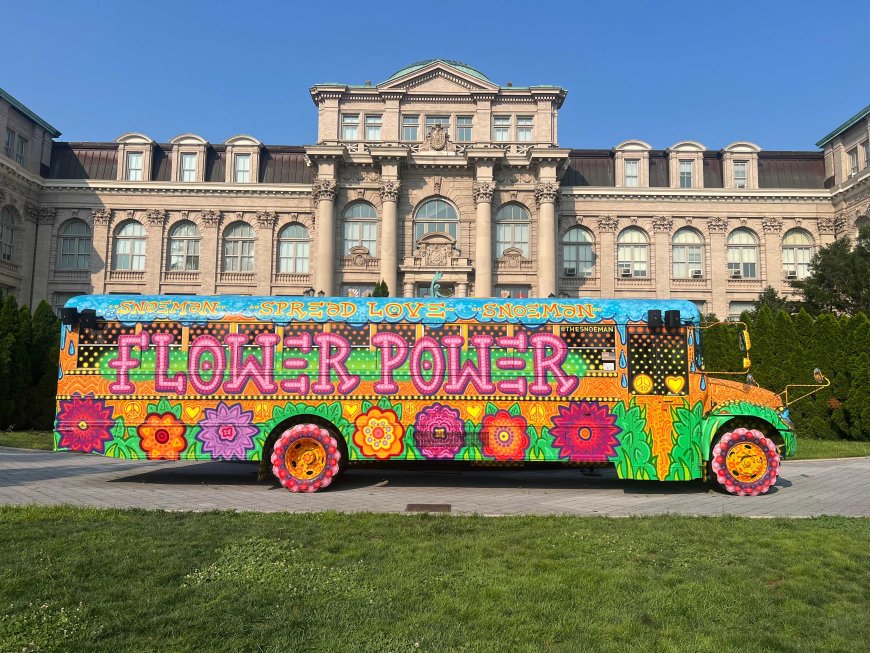
A soundtrack of sixties music blares from inside hollowed out vintage Volkswagen vans, the kind the flower children, as the young adherents of the movement called themselves, zipped around in. The vehicles’ exteriors are brightly designed by Bronx-based artists Blanka Amezkua and Carlos Wilfredo Encarnación-Vazquez. There is also a school bus parked out front of the imposing Mertz Library that has “Flower Power” emblazoned across it in pink, the work of graffiti artist Snoeman. This bus is a take on “Road Hog,” the beloved hand-painted bus belonging to Hog Farm, considered the country’s longest-running hippie commune, out in California. Painted buses like Road Hog transported hippies and flower children to mass gatherings around the country such as Woodstock, the Upstate New York music festival in 1969 whose name alone has come to define the moment.
Inside the Mertz Library, the art gallery features an exhibition of paintings, photographs, screenprints, and collages by artists from the 1960s and early ‘70s, depicting flowers as symbols of peace and love. Andy Warhol’s 1964 creation, “Flowers,” is on view alongside the photograph it was contentiously based on, taken by photographer Patricia Caulfield. There are also archival photographs and newsreel of demonstrations from this period of dissidence: anti-war, desegregation, draft resistance, gay liberation, free love. A reproduction is on display of the 1967 Pulitzer Prize-nominated photograph, “Flower Power,” taken by photojournalist Bernie Boston (no relation to this writer) at the March on the Pentagon to end the Vietnam War, of a protester (believed to be gay liberation activist George Harris III) inserting a carnation into the barrel of a soldier’s gun.
The coining of the expression “Flower Power” is often attributed to queer poet and activist Allen Ginsberg. In a 1965 essay, he urged anti-war protesters to use “masses of flowers” to turn demonstrations into “a visual spectacle.” Ginsberg never publicly explained why he settled on the flower as a symbol, but it likely grew out of his embrace of Buddhist philosophy, common at the time. Consistent with this connection, in the lotus and lily filled courtyard of the Enid A. Haupt Conservatory, an interactive installation created in partnership with the Rubin Museum of Himalayan Art’s Mandala Lab invites visitors to explore their emotions following Zen Buddhist principles.
[caption id="attachment_64677" align="aligncenter" width="700"]
“Flower Power” at the New York Botanical Garden.Nicholas Boston[/caption]
A soundtrack of sixties music blares from inside hollowed out vintage Volkswagen vans, the kind the flower children, as the young adherents of the movement called themselves, zipped around in. The vehicles’ exteriors are brightly designed by Bronx-based artists Blanka Amezkua and Carlos Wilfredo Encarnación-Vazquez. There is also a school bus parked out front of the imposing Mertz Library that has “Flower Power” emblazoned across it in pink, the work of graffiti artist Snoeman. This bus is a take on “Road Hog,” the beloved hand-painted bus belonging to Hog Farm, considered the country’s longest-running hippie commune, out in California. Painted buses like Road Hog transported hippies and flower children to mass gatherings around the country such as Woodstock, the Upstate New York music festival in 1969 whose name alone has come to define the moment.
Inside the Mertz Library, the art gallery features an exhibition of paintings, photographs, screenprints, and collages by artists from the 1960s and early ‘70s, depicting flowers as symbols of peace and love. Andy Warhol’s 1964 creation, “Flowers,” is on view alongside the photograph it was contentiously based on, taken by photographer Patricia Caulfield. There are also archival photographs and newsreel of demonstrations from this period of dissidence: anti-war, desegregation, draft resistance, gay liberation, free love. A reproduction is on display of the 1967 Pulitzer Prize-nominated photograph, “Flower Power,” taken by photojournalist Bernie Boston (no relation to this writer) at the March on the Pentagon to end the Vietnam War, of a protester (believed to be gay liberation activist George Harris III) inserting a carnation into the barrel of a soldier’s gun.
The coining of the expression “Flower Power” is often attributed to queer poet and activist Allen Ginsberg. In a 1965 essay, he urged anti-war protesters to use “masses of flowers” to turn demonstrations into “a visual spectacle.” Ginsberg never publicly explained why he settled on the flower as a symbol, but it likely grew out of his embrace of Buddhist philosophy, common at the time. Consistent with this connection, in the lotus and lily filled courtyard of the Enid A. Haupt Conservatory, an interactive installation created in partnership with the Rubin Museum of Himalayan Art’s Mandala Lab invites visitors to explore their emotions following Zen Buddhist principles.
[caption id="attachment_64677" align="aligncenter" width="700"] The New York Botanical Garden's Flower Power exhibition runs through Oct. 18.[/caption]
[caption id="attachment_64678" align="alignnone" width="525"]
The New York Botanical Garden's Flower Power exhibition runs through Oct. 18.[/caption]
[caption id="attachment_64678" align="alignnone" width="525"] A school bus at the exhibition is a nod to “Road Hog,” the beloved hand-painted bus belonging to Hog Farm.Nicholas Boston[/caption]
Inside the Conservatory, artist Amie Jacobsen presents three sculptural works: a large cluster of flowers in psychedelic colors rising from the pool, a big daisy shape with a translucent globe as its center, and an archway of flowers.
The 1960s were a heyday of poster art. Psychedelic colors and designs merged with political statements and music advertising to produce an original genre of art crossed with advertisement. Artist Eugenia Mello channels this vibe in her series of banners, “Radical Graphics.”
In the courtyard, textile artist Mushaman provides a grouping of hand-painted canopies in trippy colors.
A school bus at the exhibition is a nod to “Road Hog,” the beloved hand-painted bus belonging to Hog Farm.Nicholas Boston[/caption]
Inside the Conservatory, artist Amie Jacobsen presents three sculptural works: a large cluster of flowers in psychedelic colors rising from the pool, a big daisy shape with a translucent globe as its center, and an archway of flowers.
The 1960s were a heyday of poster art. Psychedelic colors and designs merged with political statements and music advertising to produce an original genre of art crossed with advertisement. Artist Eugenia Mello channels this vibe in her series of banners, “Radical Graphics.”
In the courtyard, textile artist Mushaman provides a grouping of hand-painted canopies in trippy colors.
“Flower Power” at the New York Botanical Garden.Nicholas Boston[/caption]
A soundtrack of sixties music blares from inside hollowed out vintage Volkswagen vans, the kind the flower children, as the young adherents of the movement called themselves, zipped around in. The vehicles’ exteriors are brightly designed by Bronx-based artists Blanka Amezkua and Carlos Wilfredo Encarnación-Vazquez. There is also a school bus parked out front of the imposing Mertz Library that has “Flower Power” emblazoned across it in pink, the work of graffiti artist Snoeman. This bus is a take on “Road Hog,” the beloved hand-painted bus belonging to Hog Farm, considered the country’s longest-running hippie commune, out in California. Painted buses like Road Hog transported hippies and flower children to mass gatherings around the country such as Woodstock, the Upstate New York music festival in 1969 whose name alone has come to define the moment.
Inside the Mertz Library, the art gallery features an exhibition of paintings, photographs, screenprints, and collages by artists from the 1960s and early ‘70s, depicting flowers as symbols of peace and love. Andy Warhol’s 1964 creation, “Flowers,” is on view alongside the photograph it was contentiously based on, taken by photographer Patricia Caulfield. There are also archival photographs and newsreel of demonstrations from this period of dissidence: anti-war, desegregation, draft resistance, gay liberation, free love. A reproduction is on display of the 1967 Pulitzer Prize-nominated photograph, “Flower Power,” taken by photojournalist Bernie Boston (no relation to this writer) at the March on the Pentagon to end the Vietnam War, of a protester (believed to be gay liberation activist George Harris III) inserting a carnation into the barrel of a soldier’s gun.
The coining of the expression “Flower Power” is often attributed to queer poet and activist Allen Ginsberg. In a 1965 essay, he urged anti-war protesters to use “masses of flowers” to turn demonstrations into “a visual spectacle.” Ginsberg never publicly explained why he settled on the flower as a symbol, but it likely grew out of his embrace of Buddhist philosophy, common at the time. Consistent with this connection, in the lotus and lily filled courtyard of the Enid A. Haupt Conservatory, an interactive installation created in partnership with the Rubin Museum of Himalayan Art’s Mandala Lab invites visitors to explore their emotions following Zen Buddhist principles.
[caption id="attachment_64677" align="aligncenter" width="700"] The New York Botanical Garden's Flower Power exhibition runs through Oct. 18.[/caption]
[caption id="attachment_64678" align="alignnone" width="525"] A school bus at the exhibition is a nod to “Road Hog,” the beloved hand-painted bus belonging to Hog Farm.Nicholas Boston[/caption]
Inside the Conservatory, artist Amie Jacobsen presents three sculptural works: a large cluster of flowers in psychedelic colors rising from the pool, a big daisy shape with a translucent globe as its center, and an archway of flowers.
The 1960s were a heyday of poster art. Psychedelic colors and designs merged with political statements and music advertising to produce an original genre of art crossed with advertisement. Artist Eugenia Mello channels this vibe in her series of banners, “Radical Graphics.”
In the courtyard, textile artist Mushaman provides a grouping of hand-painted canopies in trippy colors.
Of course, no meditation on the 1960s in America would be complete without a nod to the peace sign. The NYBG exhibit places it front and center. Near the main entrance is a 15-foot diameter one filled with live plants, and nearby is a decorative fence reminiscent of the security fences put up at the Woodstock Festival, with peace signs affixed to it. Interestingly, the peace sign, now so closely associated with the sixties in the United States, was originally created by the Brits as a logo to represent a call to ban nuclear bombs.
As the days of summer dwindle, “Flower Power” at the New York Botanical Garden is an indoor and outdoor exhibition to take in before all the leaves are brown and the sky is gray.
Flower Power | New York Botanical Garden | Through Oct. 18
Nicholas Boston, Ph.D., is a professor of media sociology at Lehman College of the City University of New York (CUNY). Follow him on Twitter @DrNickBoston and Instagram @Nick_Boston_in_New York