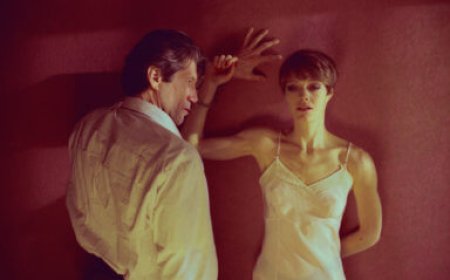
In ‘The Stranger,’ gay director François Ozon adapts a classic French novel
Albert Camus’ 1942 novel “The Stranger” spins around a psychological mystery. Why would Meursault, a Frenchman living in colonial Algeria, suddenly kill a man following his mother’s death? It’s had a long afterlife. Gay director François Ozon’s new adaptation is the third film based on it. The Cure’s debut single “Killing An Arab,” which plays … Read More
 Mark
Mark
0
48

Albert Camus’ 1942 novel “The Stranger” spins around a psychological mystery. Why would Meursault, a Frenchman living in colonial Algeria, suddenly kill a man following his mother’s death? It’s had a long afterlife. Gay director François Ozon’s new adaptation is the third film based on it. The Cure’s debut single “Killing An Arab,” which plays during the closing credits of Ozon’s film, took it as inspiration, with Robert Smith singing “I’m alive, I’m dead/I’m the stranger killing an Arab.” Algerian author Kamel Daoud wrote a novel relating the life of Meursault’s nameless Arab victim, “The Meursault Investigation.”
When “Killing An Arab” received college radio play in the ‘80s, it was sometimes taken for an anthem of racist hatred. Although that wasn’t the band’s intention, the background of French colonialism has come to dominate the book’s more philosophical concerns. A white man who grew up under French rule in Algeria, Camus mirrored his creation. He went on to oppose the country’s independence. A French director taking on this adaptation now has to be aware of the debates around the novel. Without pretending that he can take on an Algerian perspective, Ozon proves to be. His script treats Camus extremely faithfully, with his only additions deepening the roles of Arab characters.
Meursault (Benjamin Voisin) goes through the motions of life, working at a dull office job. One day, he receives a terse telegram informing him that his mother has died. Taking a bus to the nursing home where she lived, he attends her funeral. His coldness disturbs its patients, including her elderly fiancée. When he returns to Algiers, he begins dating Marie (Rebecca Marder), a former co-worker. The two meet up with Meursault’s neighbor Raymond (Pierre Lottin), a pimp who’s been accused of beating an Algerian woman, on the beach. Her brother Moussa and several of his friends see them, and the ensuing conflict ends in Meursault shooting Moussa (Abderrahmane Dekhani). He’s arrested and tried for the crime.
Sometimes, “The Stranger” turns out to be too polished to make its own points. The casting of Benjamin Voisin plays a role in this. He’s worked with Ozon before, appearing in his 2020 film “Summer of 85.” Frankly, he’s too attractive for the part of a man who’s indifferent to every aspect of his life. Such a man would be unlikely to put much effort into his looks. Despite having a girlfriend, one pictures Meursault as a proto-incel. Impeccably handsome, Voisin looks as if he turned up on the set from a fashion runway. Ozon’s direction accentuates this, caressing the actor’s body with slow camera movements. Scenes of Meursault at the beach show off his chest.
It’s tempting to treat Meursault as a person who should have recognizable emotions. Since he doesn’t, is he depressed, neurodivergent, or both? Yet these potential diagnoses can narrow experience down to accepted norms. Voisin’s impressively blank performance avoids all outward displays of emotion. At his trial, this is used as evidence of his guilt. The novel’s opening line is the curt “Mother died today.” Camus’ stripped-down prose was influenced by American crime fiction. When people speak to Meursault, he blinks more often than he replies. As his neighbor says “you must be so sad since she {his mother} died,” he responds less than if he’d been asked if he took out the garbage.
Still, Ozon’s film does gesture towards several rationales for Meursault’s behavior. One is a hint of gay panic. When he confronts Moussa on the beach, the Algerian man brandishes a knife. Just before, the camera glances at his body with unmistakable desire. During the trial, his complicity in French colonialism is brought out. As passive as he is, it’s impossible to ignore the ways in which he aids Raymond’s exploitation of Djemilla. The norm is racism, and he does nothing to challenge it, even if he participates in it unconsciously. Manu Dacosse’s cinematography, which accentuates the extremes of light, makes whiteness a constant visual presence.
Ozon’s “The Stranger” risks turning into a filmed thesis. To its credit, it avoids doing so. Voisin keeps us at a distance from Meursault’s inner life, to the point where one wonders if he even has one. He’s an archetype of so many emotionless, violent men in subsequent books and movies. Up to the point where Meursault finally erupts into an explanation of his state of mind while speaking to a priest, “The Stranger” respects his inscrutability, without shying away from the damage he causes.
“The Stranger” | Directed by François Ozon | Music Box Films | In French with English subtitles | At the Angelika and Film at Lincoln Center