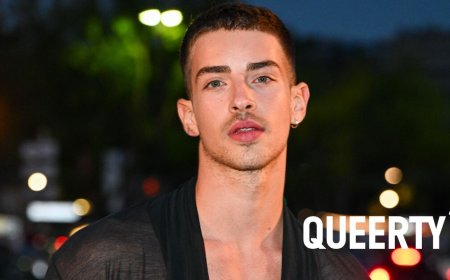
Karan Brar dishes on eerily timely play Data, what he learned from The Disney Channel & bisexual awakenings
The actor opens up about making the jump from screen to stage & what he's learned about himself since coming out.
 Mark
Mark

When Karan Brar first read the script for the acclaimed play Data, he said a certain, much-meme’d moment from Euphoria came to mind: “Wait, is this f*cking play about us?”
The drama finds the actor making his stage debut as Maneesh, a young programmer who he shared an eerie number of similarities with, from his identity & sexuality, right on down to his “coping mechanisms.” And though he admits he used to be intimidated by the theater world, it was enough to feel like a sign: he had to cast those fears aside to be part of the production.
Your dose of fabulosi-TEA
Subscribe to our newsletter for your front-row seat to all things entertainment with a sprinkle of everything else queer.
Subscribe to our Newsletter today
But there’s also the fact that Data is an incredibly timely show, one that holds a mirror up to our own society just as artificial intelligence begins to find a way to seep into every facet of our lives. Written by Matthew Libby (and directed by Tyne Rafaeli, now playing at the Lucille Lortel theatre through March 29), it follows Maneesh during his early days at the fictional yet all-too-real Athena Technologies, where he quickly finds an algorithm he developed is key to the company’s dystopian ambitions.
Tackling urgent questions around AI & surveillance, the play (also starring Justin H. Min, Brandon Flynn & Sophia Lillas), is a fantastic showcase for Brar, one that shows of the breadth of his talents, especially in comparison to the family comedies where he got his start, like Diary of A Wimp Kid series or the Disney Channel sitcom Jessie. In that sense, Data—Brar’s first major role since coming out as bisexual in late 2023—feels like a fantastic full-circle moment for a young actor continuing to step into his power.
With the play & Brar’s bravura performance continuing to wow audiences, we thought it was the perfect time to invite him into the hot seat for our long-running Q&A series, Dishin’ It. In our conversation, he opens up about how multi-cam sitcoms prepared him for the stage, how Data has him thinking about technology in new ways, and the surprising movie that inspired his bisexual awakening.
Is there a piece of media—whether a movie, TV series, book, album, theater, video game, etc…—that has played an important role in your understanding of queerness and the queer community, or your own identity? Why does it stand out to you?
This reminds me of this very specific memory where my friends and I were talking about our sexual awakenings, and I was saying I think I knew I was bisexual when I saw The Proposal, when I saw Ryan Reynolds do the balcony changing scene—I think that was probably one of the most formative pieces of media to impact my identity! There was something about that where I remember I was so confused; I was like, “Is this a thing they do in America? Why do they change on balconies?”—even though they were in Canada, because that’s the whole point of The Proposal. But then I was also like, “Why is this doing something for me?” Because then there’s also Sandra Bullock, and she’s also naked, so they’re both naked. And, yeah, that’s what it probably for me.
Congratulations on DATA and the fantastic reception thus far, a play I hear has been in the works since 2018, yet feels more timely than ever right now. What was your initial reaction to the script, and what made you most excited about being part of it?
Data was my first audition for theater ever. I was always very intimidated to approach theater because I grew up with Kevin Chamberlin [on Jessie,] who’s a three-time Tony nominee, so he really emphasized the intensity around theater, the respect of the craft there, and how there’s this nonchalance around a lot of film and TV actors who come into theater without as much respect for the space. But when I moved to New York, I was like, “Let’s try theater! I think I’m ready.”
So, when I read the play, I very much had that Euphoria reaction, like, “Wait, is this f*cking play about us?” Because the character’s circumstances, his identity, his sexuality, his coping mechanisms, so much of the character was eerily similar to my experiences. So much so that when I was performing the play—there’s a reference to grief, and the timeline that this character is on with processing his grief was the exact timeline that I was on with my processing of that. So now that I’ve had friends see the show, they’re like, “how much of yourself did you put into this?” But no, nothing!
This came to [playwright Matthew Libby] in 2018 when he was graduating from Stanford, looking for internships, and he was ironically very close to an internship at Palantir. And that’s when the idea came from, where he was holding on to all this anger and frustration about this really intense intersection that we cannot seem to escape, or have no reprieve from. And doing this play has really coincided with some very insane life experiences. Originally, this play was supposed to start in 2020—this was way before my involvement—and of course the pandemic happened. And then when we first got it up on its feet for its regional debut, our first preview was when Trump was re-elected, and we were in Washington, DC, so it was a very somber vibe. And in New York, I’ve found that, because of the subject matter, reaction to the shows have changed on a show-by-show basis, depending on what’s going on.
One show, it was a matinee, and everyone was laughing. There are some shows where audiences just find every word you say hilarious, and you’re like, “That’s not a joke, but I’m so glad you’re enjoying it.” But then we did the evening show, it felt like you could hear a pin drop, and you’re like, “Oh, they’re paying attention; they’re just really holding their breath.” And I was speaking to the director Tyne Rafaeli afterwards, and I was like, “Yeah, it’s so strange: we’ve had such different reactions.” And she was like, “Did you hear about Alex Pretti? Check the news.” In between our shows, that’s when that news had broken. It is really depending on what’s in the news cycle that impacts how the piece is received, because it’s that timely.
Has the play had you reconsider your own relationship with technology, or inspired you to change how you use it or what you get out of it?
I think, on a micro level and a personal level, I have noticed the the difference between my generation’s reaction—which is a bit more of apathy—to previous generations’ hyper-vigilance, and this feeling of being overwhelmed, or that they maybe don’t fully understand how data is collected and sold and whatnot. So it feels very doomsday-esque. Whereas my generation will make a joke like, “Oh, I miss my Chinese spy,” or talk about “the FBI agent who’s watching over me,” or whatever it is on TikTok. And so there’s a weird acceptance of just knowing that our data is going to be mined, and that’s just what it is.
I think there are two things that really freak me out. One that we talk about is “black box thinking,” which is something that I found incredibly fascinating during my research of this play: Artificial intelligence, as it progresses and becomes more complex and intelligent, there’s a point where it turns into a black box, similar to a human mind. We can’t fully understand why it’s making the decisions that it’s making, whether it be the correct decision or not, and typically it’s like the programmer themselves don’t even know how it’s able to get to that conclusion. And I think that’s really terrifying. We talk about how, if AI is going to automate decisions for us, we can just ask it how it came to that decision, right? But there’s a point of complexity that is hard to come back from.
The other thing is, I worry about how data & class are going to intersect. I fear that the wealthy will be allowed to opt out of it, in a way, as a luxury, while for people in lower-income households, it will be a given of their circumstances. In the same way that a wealthy family will buy a nice house in a nice suburb and pay for Ring security cameras, and will have these luxuries to feel safer, more secure, whatever it might be—data will be a similar part of that conversation, and thus we will no longer be divided as man and machine, but versus rich and poor.

You’ve been acting on screen for years, but as you mentioned, this is your first time doing theater. Considering how weighty Data‘s themes, and how trenchant it is, what helps you stay focused, emotionally & physically, performing this show live night after night?
The play is very intense, from the visuals, to the dialogue, to how we go from scene to scene. And so, when you’re in it, it almost feels like you’re catching a wave. This play is moving so quickly that you don’t fully always get to sit in each individual moment to reach its deepest depth. We’re moving at such a rapid pace that, actually, every time I do a pass of the show there, there seems to be new things that are illuminated.
And his is the spoiler part of the interview, but this play is centered around immigration. I’m first-generation, and I’m so lucky and fortunate that I get to pull directly from my parents’ life, my life. I’ve been thinking about this unnamed non-image of a person—whichever case officer was overseeing my parents’ immigration—and I think about what flippant thought or what very conscious decision was made to say yes to them. And I think, in that brief moment—whether it be seconds, minutes, hours—there’s a lot of humanity in that. And my parents, I’m really proud of the people they are, and that I’ve been able to explore so many firsts with them. That’s what I keep with me in those moments: of people getting some kind of warm feeling and being like, “I should trust these people; I should give them a chance.” My parents got this chance, for whatever reason, and they’ve been able to soar with me.
More tactically speaking, how I get through it day-by-day, it’s so much asking for advice. Again, Kevin Chamberlain, I was just on the phone with him yesterday, and I feel really lucky! I have a three-time Tony nominee uncle who is willing to jump on the phone with me at any given moment, and he gives the most amazing advice, and he reminds me that this is an ever-changing process.
And as a general thing, what has helped me thrive in any new work environment, is that I do try to jump around a lot. Though many of the big markers of my career are comedic, I’ve been lucky enough to kind of jump around to different formats, mediums, genres. And I always really like to practice radical accountability, and just operating from a place of being like, “let me just assume everyone here is here to help me; that we’re just trying to make the best thing possible.” I care a lot about this piece and what it has to say, and what it has to say is much larger than me and how I deliver any given line.
You and Brandon Flynn share a number of lengthy dialogue scenes where you’re actually playing ping-pong. Marty Supreme, eat your heart out! How did you prepare for these scenes, and what’s the worst way it’s gone wrong, whether in rehearsal or during a live show?
Oh, everything goes wrong! It happens. I think what’s so amazing is working with Tyne Rafaeli—she’s such a brilliant director. And, not to air out too much of her process, but she is kind of like, “let’s just dive deep into the characters.” At one point, she’s like, “I literally don’t care about the ping-pong.” And, mind you, it is a pretty big part of the script! So she just had us focus on these characters and what they have to say. By the time we moved to the theater, we were still trying to figure out, like, “Do I catch the ball here? How do we rally? Where do we want to speed it up?” So, when we were first learning it, we didn’t even think about it—at one point, we didn’t even have a ping-pong ball, we were just miming hitting the ball with these paddles, just so we could get it into our body.
But it’s become this amazing vehicle to relax in a scene, like it gives you something to do, something to engage with. And, for Brandon and I, they were just kind of like, “here’s the ping pong table—you guys got it, right?” So we just kept practicing and practicing. You might think that your ping-pong skills are linear—that you just get better and better—but there are days when you just can’t keep this ping-pong ball on the table. And that’s when I look at Brandon and just go, “I am sorry!” But it’s a lot of grace, a lot of patience, and a lot of practice.

I have to imagine working on a multi-cam Disney sitcom for a number of years was a helpful experience in making the transition to theater. What’s something you learned about yourself as an actor while on Jessie that you’ve kept with you since?
I think the general framework is very, very similar. You know, terms such as upstage, downstage—it’s all part of how old multicam sitcom sets used to be structured: They used to be on a slant, similar to how they are when you’re at a theater, so that the audience can can see the the back of the stage better. So I think that there is a familiarity there, which helps.
But multi-cam is very technical sport. I tell people like, “There’s a music to it, but my job isn’t necessarily to feel like I’m having the most honest performance”—I’m thinking about a million other things. Like, because of working on Disney, as I got older, there was younger cast members that I was working with that were learning how to do multi-cam, which was such a cool experience. I’m thinking about the new line changes that have come in, making sure I’m implementing them while I’m in the scene. I’m making sure that my cast member has their light, that they’re not blocking my light. I’m thinking about, “Op, they accidentally used the old word from an old draft to set up my joke, so now I have to adjust my joke.” And then I’m also thinking about the email that I’m going to send right after I’m done with this take” There are multiple different tabs going on in my head, because it is very musical, it’s very structured.
Whereas the brilliant thing about theater, which I’ve enjoyed, is it is all instinct-based, which is hard to do. Multi-cam, once you get good enough, you read a script, and you’re like, “Okay, this is a crossing line, I know I’m supposed to cross over here, so this is where I land and how I position my body.” And I think the funny thing is that—both Margot Bordelon, who directed the DC run, and then Tyne Rafaeli, who directed this run—is that sometimes I’ll walk into a scene and then I’m like, “Where do I go?” And they’re like, “You can go wherever you want; just feel it out.” It almost feels like a kid walking for the first time, where I’m not used to not being told exactly where to go. So, in some ways, I’ve had to really let go of things that I’ve learned back in the day, and get back to this really true, artistic root of myself.
In terms of something that I have kept with me from those days? It’s the work ethic. I have yet to meet a young person who has left multi-cam that can’t take a note, or that doesn’t know how to work rigorous hours. And I think that’s something I’m always really grateful for. I mean, it’s amplified by the fact that I have immigrant, workaholic parents, but I’m very lucky to say that it was put into me at a young age to rise to the challenge.
A few years back, you shared a beautiful essay about finding yourself after all that you’d been through and embracing your bisexual identity. I think so many of us were so moved by what you wrote, and I hope you felt embraced by our community right back. With that, I’m curious: Where’s one of the first spaces you can remember that made you feel a part of a queer community?
In so many ways, what happened leading up to that essay and what I continued along after its publication, was a really similar journey that a lot of young queer people go through: Every emotional benchmark that their straight peers went through as teenagers, I was having to either revisit or do for the first time. And I think that was also amplified by the fact that I was homeschooled and working at a young age. I’m obviously incredibly grateful for that, but it’s interesting! Like, I knew how to be cordial over emails before I knew how to talk to a guy.
What I’ve been really like grappling with, and what I’ve been navigating is: I think sometimes we conflate coming out as the end point—I think we subconsciously do that—but what I’ve realized is that it’s a beginning, and a really uncomfortable beginning, reckoning with your shame, and coming to terms with the adult you want to be, the person you want to be. And I think queerness adds a beautiful layer of complexity to that. I like to say your 20s are about taking inventory of everything that’s been given to you, and figuring out what you want to keep in which you don’t. And I think that has added to that checklist of looking at every little object that comprises me, and being like, “How much of this is true to me, how much of this is harboring shame,” whatever it might be.
Who is an LGBTQ+ artist/performer/creator that you think is doing really cool work right now? Why are they someone we should all be paying attention to?
I love how I’m in this interview right now and I’ve forgotten every gay person that has ever existed [Laughs.] No, you know this, this isn’t necessarily fair because he’s a good friend of mine, but Nik Dodani! He’s a proud gay man who is really re-defining what it means to be a leading man, all while telling queer stories. I think he’s such a genuine champion of community, and not in a superficial way—like he genuinely is rooting for the people around him. And I would say he inspires me a lot as an artist these days.
Don’t miss Karan Brar in Data, now playing at the Lucille Lortel Theatre through March 29.
Related
Actor Karan Brar says coming out saved him from a “downward spiral”
The former Disney star has found strength in vulnerability since coming out as bisexual.
Sign up for the Queerty newsletter to stay on top of the hottest stories in LGBTQ+ entertainment, politics, and culture.