Queer Belgrade: What to expect in Serbia’s affordable capital
A gay travel guide to Belgrade.
 Mark
Mark

“Why Belgrade?”
It’s a question I was asked several times when I recently decided to make my first trip to Serbia.
I work remotely. Although that might sound blissful to any commuters, the downside is that I end up spending a huge amount of time alone in my apartment in London. At least a couple of times a year, it’s rejuvenating to go and work somewhere different.
Cost is a big factor on where I decide to go for such trips. Serbia is definitely at the more affordable end of the European spectrum.
Pack your bags, we’re going on an adventure
Subscribe to our weekly newsletter for the best LGBTQ+ travel guides, stories, and more.
Subscribe to our Newsletter today
Secondly, I’ve not previously been to a Balkan country. I’ve visited almost all of Western Europe, Scandinavia and the Baltics. This part of the continent intrigued me.
Despite being Serbia’s capital (the city has a population of around 1.2 million, while the wider country is 6 million), I get the feeling that Belgrade remains off the radar for many tourists. When it comes to the Balkans, Croatia is easily the number one choice, thanks in part to its stunning Adriatic coastline.
However, tourism to Serbia is growing. The country reported a 12% uptick in 2024. So, what is there to see and do?
From airport to city
Upon arrival at Belgrade’s Nikola Tesla Airport, travel to the city either by taxi or bus. I opted for the latter, given it cost just $4 (or 400 Serbian dinars). I bought my ticket online the day before I flew, otherwise payment is by cash only to the driver of what turned out to be a minibus into the city.
Somewhat uniquely, I discovered public transport within Belgrade itself is free. This makes it easy to jump on the buses and trams to get around.

The airport bus dropped me off at Slavija Square, a 10-minute walk from my accommodation: The Mercure Belgrade Excelsior. This provided the perfect base from which to explore the city.
My first impressions were that Belgrade felt a little … well, Soviet. However, that was largely down to the signage. Serbia, in common with Russia, shares the Cyrillic alphabet. The city boasts many fine buildings, such as the National Assembly, just across from my hotel. Other parts are more austere, and some are a little rough around the edges: watch out for dodgy paving slabs and high kerbs when walking!
In terms of top tourist attractions, and if the weather is good, head straight for Kalemegdan. The large park contains the Belgrade fortress, which dates back some 2,000 years to Roman times. It occupies a strategic position high above the junction of the Danube and Sava rivers.

The Sava Promenade offers a stunning, elevated view over the waterways and wider city. It was packed on the Saturday afternoon I visited (the park’s zoo is a magnet for local families).
Museums and churches
From here, it’s a short walk to Knez Mihailova, a pedestrian street that runs through the heart of the city and offers shops and cafés. At one end sits Republic Square, where you’ll find the National Museum of Serbia. It offers a history of the country dating back to Neolithic times.

Besides the National Museum, I recommend the Museum of the Nineties. The small exhibition space that offers a non-traditional take on the country’s history during one of its most tumultuous decades. The dissolution of Yugoslavia into six separate countries, and some of the violent conflicts that ensued, is depicted through a range of often ordinary-yet-symbolic objects.
Places of worship might not be on your regular sightseeing list, but Belgrade’s St Sava church is one of the world’s largest Eastern Orthodox churches. It’s extraordinarily ornate, not only for its Byzantine-inspired architecture and soaring central dome, but also for the amount of gold on display.
In common with other orthodox churches, there are no pews. Worshippers must stand. I assumed it was centuries old. Only afterward did I discover that construction began in 1935 and the building wasn’t consecrated until completion in 2004.

Food
The other most-mentioned tourist hotspot is Skadarlija, known as the bohemian quarter. It’s a sloping, cobblestone street that’s full of cafes and restaurants. These compete for custom in the evening. At the foot of the street, across a road, you’ll find Bajloni Market, with dozens of fresh fruit and vegetable stalls.
For food lovers, I also recommend Palilulska Market, which is indoors. Besides its fresh produce, there’s also a range of dining outlets perfect for breakfast or lunch.
Palilulska is next door to one of my favored dinner options, a rustic restaurant named Cevaplija. It’s dark, atmospheric, and very Balkan, with traditional Serbian dishes served on tables adorned with red and white checkered tablecloths. A generous portion of smoked sausage in bread with mustard and onions cost around $6.50, while fried chicken encrusted in cornflakes with spicy mayo was $7.90. Save space for a slice of traditional Vasina Torta, an orange-flavored, layered Serbian cake.
St Mark’s Place (next to St Mark’s Church) is a popular, brasserie-style restaurant. It has a suntrap, outdoor terrace overlooking a large park, and offers a mix of Serbian and Italian dishes.

For lovers of afternoon tea, check out the Hotel Moskva. It’s an early 20th-century landmark dating back to 1908. It’s a sumptuous European grand cafe, complete with ornate chandeliers, heavy drapes, and gold cornicing and coving. I felt transported back to an earlier age as I sat and enjoyed chocolate cake and the tinklings of the hotel pianist.
What about gay life?
It’s not illegal to be gay, and there are some anti-discrimination protections. However, there’s no legal recognition of same-sex relationships. There is an annual Belgrade Pride festival, and the country is one of the few to enjoy a queer head of state: Ana Brnabić was Prime Minister from 2017 to 2024. She was the first woman and first lesbian to take the role.
Despite this progress, the country as a whole remains conservative. Eighty-six per cent of citizens identify as Christians, with almost all of those adhering to the aforementioned orthodox church.
As you may expect, faceless profiles abound on the apps (with Grindr, Planet Romeo and Hornet probably the most popular). There is a queer scene, but it’s small.
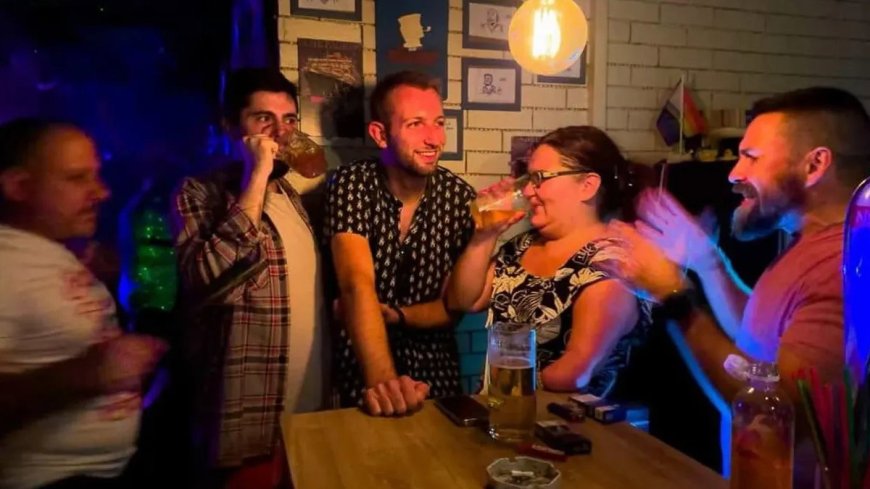
Bar 54 offers a pocket-sized two-floor space. I visited on a Saturday night and found it packed, but then again, it doesn’t take many people to fill it. A red light bounced off a mirrorball while tracks from Madonna, Charli XCX and Calvin Harris wafted from the speakers. It felt a little bit 90s, but that might have also been down to the fact that people were smoking, which is still allowed indoors here.

Guvernanta is a more hipster hangout, featuring kitsch wallpaper, old mannequins and retro furniture. Pink lace covered illuminated white walls. There was a ‘Desperately Seeking Susan’ vibe to the place, aided by the new wave music being played on the quiet Tuesday that I visited (The Police, Culture Club, XTC, etc). It stocked a range of art zines, including some queer stuff. From its social media, it appears far rowdier at weekends, often hosting drag and live music for a mixed male-female crowd.
Mornar and Musk

Mornar (Serbian for ‘sailor’) is buried in a slightly scary underpass. On the night I visited, it was hosting a monthly games night with locals sitting around tables and rolling their dice. Talking to the friendly owner, I was informed that the small venue totally transforms for different nights. The next night was an underwear party, and there’s a regular, monthly bears event.

There’s a weekend nightclub with the evocative name of the Musk Machine, which plays mainly Serbian pop music, and a late-night, post-bar haunt called Mystic. There’s also a gay sauna, Red Line. The cheaper-priced Sunday evening session seems the best night to attend. Like other venues, check Google Maps for reviews and photos detailing how to find these places. Some of them are rather hidden away and far from obvious!
Danube and Museum of Contemporary Art
Toward the end of my trip, I took a bus to Zemunski Kej (Quay) on the Danube. I then walked 3km alongside the riverside to the Museum of Contemporary Art. This stretch is lined with floating restaurants and hostels. The museum itself is light and airy with soaring glass windows.

It featured a temporary exhibition by Serbian sculptor Olga Jevric. I was struck by a quote from her printed on a wall. Discussing the value of art, she said it allows one “to rise above the banality of the everyday”.
Maybe that’s what brought me to Belgrade: A requirement to escape the banality of the everyday. Isn’t that part of the reason we travel? It’s a feeling I suspect many, remote workers or not, will be familiar with.
As such, Belgrade did not disappoint. If traveling from afar, I can also see the appeal of combining a trip here with a couple of stop-offs at neighboring countries, such as the aforementioned Croatia or Hungary. A high-speed rail link from Belgrade to Budapest is expected to be completed by this summer, with a travel time of just over three hours.
Accommodation: Mercure Belgrade Excelsior
The Mercure Belgrade Excelsior is a central hotel located at the edge of Pioneer Park, which lies in front of the State Parliament building. The neoclassical building first opened in 1924. It was originally designed as a clinic but was repurposed as a hotel during construction.
It joined the Accor network in 2017, becoming the brand’s first hotel inspired by Serbian culture. The lobby features Pirot and Sirogojno “ćilim” rugs, national symbols of Serbia, while the restaurant is named after Ivo Andrić, a Serbian Nobel prize winner and former guest.

It offers 73 rooms. My ‘prestige’ room on the sixth floor offered a great view over the neighboring park and city skyline. The color palette was cookie-dough beige, with light wood and flashes of color (a red velvet desk chair, throw cushions, those traditional rug motifs, a De Stijl-style painting). It made for a beautifully serene space, especially at dusk when the setting sun cast a golden glow across the ceiling.
The restaurant serves a plentiful breakfast buffet of hot and cold dishes, and there’s an outdoor terrace on the second floor for the summer months.

Related
Six must-do things to check out on a gay trip to Warsaw
Looking for an affordable, history-packed adventure in Europe? Warsaw may tick your boxes.Here’s how they’re celebrating Pride in Kharkiv, Ukraine, this year
A unique pride event will take place in Kharkiv this weekend.
Join the GayCities newsletter for weekly updates on the best LGBTQ+ destinations and events—nearby and around the world.