AARP New York hosts panel on the future of Social Security
Concerned that Social Security could soon turn into “Social Insecurity” amid declining funds, older residents recently united to say no to cuts. Schneps Media, PoliticsNY and the Bay Ridge Courier presented on Sept. 29 “Protecting the Promise: A Social Security Forum” sponsored by AARP New York, at the Greenhouse Cafe in Bay Ridge, Brooklyn,… Read More
 Mark
Mark
Concerned that Social Security could soon turn into “Social Insecurity” amid declining funds, older residents recently united to say no to cuts.
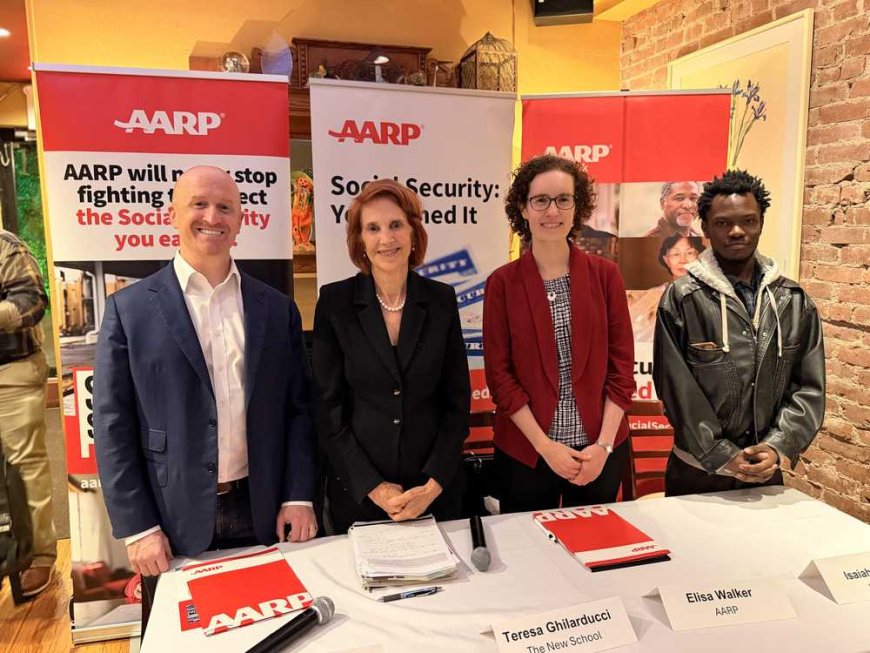
Schneps Media, PoliticsNY and the Bay Ridge Courier presented on Sept. 29 “Protecting the Promise: A Social Security Forum” sponsored by AARP New York, at the Greenhouse Cafe in Bay Ridge, Brooklyn, during which federal officials discussed the perilous future of Social Security.
According to the officials, Social Security will no longer be able to fully pay benefits in six years without meaningful action by Congress and the president. The Social Security Board of Trustees said by the third quarter of 2032, unless Congress acts, Social Security’s trust will be depleted so the program would be able to pay about 83% of benefits.
Schneps Media CEO Joshua Schneps led the panel seeking solutions to ensure Social Security solvency while “we all realize the cost of living is rising.”
Social Security paid $1.6 trillion benefits to 70 million people in 2025, with around 185 million people paying payroll taxes contributing to the social safety net.
“Social Security is the peace of mind that comes from knowing you can meet those everyday expenses and maintain your independence,” AARP New York State Director Beth Finkel said. “If you cut Social Security, you still have costs. Nobody’s giving you a 20% discount on fuel, utilities or food.”
The Social Security trust fund, meanwhile, is about $2.56 trillion after declining $150 billion in 2025, representing a shrinking pot at the end of retirement’s rainbow.
“When you cut Social Security, that affects real people, and their families, where they shop and their communities,” said AARP Government Affairs Director for Social Security Elisa Walker.
She said AARP “100% believes it’s possible to strengthen Social Security” without cutting benefits for current or future generations of seniors.
New York Public Interest Research Group Student Board Representative and CUNY student Isaiah Davis said this affects young and old.
“It’s an inter-generational issue,” Davis said. “A lot of people in my generation don’t even see retirement as a feasible option.”
Deja Vu
The last major Social Security reform took place in 1983, when Congress approved a reduction in benefits and raised the full retirement age for Social Security from 65 to 67. Retired seniors can receive a reduced Social Security benefit as early as 62 years old.
“There was nothing in that bill to make sure there were jobs for older people,” Teresa Ghilarducci, Labor Economist and Chair of Economic Policy Analysis at The New School for Social Research, said. “The idea that you can merrily roll along and tell your employer when you want to retire isn’t true.”
Today, about half of retirees have little or nothing in their 401(K) where the median amount is $100,000, which Ghilarducci said amounts to “a dinner and a movie for the rest of your life.
“What they thought would happen 40 years ago when they cut benefits didn’t,” Ghilarducci added. “If the Reagan cut didn’t happen, people today would get 19% more on average.”
There was a 2005 fight about privatizing Social Security like a 401(K) invested in the stock market, leading to catastrophe if the market crashes. Ultimately, the privatization gambit was stopped.
“There was a huge public outcry,” Walker said. “It became such a liability for politicians that they ultimately had to drop that idea, which we occasionally hear people floating now.”
Walker said “raising the retirement age again brings a lot of pain and not much money,” potentially raising a quarter of what’s needed.
The Big Problem
With Social Security facing a fall off a financial cliff, residents called for closing the gap to protect retirees from a shock to the system.
“People depend on Social Security,” said 71-year-old Bronx resident Ralph Rivera. “They want to take it away, cut down on it. Everybody else is flourishing.”
Troy McGhie, a 58-year-old Staten Island resident and special education teacher, said people expect the full promised benefit.
“Reductions in Social Security are fundamentally wrong," McGhie said. “People have been paying into this for years. It’s their money that when they went into it they were expecting to be there at the end.”
Social Security, others said, is not an “entitlement” — but money earned by those who worked their lives and paid payroll taxes to support the program.
“We all own Social Security. Every one of us has been paying into the trust,” Finkel said. “Congress has to come together and finally come up with a fix.”
The Big Fix
Walker said some people talk about mixing benefit cuts and revenue increases, but said the time had come to raise new revenue for Social Security.
“There are a lot of ways you could change Social Security’s financing structure from other sources of income,” Walker said. “The math is really not that hard. It’s more a question of priorities and political will.”
She said higher earners stop paying into Social Security when income reaches a certain level, currently around $180,000.
“Everybody else pays all year long on every dollar,” Walker said. “If you change that, it could easily close half or more of Social Security’s long-term shortfall.”
Ghilarducci said Elon Musk earns that in about 36 minutes before stopping paying into the fund.
“We’re talking about having everybody pay until the end of their year on all of their earnings,” Ghilarducci said.
Some residents agree removing or raising the cap could help seal the hole in the Social Security ship.
“The fix to the problem is having people paying in,” McGhie said. “Everyone pays a flat percentage into Social Security. It stops that tax cap.”
Social Security could apply beyond wages to investment income or capital gains. “Perhaps taxing other types of income,” Walker said.
Ghilarducci said legislators need to make the Social Security shortfall an issue. “We need their voices to be loud, for them to know what their interests are,” she said.
She said politicians who say they won’t “touch” Social Security may mean they won’t stabilize the fund.
“Not touching it is running out the clock,” Ghilarducci said. “Doing nothing devastates households and the economy.”
She believes it’s important to support and stabilize a program on which millions depend.
“If we don’t support Social Security for workers working now, we are burdening a generation less likely to own houses, more likely to face job displacement,” Ghilarducci said. “We’re going to hurt the generation that has more student debt and will probably face a lot of problems with employment insecurity.”