‘Be out and proud’: Brooklyn queer lawmakers highlight the importance of Pride Month
At a time when LGBTQIA+ rights face mounting challenges from the federal government and state legislatures across the country, Pride Month has become more than a celebration of the contributions of lesbian, gay, bisexual, transgender and queer communities. It has also taken on added urgency as efforts to roll back protections continue to grow.… Read More
 Mark
Mark
At a time when LGBTQIA+ rights face mounting challenges from the federal government and state legislatures across the country, Pride Month has become more than a celebration of the contributions of lesbian, gay, bisexual, transgender and queer communities. It has also taken on added urgency as efforts to roll back protections continue to grow.
Brooklyn Paper spoke with two queer Brooklyn lawmakers about the meaning of Pride Month and the importance of continued advocacy for the LGBTQIA+ community amid what they described as an unprecedented wave of anti-LGBTQIA+ legislation nationwide.
State Sen. Jabari Brisport
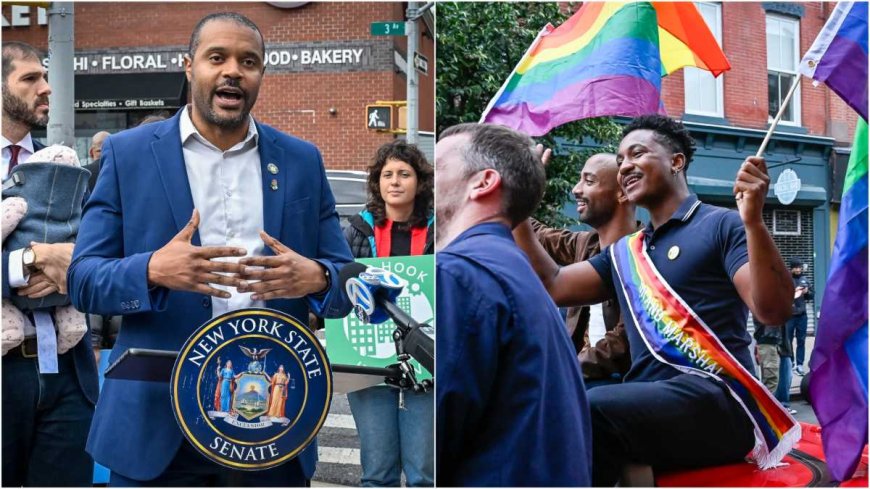
State Sen. Jabari Brisport, whose district includes parts of Fort Greene, Crown Heights and Bed-Stuy, is the first Black openly gay person to serve in the State Senate and one of only two openly queer state senators.
At the beginning of Pride Month, Brisport, who chairs the Committee on Children and Families, delivered a passionate speech on the Senate floor after the legislature passed a resolution recognizing June as LGBTQIA+ Pride Month in New York State, telling anti-gay critics “to give it up.”
He told Brooklyn Paper that Pride Month is an opportunity to celebrate the resilience of the LGBTQIA+ community while paying homage to queer trailblazers like William Dorsey Swann, Marsha P. Johnson, Sylvia Rivera, Harvey Milk and Cecilia Gentili, noting that their legacy continues to shape the movement and encourage LGBTQIA+ people to keep pushing forward.
“Pride is a chance to celebrate the history of resilience in the community,” Brisport said. “Being unashamed and unabashed to be who we are, to be out and proud, and to celebrate the historical figures whose shoulders we stand on.”
[caption id="attachment_245048" align="alignnone" width="700"] For State Sen. Jabari Brisport, queer visibility is a powerful form of resistance.[/caption]
Brisport said the queer community is deeply concerned about the future of LGBTQIA+ rights, but noted that queer visibility remains a powerful form of resistance.
“First and foremost, being out of the closet is a major step that any queer person can take," Brisport said. "That was something that Harvey Milk beat the drum on a lot: that every time you come out of the closet, you normalize it, you make it something that is closer to home for your entire circle of family and friends, and you make it easier for other people to come out of the closet."
He recalled an experience from his years as a teacher that underscored the importance of coming out. While working as a teacher, Brisport launched his campaign for State Senate. His election win garnered significant media attention, as he was the first openly queer person of color ever elected to the New York State Legislature. He said that one of his students, who used to make anti-trans jokes in class, later apologized and told Brisport that because of him, they had found their identity.
“They had done more soul-searching and realized that they themselves were non-binary, and that's the power of just being an out and proud politician,” Brisport said.
For Brisport, Black and queer identity have long been intertwined, and he encourages young queer people considering a career in politics to “dive right in,” using their identity as an entryway.
“I kind of started in these places of identity of what is the struggle of queer community, what is the struggle of the Black community, and those snowballed into greater and greater political activism, and [now] I'm a senator,” Brisport said.
Brisport’s political career began in college when he organized grassroots support for New York's same-sex marriage legislation in 2009. At the time, same-sex marriage was far from politically popular, and his first major political campaign failed when the New York State Senate voted down marriage equality in 2009.
He admitted that he wanted to give up, but fellow activists urged him to continue organizing. On July 24, 2011, the Marriage Equality Act took effect in New York State.
“That taught me that if you believe your cause is just, you have to keep banging the drum on it. You may get your butt kicked the first time, but if you keep on doing it and keep organizing, you can eventually win,” Brisport said, noting the importance of continuing to push for morally just causes, even when they seem unpopular.
[caption id="attachment_245051" align="alignnone" width="700"] Pride Month is more than a celebration of the LGBTQIA+ community — it highlights the importance of protecting queer rights.File photo by Gabriele Holtermann[/caption]
Brisport expressed disappointment that the push for higher taxes on New York’s top earners failed and warned that recent cuts to Medicaid and Medicare will disproportionately affect queer communities, which already face higher rates of health care and housing insecurity, as well as economic instability compared to cisgender and straight people. Nearly 2 in 3 transgender people live in poverty.
“We had a real opportunity to raise taxes on the wealthy, to plug the gaps in Medicaid, and keep hundreds of thousands of New Yorkers insured, but that unfortunately couldn't get past the governor in the state's budget process, and we have a real issue coming down the pike with a lot of New Yorkers, including many queer New Yorkers about to lose their health insurance,” he said.
He emphasized the importance of leveraging state and local governments, as well as nonprofits and mutual aid groups, to protect LGBTQIA+ New Yorkers, citing the Trans Safe Haven Act and organizations such as the Brooklyn Community Pride Center and Black and Pink. Brisport also praised SAGE, which was part of a DEI-related lawsuit against President Trump that successfully overturned an administration-wide freeze on federal grants and contracts intended for diversity, implicit bias and equity-focused programs, and the GRIOT Circle, a Brooklyn-based multigenerational organization supporting LGBTQ+ elders of color, which Brisport has supported with discretionary funding.
“I think it shows the uniqueness of us; the focus on queer New Yorkers of color, too, which is something that has not always been first and foremost in the queer rights movement,” Brisport said, noting that during state budget negotiations, he fought to include $500,000 for the LGBT Center to expand its mental health services for LGBTQIA+ members.
“Not many people are talking about mental health for LGBTQ people, so we're getting them about $500,000 for mental health services at a time when so many people in the community feel attacked. I think it would not have happened if you did not have queer state senators in the room."
The best advice Brisport received came from a fellow actor in “another life” when he was pursuing an acting career, who referred to the entertainment industry as a “big wheel” that keeps on turning.
“If you don't get picked for something, it's because it's simply just not your time in the wheel, but the wheel will keep on turning, and I think that applies to politics too," Brisport said. "Sometimes you don't get it at first, but you keep going for it. If you really believe in it, you'll eventually succeed."
Council Member Chi Ossé
Council Member Chi Ossé represents Bedford-Stuyvesant and North Crown Heights and is co-chair of the Brooklyn delegation and the LGBTQIA+ Caucus.
Ossé told Brooklyn Paper that Pride Month was not only about celebrating the queer community, but also served as a reminder that the fight for equal rights continues, urging New Yorkers to organize and advocate for LGBTQIA+ people.
“Now more than ever, as we're seeing so much of our queer siblings attempted to be erased by this fascist far right government, I find this month to be a month where we recognize our existence, but also hone in on the action steps that need to be taken in order to protect us,” Ossé said.
[caption id="attachment_245049" align="alignnone" width="700"] Council Member Chi Ossé (right) said Pride Month recognizes queer existence but also calls for action to protect the LGBTQIA+ community.File photo by Gabriele Holtermann.[/caption]
He noted that state and local government legislation — such as expanding access to affordable gender-affirming health care, making the city more affordable for queer New Yorkers, particularly trans people, and creating a shelter system that supports trans and queer youth — were instrumental in ensuring the city remains a safe “haven” for the queer community. LGBTQ+ youth are more than 120% more likely to experience homelessness than their non-LGBTQ+ peers and make up as much as 40% of all youth experiencing homelessness.
“Those are various different ways that we can step up and support our community,” Ossé said.
Queer representation in state and local government matters more than ever, and one of Ossé’s top priorities is ensuring the city is affordable for queer New Yorkers, as New York City — particularly Brooklyn — serves as a sanctuary for the LGBTQIA+ community. Last year, the City Council’s LGBTQIA+ Caucus was instrumental in securing more than $13 million, a record amount, for gender-affirming care for trans youth, LGBTQ youth services, and funding for the Trans Equity Fund, which supports trans-led organizations.
“Without us being in the respective seats that we are in, I don't think there would be people who would be advocating on behalf of trans people as much as we were," Ossé said. "I truly believe that that representation has translated into dollars that are allocated to save and protect and keep trans people alive."
When Ossé ran for City Council in 2020, he openly embraced his identity, and he advised young people who are afraid to come out because of family dynamics or where they live to find a community that embraces queer people.
“Ensure that you are being safe in your process and find a community, whether it's in New York City [or] whether it's in whatever town you're in. If it's not in the town you're in, I would urge you to come to a place that’s a safe haven, so that you could live freely and live safely and be yourself,” Ossé advised.
The most important lesson Ossé learned from the queer rights movement was the importance of intersectionality. He noted that LGBTQIA+ rights trailblazers not only fought for queer rights but also against racism and misogyny while advocating for queer people in countries living under oppressive regimes.
“You can't just fight for rights for gay people, you need to fight for rights for all queer people. You can't just fight for rights for white gay men, you have to fight for the rights of Black queer women [and] Black trans women," Ossé said. "Those are the lessons that I have learned through the queer civil rights movement, especially as it's progressed throughout the years."