Two women fall in love inside a horror movie in ‘Teenage Sex and Death in Camp Miasma’
Filmmaker Kris (out bi actor Hannah Eimbinder) was changed forever by looking into another woman’s eye. When she was 8, she watched the slasher film “Camp Miasma.” One image stuck with her, shaping her views of sex and gender. In it, the camera focuses on the eye of a girl having her first orgasm. As … Read More
 Mark
Mark
0
33
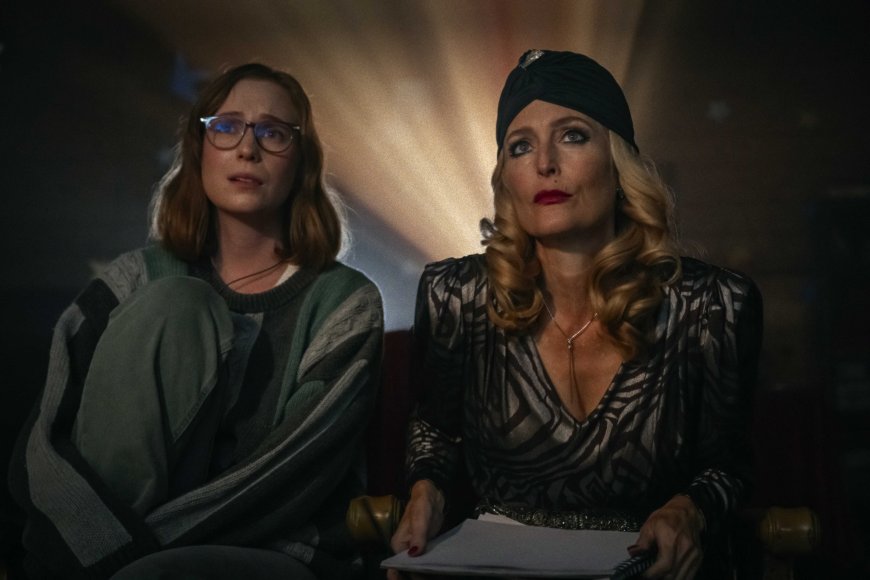
Filmmaker Kris (out bi actor Hannah Eimbinder) was changed forever by looking into another woman’s eye. When she was 8, she watched the slasher film “Camp Miasma.” One image stuck with her, shaping her views of sex and gender. In it, the camera focuses on the eye of a girl having her first orgasm. As she moans, a knife-wielding killer is visible in her pupil. Non-binary director Jane Schoenbrun’s “Teenage Sex and Death At Camp Miasma” gets extremely meta, musing on the uses LGBTQ people make from images intended to be hostile to us.
Seeking to remake “Camp Miasma,” Kris goes to visit its set. Despite its many sequels, the original final girl, Billy Presley (Gillian Anderson), dropped out of Hollywood after the first film. Becoming a recluse, she now lives at the camp used as its set. Heavily made-up, Billy exudes an old-fashioned glamour. She doesn’t fully understand the much younger Kris. However, they’re clearly attracted to each other. Schoenbrun’s film includes a long section representing the original “Camp Miasma,” in which teenage counselors are hunted down by serial killer Little Death, who presents as a boy and girl on alternate days. It’s full of the clichés and stereotypes of slasher movies: Little Death’s first victim is a punk stoner girl. The images of murder are phallic and sexualized. Kris and Billy come to believe that these fictions contain a literal truth.
All three of Schoenbrun’s features address dependency on media: the Internet in “We’re All Going To the World’s Fair,” television in “I Saw The TV Glow,” and film in “Teenage Sex And Death At Camp Miasma.” Entering a portal where it’s possible to live within a movie, “Teenage Sex And Death At Camp Miasma” maintains its air of unreality. From the very start, it establishes itself as a fantasy. Characters from “Camp Miasma” continue their roles in the real world. Kris walks past a painted forest. Nature is represented only via art. “Camp Miasma” luxuriates in sub-Tom Savini kills, with geysers of CGI blood. Its murders are entirely removed from the reality of violence, except when they become an expression of trans panic.
On the surface, Kris is more savvy than any other Schoenbrun protagonist. As a filmmaker, being a queer woman has actually helped her career (even at the price of tokenism). She scoffs at the idea of marriage, living in a polycule. She’s able to create the kind of images that have shaped her life. Despite all this, she remains unhappy and repressed, burying herself in work. She can speak about gender, sexuality, and film in terms of critical theory, but she needs a great deal of help to actually live on her own terms. Until she meets Billy, she doesn’t realize this.
While the second half demonstrates its imagination, “Teenage Sex And Death At Camp Miasma” carries a nagging feeling that Schoenbrun may have begun repeating themselves. Like so many recent horror films, it tends to spell out its ideas bluntly, placing some in Kris’ mouth. Kris’ position in film culture, as a “Sundance wunderkind,” mirrors Schoenbrun’s own. Although they have been more successful at working on their own terms, they must’ve taken embarrassing business meetings where they were asked to make an “elevated” and “woke” horror reboot.
“Teenage Sex And Death At Camp Miasma” is loaded with references any horror fan should get. It feels as though it was made to speak to several audiences at once, bringing out the queer and trans potential latent in even the most conservative ‘80s horror. Ray Blanchard, a sexologist who came up with the transphobic theory of autogynephilia, is billed as the director of “Camp Miasma.” Since I’m cis, I know I missed many more such in-jokes. It restages the scene in “Videodrome” where James Woods’ stomach opens in a vaginal slit to accept a videotape. “Camp Miasma” is based on “Sleepaway Camp,” which might now be forgotten if not for its transphobic twist ending. Derided by many trans spectators, it’s also become a cult film in the community. More generally, slasher movies tended to feature androgynous male killers and female heroes. Kris and Billy’s names reflect this trait.
This isn’t “Sleepaway Camp” fan fiction. Schoenbrun’s ideas extend beyond other movies. Criticisms that their work can’t imagine life outside pop culture aren’t entirely inaccurate, but “Teenage Sex And Death At Camp Miasma” dramatizes the struggle to enjoy sex when that culture equated it with death. Rather than condemning these images, Schoenbrun seeks to transform them.
“Teenage Sex And Death At Camp Miasma” follows the notion that the male gaze requires women to see themselves through images of other women created for male pleasure. Dripping with love for ‘80s horror films, it also suggests how much human experience they treated as monstrous or left out. It finds as much space for happiness as possible within a trap.
“Teenage Sex And Death At Camp Miasma” | Directed by Jane Schoenbrun | MUBI | Opens August 7 at the Angelika and AMC Lincoln Square