‘Free Leonard Peltier’: An infuriating documentary about an imprisoned activist
The title of “Free Leonard Peltier” doesn’t tell the full story. This documentary takes on a wider scope. The Native American activist’s 50-year imprisonment on trumped-up murder charges becomes a vehicle to relate the American Indian Movement’s history. Gay director David France and indigenous filmmaker Jesse Short Bull helmed “Free Leonard Peltier” together. France, who … Read More
 Mark
Mark
0
2
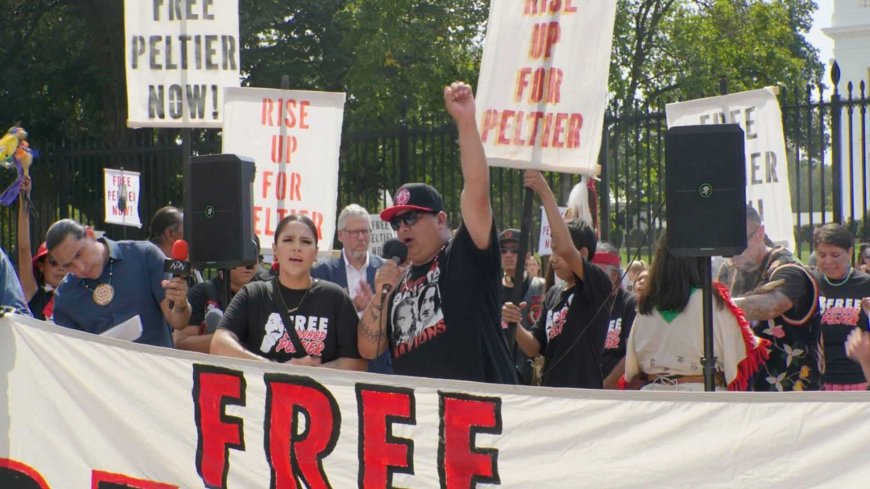
The title of “Free Leonard Peltier” doesn’t tell the full story. This documentary takes on a wider scope. The Native American activist’s 50-year imprisonment on trumped-up murder charges becomes a vehicle to relate the American Indian Movement’s history. Gay director David France and indigenous filmmaker Jesse Short Bull helmed “Free Leonard Peltier” together. France, who worked as a journalist for “New York” magazine, took on ACT UP’s history in his book and movie “How To Survive A Plague.” Without departing much from a format of archival footage and interviews, “Free Leonard Peltier” moves forward with panache, although its early sections are a bit overloaded with information. The complex story of the AIM calls for a little more time than “Free Leonard Peltier” can give it in 105 minutes.
“Free Leonard Peltier” begins in the late ‘60s, when it seemed as though the fight against racism could lead to radical change in the US. Native Americans demanded control over their own destinies. Like many indigenous people his age, Peltier was sent to a boarding school, intended to strip them of their culture and force assimilation. The community’s official leaders collaborated with the US government. After joining the AIM, Peltier participated in a protest on the Pine Ridge Reservation. After two FBI agents were killed, he was one of four people charged with their murder. Although he fled to Canada, the Feds forced his extradition, relying on testimony from a woman who lied that she was his girlfriend. One of the jurors expressed open racism against Native Americans. His argument that he was tried and convicted for his political practices rings true. On Jan. 19, 2025, Joe Biden commuted his sentence to house arrest. Since this occurred days before the film’s premiere, Short Bull and France quickly shot and edited new footage.
Peltier became a cause celebre in the ‘90s. Joni Mitchell and Willie Nelson performed at a benefit for his release, while “Free Leonard Peltier” shows actor Peter Coyote speaking out on him. Rage Against The Machine’s “Freedom” envisioned him painting in prison, still a rebel. Its music video brought his case to MTV, using clips from Michael Apted’s documentary “Incident At Oglala.” Political and religious figures like Jesse Jackson, Desmond Tutu, and the Dalai Lama also championed his cause. These efforts came to a head when Bill Clinton considered granting Peltier clemency. According to “Free Leonard Peltier,” pushback from the FBI dissuaded him from following through.
Due to his 50 years in jail, Peltier becomes an absence in the documentary. Short Bull and France filmed new interviews with fellow activists who were at Pine Ridge, but they couldn’t speak to Peltier on camera. Making use of a collection of historical interviews, this difficulty in accessing him directly pushes the film further towards showing the movement as a whole. Short Bull and France were able to get an inside look at the final fight for the commutation of his sentence.
The credits reveal that the filmmakers used generative AI to make reenactments more believable and boost recordings of Peltier’s voice, with his permission. Their recreations are tinted green and purple, but they’re also put through a filter simulating the look of ‘70s video. Without knowing the production’s details, it’s impossible to tell what it added to these scenes that couldn’t have been achieved with conventional staging and special effects. As critic Daniel Fienberg noted, “the reenactments have no notable visual aesthetic and add very little information.” If Peltier approved AI’s enhancement of his voice, it still feels questionable to use the technology to come up with new images of a historical event. Silicon Valley has proven it’s no friend to artists or leftists. Data centers have contributed to pollution affecting communities of color. Is it justifiable to use generative AI in a film advocating for Peltier’s cause at all?
“Free Leonard Peltier” isn’t a feel-good story of justice triumphing. Peltier couldn’t attend the IFC Center’s advance screening in person because he’s prohibited from traveling. Clinton might have pardoned him had he been willing to denounce the AIM. The structure can’t help build towards a moment of excitement, but Peltier’s frailty is sobering. The last decade has pretty definitively shown the arc of history doesn’t necessarily bend towards progress. Peltier’s release from jail into a less arduous form of incarceration is the bare minimum.
If the directors weren’t so pressed for time, what would he have to tell them about the decades he lost and his plans for the future? Despite some missteps, “Free Leonard Peltier” forges a damning indictment of what justice really means in the US.
“Free Leonard Peltier” | Directed by Jesse Short Bull and David France | Available on Netflix Oct. 12