In ‘Girls Like Girls,’ Hayley Kiyoko turns from sapphic pop star to filmmaker, telling the same story
Coming-of-age stories are a perennial in LGBTQ cinema. Even in the most accepting environment, a queer teenager’s first experiences of love and sex have an inherent drama. As time passes, these types of films have remained popular even while the larger culture changes. They can be a marker of those shifts. Lesbian musician Hayley Kiyoko’s … Read More
 Mark
Mark
0
28
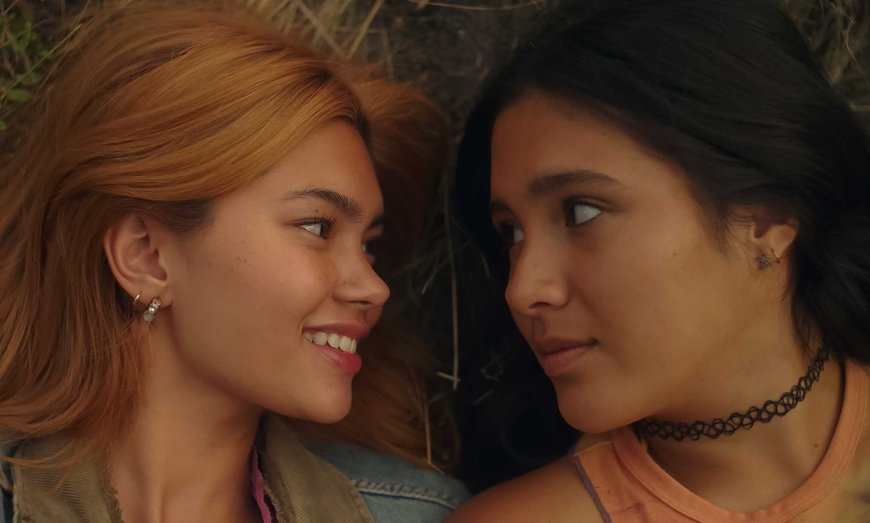
Coming-of-age stories are a perennial in LGBTQ cinema. Even in the most accepting environment, a queer teenager’s first experiences of love and sex have an inherent drama. As time passes, these types of films have remained popular even while the larger culture changes. They can be a marker of those shifts. Lesbian musician Hayley Kiyoko’s directorial debut, “Girls Like Girls,” bears a minimum of anxiety about sexuality. Her protagonist struggles with her share of problems, but they’re caused by difficult relationships with her girlfriend, father, and late mother. If not exactly subtle, ‘Girls Like Girls” leaves a lot unsaid.
Following the death of her mother, Coley (Maya da Costa) has come to Oregon to live with her father Curtis (Zach Braff.) Her parents separated when she was young, and Curtis played a minimal role in her life until recently. She hangs outside with a group of local teenagers. Sonya (Mary Molloy) catches Coley’s eye, although Sonya’s tentatively dating Trenton (Levon Hawke). She remains part of Coley’s social circle. When finally alone together, the two make out, exploring their attachment to each other. Coley falls hard for Sonya, but the latter remains a little distant, keeping her options with Trenton open. After Sonya heads out of town, Coley tries to reconcile with Curtis.
“Girls Like Girls” has gone through four incarnations across media: a song, music video, book, and now a film. Although I didn’t know Kiyoko adapted it from her own YA novel as I was watching it, that aesthetic pervades it. (It could have been the source for a CW show from the 2000s.) It plays as though as it was made for girls the age of her characters, while their parents would also feel comfortable watching it with them.
The film’s set in 2006, when the Internet was popular, but before it came to dominate society. Coley and Sonya chat with each other on AOL. Only glimpsed a few times, cell phones are actually used to make calls. Coley listens to Tegan and Sara on an iPod, and her computer is big and old-fashioned. If this is surely an appeal to nostalgia, it also reflects the period when Kiyoko, who was born in 1991, grew up. She lived through this era as her characters do. Coley’s biracial background reflects Kiyoko’s own heritage: The director’s mother is Japanese-Canadian, while her dad is an American with ancestry from the U.K.
Kiyoko’s camera takes the point of view of her characters, looking at each other with desire. On group excursions to go swimming, the two girls’ glances speak a private language even amidst a crowd. The boys around them are unaware of their connection. Even though it’s set in Oregon but shot in British Columbia, the locations have a genuine flavor. The cinematography brings a misty light to summertime in the Pacific Northwest.
For a film by a musician, it’s ironic that its greatest weakness is its score. Jessica Rose Weiss attempts to heighten the emotions of the most fraught scenes. Her strings emphasize longing and conflicts that were already there. They push us in the path of feelings instead of contributing to them. This plays worst in a post-credits scene, where the music actually takes away from a moment of heightened emotion. The soundtrack’s deployment of indie pop songs, including new music by Kiyoko, works far better, particularly since they’re presented as a part of Coley’s life, not something laid on top of it.
The scenes about Coley and Curtis’ struggle to connect as a family don’t hit as hard as the ones about her relationship with Sonya. The film reveals details of a backstory in small installments, never giving us the full picture. Curtis says that Coley’s mother had “very high highs and very low lows.” “Girls Like Girls” sketches in his character with glimpses of life as a musician who never quite made it. Now making jewelry, he keeps a guitar in his living room. Zach Braff’s own arm tattoos fit his character.
“Girls Like Girls” expands upon a story Kiyoko has kept telling. It holds off on playing the song, recorded in a new version, until the very end. Comparing the 2015 music video, which she co-directed, is instructive. Kiyoko repeats certain kinds of images, like the opening scene of a girl riding her bike. The video is far more pointed about homophobia, with its love triangle turning into an attack by the boy. In that context, the lyric “girls like girls just like boys do” has a confrontational edge. The film treats Sonya and Corey’s relationship as one like any other, although the question of whether Sonya will leave Corey for a boy hangs over it. It’s not a tale about the difficulty of coming out. The film emanates from a more relaxed place. Despite some hiccups, it earns its chill.
“Girls Like Girls” | Directed by Hayley Kiyoko | Focus Features | Opens June 19th