
‘Julian’ charts a couple’s heartbreaking path from marital bliss to tragedy
The bittersweet drama “Julian” is even more heartbreaking because it is true. In Brussels in 2017, two women, Fleur Pierets (Nina Meurisse), an artist and writer, and Julian (Laurence Roothooft), a hydrographer, got engaged. As part of an art project, they decided to wed in every country that had legalized same-sex marriage. (This was not … Read More
 Mark
Mark
0
27
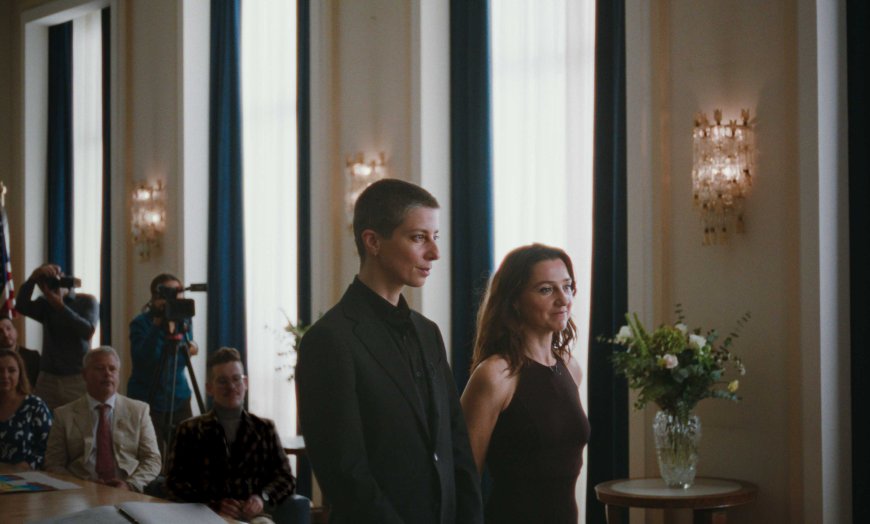
The bittersweet drama “Julian” is even more heartbreaking because it is true. In Brussels in 2017, two women, Fleur Pierets (Nina Meurisse), an artist and writer, and Julian (Laurence Roothooft), a hydrographer, got engaged. As part of an art project, they decided to wed in every country that had legalized same-sex marriage. (This was not a symbolic act, although all but the first ceremony was symbolic.) There were 22 countries that supported same-sex marriage at the time, so they created “Project 22,” and sought funding for some of their travels and expenses.
“Julian” shows the couple getting married in New York City, but also receiving a phone call from someone in São Paulo, who denies them the opportunity to wed because it would require police protection. “Are we a national threat?” Fleur asks at this development. When the women are in Paris, however, for their fourth wedding, Julian feels dizzy and suffers a health issue. She eventually was diagnosed with multiple brain tumors.
Director Cato Kusters tells this story with respect and restraint. She toggles back and forth in time between the couple meeting at a concert — Fleur has to pass by Julian to get to her seat and is intrigued by her — to Fleur sitting by Julian’s deathbed, whispering to her wife in the film’s most emotionally affecting moment, “I will always love you. You’ll always be in my heart.”
In between, Fleur is seen preparing to give a lecture about Project 22 in New York City after Julian’s passing. The stress of this, which involves film files of Julian being seen and disappearing, trigger Fleur’s emotions.
At times, “Julian” feels less about Julian and more about Fleur. That is not a bad thing; Fleur is keeping her wife’s legacy alive while also calling attention to the legal rights for same-sex couples. And the film does jerk tears. There are some beautiful scenes of the couple kissing at a wedding that are more poignant because of how the couple only managed to get married four times, rather than have 22 ceremonies as they initially planned.
Scenes between the couple filming each other and cuddling together provide a sense of their close bond. Kusters lets viewers sit with the characters, which conveys the extent of their love. It is also interesting that Fleur plans to use the same vows at each wedding while Julian is going to “change them up.” When they have an extended kiss at one of their weddings, it is a joyous moment.
One of the best scenes has Julian and Fleur meeting with a city clerk in New York who wants to be their officiant. He tells them how moved he was by their proposal—and how it would have inspired his late nephew. He also arranges to get them extra time to set up cameras to record their union. The exchange emphasizes the importance of Project 22, but it is the scene that comes after that makes “Julian” so heartrending. Julian insists that Fleur takes a minute to go look at the Brooklyn Bridge and not go back to the hotel and her computer, where there are likely hate messages about what they are doing. It is the opportunity to “live in the moment” and appreciate life that resonates here. Given how things play out, this is especially poignant.
“Julian” is a heavy film, and there are hardships as Fleur fights, such as getting Julian’s name correct on legal documents. But there are also moments of levity, including one amusing exchange where Fleur’s mother, Ingrid (Rosalia Cuevas), keeps mentioning crack when she is working with a thickener to help Julian swallow food and medication. (The film shrewdly does not go into too many details about Julian’s condition; in real life she lost use of her limbs as well as her memory.)
Kusters films “Julian” with an appropriately reverential tone. Nina Meurisse captures Fleur’s passion and pain well, making her noble without being strident. As Julian, Laurence Roothooft exudes warmth, and viewers will be saddened as her health declines.
“Julian” is touching without being maudlin. The film should also generate more interest in both Fleur and Project 22.
“Julian” | Directed by Cato Kusters | Opening August 7 at the IFC Center | Distributed by Strand Releasing