‘Leviticus’ Is the Queer Horror Love Story at Sundance That Might Break You
A queer horror breakout at Sundance turns love into a literal killer in “Leviticus.”
 Mark
Mark
There’s no shortage of horror films built on fear of the unknown. “Leviticus,” the debut feature from Australian filmmaker Adrian Chiarella, takes a more pointed route, asking what happens when fear is taught, enforced, and ritualized. Premiering in the Midnight section at the Sundance Film Festival, the film has quickly become one of the most talked-about genre entries of the year.
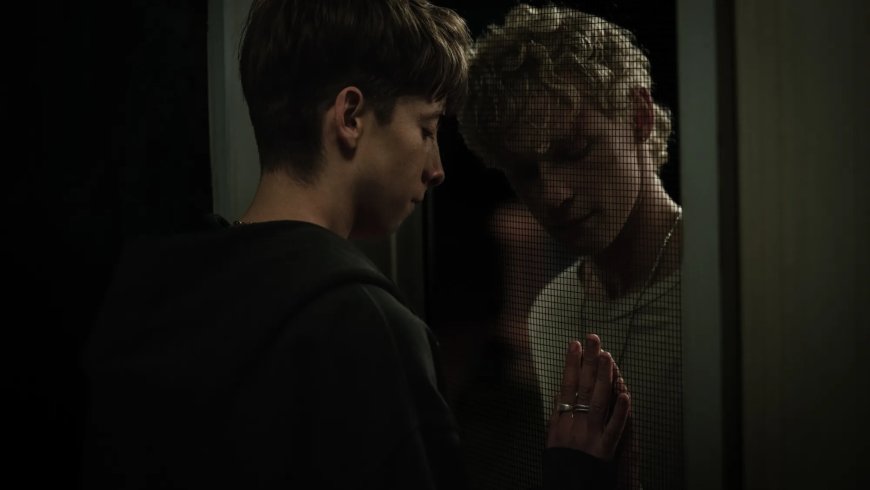
Set in a remote Australian town shaped by rigid religious beliefs, “Leviticus” follows Naim (Joe Bird), a quiet teenager adjusting to life with his well-meaning but oblivious mother (Mia Wasikowska). His world shifts when he forms a connection with Ryan (Stacy Clausen), a classmate who introduces him to feelings he hasn’t yet named. What begins as tentative curiosity soon turns into something deeper, and far more dangerous. When Desire Becomes the Monster
In Chiarella’s vision, queer attraction isn’t just taboo, it’s weaponized. After their relationship is exposed, Ryan and another boy, Hunter (Jeremy Blewitt), are subjected to a conversion ritual led by an outsider who promises “healing.” Instead, something else takes hold.
The film’s central horror conceit is as simple as it is unsettling: the curse manifests as the person you desire most. When you’re alone, they appear, and they’re trying to kill you. No one else can see them. No one else can help. And the cycle doesn’t end until you do.
It’s a sharp twist on familiar genre mechanics, echoing the slow-burn dread of It Follows while carving out its own identity. Where many films lean on metaphor, “Leviticus” makes its subtext unavoidable. Desire becomes both connection and threat, intimacy and your own demise (I’m scared!). Horror Meets First Love
What keeps the film grounded is its emotional core. Bird and Clausen bring a natural vulnerability to Naim and Ryan, capturing the awkward, electric rhythm of first love. Their early scenes carry a quiet tension, glances that linger too long, touches that feel risky. Even moments of closeness are charged with the fear of being seen.
Chiarella balances this intimacy with bursts of violence that arrive without warning. A private encounter can shift into something brutal in seconds, reinforcing the film’s central idea: safety is never guaranteed. Still, the connection between the two boys gives the story its pulse. You root for them, even as the film suggests the odds are stacked against any kind of happy ending. A Different Kind of Small-Town Horror
Rather than leaning into exaggerated portrayals of religious extremism, “Leviticus” finds something more unsettling in restraint. The adults in Naim’s life aren’t caricatures. His mother, played with nuance by Wasikowska, isn’t framed as cruel. She’s caring, present, and deeply misguided. That contradiction lingers, making the film’s world feel uncomfortably real.
Chiarella avoids easy targets, instead showing how harm can come from people who believe they’re doing the right thing. The town’s quiet complicity becomes just as frightening as the supernatural force stalking its teenagers. Playing With the Rules
The film sets up familiar horror beats, a search for answers, an attempt to break the curse, but rarely follows through in expected ways. Scenes that feel like they’re building toward resolution veer off course, keeping the audience off balance. Even when the narrative treads familiar ground, it does so with enough variation to stay engaging.
At a lean 86 minutes, the pacing is tight, though the final stretch briefly circles its own ideas before finding its footing again. When it does, the payoff lands. The closing moments, underscored by a track from Frank Ocean, deliver a mix of melancholy and release that lingers after the credits. A Breakout With Staying Power
“Leviticus” arrives during a crowded moment for elevated horror, queer storytelling, and festival breakouts. Yet it manages to stand apart by committing fully to its premise. It’s not interested in softening its edges or offering easy answers.
The film has already secured distribution through Neon, the studio behind recent indie horror successes, signaling confidence in its crossover potential. With a theatrical release planned later this year, it’s poised to reach a wider audience beyond the festival circuit.
For viewers tracking the evolution of queer horror, “Leviticus” marks a notable step forward. It’s a film that understands the genre’s history while pushing it somewhere more personal, and more dangerous.