What’s behind Guitarricadelafuente’s body & soul-baring performance of “La Nieve”?
The singer-songwriter & 'La Bola Negra' star wasn't just trying to show off his pits...
 Mark
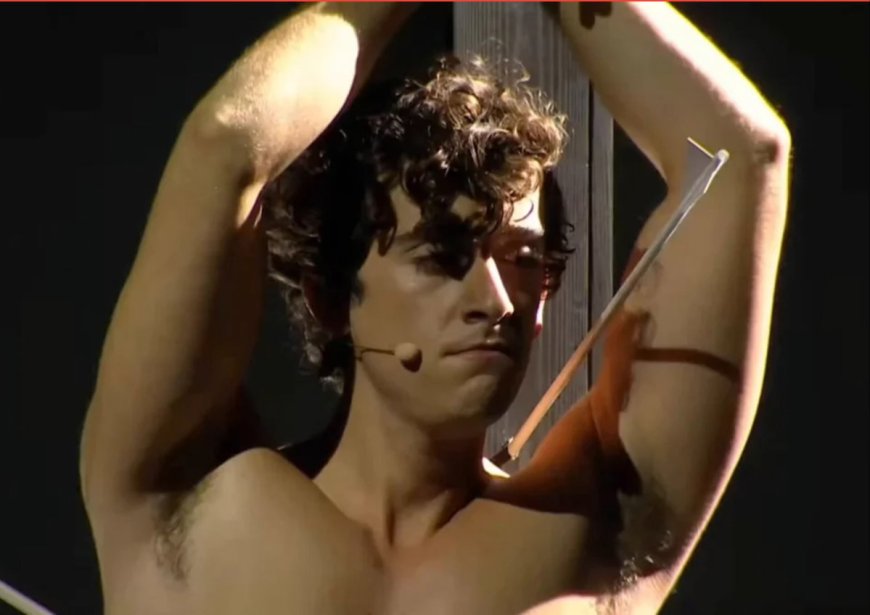

This past Friday, singer-songwriter and newly minted actor Guitarricadelafuente was honored with the special Spanish Phenomenon Award at the Los 40 Music Awards 2026 in Barcelona.
And while we’ll admit the awards show wasn’t exactly on our radar before, it sure is now after the star gave a breathtaking performance of his La Bola Negra theme “La Nieve” that immediately went viral across the internet.
How about we take this to the next level?
Subscribe to our newsletter for a refreshing cocktail (or mocktail) of LGBTQ+ entertainment and pop culture, served up with a side of eye-candy.
Subscribe to our Newsletter today
As lights raised on the stage, Guitarrica could be seen shirtless, hands tied above his head to a wooden post with arrows protruding out of it as if they’d been launched at him from all directions.
It made for quite the evocative image, which beautifully complemented the forlorn beauty of the number, sung so passionately by Guitarrica. And of course it probably didn’t hurt that his toned body was on full display…
But this wasn’t just an excuse to show off his pits—the staging of the performance was incredibly intentional, referencing a religious figure with a deep resonance for the queer community over the past few centuries.
Bare from the waist up, tethered, and flanked by arrows, Guitarrica’s pose is meant to evoke the iconic imagery of Saint Sebastian, a Catholic martyr made into a saint who, according to religious myth, was hunted for trying to conceal his faith, only to magically come back to life, as if by divine miracle.
Sebastian’s story became a popular subject of art during the Renaissance, with famous works from the likes of Spanish painter El Greco depicting the saint as a particularly lithe young man—some might even call him a twink!—whose look of wistfulness or even ecstasy stands in contrast to his dire situation.
Perhaps because of the drama of it all and his *ahem* twink-like physique, the figure has captured the imaginations of queer folks for centuries, most notably writer Oscar Wilde who is often credited with first re-contextualizing Sebastian as a queer icon in the public eye.
Related
How did this suffering Catholic twink become a queer mascot?
He’s a gay saint for a reason
Since then, many other LGBTQ+ artists have been inspired by or even directly depicted Saint Sebastian in their work: Bisexual dancer Ida Rubenstein donned drag to play him on stage in 1911, gay Japanese writer Yukio Mishima posed as him after writing about the legend in his 1970 novel Confessions Of A Mask, and trailblazing queer filmmaker Derek Jarman’s very first feature Sebastiane brought the story to the screen in explicitly homoerotic fashion in 1976.
The saint was also a major fixation for queer Spanish poet & playwright Federico García Lorca, who once wrote to his close friend Salvador Dalí about how he believed Sebastian’s classical image to represent “one of man’s most beautiful postures.”
He, like so many others, saw Saint Sebastian as a potent symbol for repression and persecution, a conduit to explore secret desires and feelings he wouldn’t dare speak publicly at the time, especially as the Spanish Civil War gave rise to fascist powers that attempted to stamp out queerness or anything that went against their rigidly patriarchal, conservative rule.
So, you’re seeing how this is all connected right? Guitarricadelafuente stars in Javier Ambrossi & Javier Calvo’s La Bola Negra, a sweeping epic of a film expressly indebted to Lorca, one that boldly excavates his work in order to champion his legacy and connect our modern queer experience to the many, many queer individuals who came before us.

And because Saint Sebastian was something of a muse for Lorca, the imagery and story of the religious figure pervades La Bola Negra as well. Guitarrica’s character’s name? Sebastián! That crumbled statue he climbs while fleeing the attack on his village? It’s one of Saint Sebastian himself!
As Sebastián the character uses the marble arrows to hoist himself up on the rubble, his face brushing up against that of the stone-carved saint, Los Javis are deliberately leaning into the figure’s loaded symbolism.
Related
The true story of the forbidden romance the inspired gay historical epic La Bola Negra
‘La Bola Negra’ blends fact & fiction for a sweeping story that uncovers forgotten queer history. Here’s what really happened…
With Guitarrica becoming Saint Sebastian via his emotive performance at the Los 40 Music Awards, that connection becomes even more strikingly clear—and all the more powerful:
“In such turbulent times, when so much is being questioned, films like La Bola Negra are more necessary than ever,” Rosalía said while presenting with the Phenomenon Award that night. “They remind us that there were figures like Lorca, who, through his poetry, expressed something that was so difficult to express in his time. That is precisely why the rights we have fought for and achieved today must continue to be defended. There are many Sebastians in this world, and Guitarricadelafuente gives them all a voice.”
And we’re grateful to Guitarricadelafuente for using this opportunity to ensure those voices will continue to resonate throughout history. (Now let’s let him do it on the Oscars stage next—shirt optional!)
La Bola Negra is currently playing in select theaters and will begin streaming December 4 exclusively on Netflix.
Related
‘Sebastiane’ brings the queer male gaze to religious epics—and it gets pretty wild!
If you thought the volleyball scene in ‘Top Gun’ was homoerotic, they’ve got nothing on the beach boys of this provocative classic.
Sign up for the Queerty newsletter to stay on top of the hottest stories in LGBTQ+ entertainment, politics, and culture.