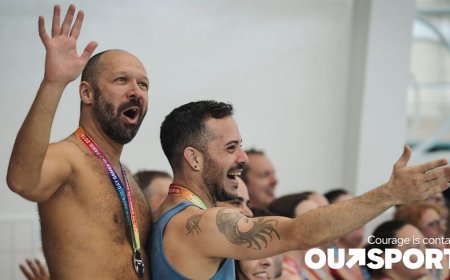
International Gay Rugby chair: Sport faces defining moment on inclusion
International Gay Rugby chair says guidelines are better than blanket trans bans, ahead of the Bingham Cup. The post International Gay Rugby chair: Sport faces defining moment on inclusion appeared first on Outsports.
 Mark
Mark

When International Gay Rugby started back in 2000, the world looked very different for LGBTQ athletes.
Homophobia was everywhere in sports. No professional rugby player had come out publicly. And the idea of a global network of gay and inclusive rugby clubs? That seemed almost revolutionary.
Today, looking back as IGR Chair, I can see how far we’ve come. But I also know we have so much more work to do.
The last 24 years have brought real change. What began as a few pioneering clubs has grown into a global federation across multiple continents.
We host the Bingham Cup, the Amanda Mark Cup, and other tournaments and leagues that celebrate both great rugby and people being their authentic selves. We’ve shown that rugby really can be “a game for all,” welcoming players no matter their orientation, gender identity, or background.
Get off the sidelines and into the game
Our weekly playbook is packed with everything from locker room chatter to pressing LGBTQ sports issues.
Subscribe to our Newsletter today
IGR’s major biennial event is being held from Aug. 19 to 23 in Brisbane, Australia. The Bingham Cup is named in honor of the late Mark Bingham, known around the world as one of the heroes of 9/11, while the women’s competition is named after his best friend, Amanda.
Related
‘Being gay is my superpower’ says out rugby legend Ian Roberts, as he celebrates his legacy
Ian Roberts made LGBTQ history 30 years ago, coming out as gay in pro rugby league. He talks to Outsports about his documentary crowdfunder.
Over the years, professional rugby has welcomed several notable, visible LGBTQ figures.
Australian prop Ian Roberts came out back in 1995 in rugby league, blazing a trail long before IGR even existed.
Welsh legend Gareth Thomas came out in 2009, one of the first major professional players to do so. His courage started conversations that had been impossible before.
World-famous referee Nigel Owens came out in 2007, proving that match officials could be themselves at the highest level.
More recently, former England women’s captain Katy Daley-McLean and others have helped make LGBTQ identities normal in both men’s and women’s rugby.
Collectively, these trailblazers have inspired thousands of people to live their lives authentically. I have lost count of how many IGR members have told me that seeing an out professional player or referee gave them strength.
Strength to keep playing. Strength to come out to their families. Sometimes, just the strength to get through another day. Rugby has always prided itself on being a sport where anyone can find their place. Tall or short, heavy or slight, gay or straight. Our inclusive clubs live this truth every single day.
But for all our progress, two huge challenges need our urgent attention. First, the transgender ban that World Rugby put in place in 2020 is a devastating step backwards.
This blanket ban on trans women competing in women’s rugby was based on flawed science. It was developed without actually talking to the women who play the sport. It goes against everything rugby claims to stand for.
Research shows that cisgender women players themselves do not support this ban. They see rugby as a game for everyone. They see no difference between competing against cisgender or transgender women.
The ban is especially frustrating because trans women have played rugby for decades without any problems. Organizations like Canadian Women & Sport and Athlete Ally have pointed out that there are no reported safety concerns involving trans players.
The policy just perpetuates harmful stereotypes about women needing protection, rather than respecting their strength and agency.
IGR stands firmly with our trans siblings. We will not stop fighting until this discriminatory policy is overturned and replaced with guidelines that actually respect both the science and the lived experiences of athletes.

Second, despite more visibility at amateur levels, elite professional men’s rugby is still largely closeted. How many current professional players feel able to be their authentic selves? The answer remains: very few.
Commercial pressures, media scrutiny, and lingering homophobia in some rugby cultures mean players still worry that coming out could cost them their careers, endorsements, or relationships with teammates.
This silence matters. Young LGBTQ athletes watching professional matches see no one like themselves at the top of the sport. They absorb the message that you can play rugby, but you cannot reach the highest level while being true to yourself. This has to change.
IGR calls on professional rugby unions, clubs, and governing bodies to implement real LGBTQ inclusion programs. Not just rainbow laces for one match a year. We need structural support at every level, confidential support services, and anti-homophobia education in academies.
More consistently visible and vocal allyship from players and coaches would also make a huge impact. The message should be absolutely clear — homophobia and transphobia have no place in our sport.
We also need more out professional players. To those elite athletes who are LGBTQ but not yet public: we see you, we support you, and we are here to help when you choose to share your truth. Your visibility would transform the sport.
Related
One of the heroes on 9/11 was gay rugby player Mark Bingham, who stormed the cockpit on Flight 93
On the 22nd anniversary of the Sept. 11 attacks, one of the heroes of that terrible day — rugby player Mark Bingham — is remembered by his best friend on IGR’s ‘The Third Half’.

Since 2000, IGR has built a global family where thousands of players can be authentically themselves while competing hard. We’ve shown what is possible. Now we must demand that the professional game catches up.
That means dismantling the trans ban, supporting closeted players, and ensuring rugby truly becomes the inclusive sport it claims to be.
The scrum, ruck, maul, the 3rd half and the stands bring us together across all our differences. It is time professional rugby remembered that.
Quinton Leduc is the Chair of International Gay Rugby (IGR). You can find out more about the organization on their website and follow on Instagram at @igrclubhouse.
Subscribe to the Outsports newsletter to keep up with your favorite out athletes, inspiring LGBTQ sports stories, and more.
The post International Gay Rugby chair: Sport faces defining moment on inclusion appeared first on Outsports.