‘Kramer/Fauci’ revives 30-year-old discussion with direct relevance to today
So-called “verbatim theater” has a unique power to contextualize history and provide a contemporary audience with new perspectives on past events. Using the actual words spoken by real people at a specific time and in a specific situation, this genre doesn’t overlay artistic abstraction — or fiction — on events. Rather, the dramatic tension arises … Read More
 Mark
Mark
0
3
So-called “verbatim theater” has a unique power to contextualize history and provide a contemporary audience with new perspectives on past events. Using the actual words spoken by real people at a specific time and in a specific situation, this genre doesn’t overlay artistic abstraction — or fiction — on events. Rather, the dramatic tension arises from an audience interpreting history through their present understanding.
Moisés Kaufman and the Tectonic Theater Project produced such important works as “Gross Indecency: The Three Trials of Oscar Wilde,” “The Laramie Project,” and the upcoming Broadway transfer of “Here there Are Blueberries.” These have been powerful examples of the effectiveness of this form to create compelling drama.
The theatrical impact of this form is on full display in the brilliant “Kramer/Fauci,” conceived and directed by Daniel Fish and now at St. Ann’s Warehouse in Brooklyn. The piece is based on the transcript of an hour-long C-Span call-in show from Nov. 30, 1993. The guests are Anthony Fauci, who at the time was the director of the National Institute of Allergy and Infectious Disease, and AIDS activist and author Larry Kramer. The conversation is moderated by C-SPAN host Steve Scully, and the topic they are debating is the formation of a task force on HIV and AIDS in the Clinton administration.
In Finch’s staging, the diametric opposition of the two men’s approach to the topic lands with force. Fauci is the measured government official who is defending the administration’s approach and trying to explain the complexity of the process of getting things done. Kramer is furious at the time it’s taking to achieve anything. Kramer, who had in other venues had called Fauci a “murderer” and an “incompetent idiot” rails at the snail’s pace of the government as people are dying.
What’s especially remarkable about hearing this confrontation 33 years later and in light of HIV evolving from a sure death sentence to a manageable, chronic disease, is that beneath the combative nature of the interaction, these are two men who respect one another as individuals. They are arguing about the issue, not engaging in ad hominem attacks. In fact, Fauci later said that it was Kramer’s relentlessness and aggressive rhetoric that finally forced the government to change its approach to researching and treating HIV and likely saving countless lives.
[caption id="attachment_65342" align="aligncenter" width="700"] Jennifer Seastone, Thomas Jay Ryan, Greig Sargeant, and Will Brill in "Kramer/Fauci."Maria Baranova[/caption]
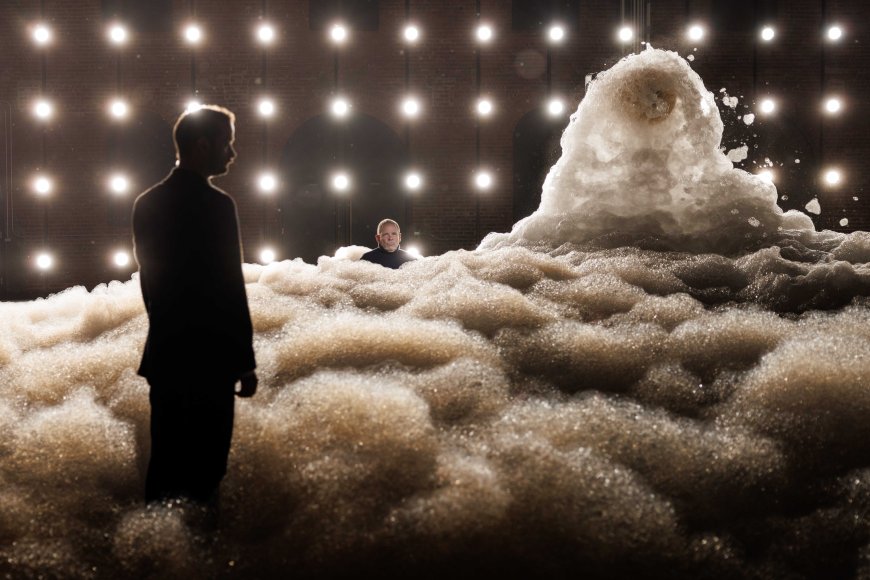
Though this was a televised interview with Fauci in-studio and Kramer by remote, Fish has placed the piece in a cavernous blank space often lit by stark white light designed by Scott Zielinski. It’s an expressionistic staging that allows the actors to roam, coming in and out of focus based on their distance from the audience and one another and always amplifying the text and the conflict between the two men. The moderator sits largely in the middle of the space, and for the call-in section of the show, one actress plays all the callers.
At one point, a massive foam machine is moved into the center of the space and blankets it with towering suds. As the pile mounts, Kramer sits in the middle of it, nearly covered by the bubbles. It’s a stunning image indicating that Kramer and, by extension, the entire issue is being consumed and obfuscated by the slow moving gears of government. Though Fauci at first haunts the edges of the foam, he later finds himself in the middle of it, as the machine stops, the bubbles melt, and Kramer squeegees the mess away. It is a coup de théâtre that is one of the most powerful I’ve seen, rendered more galvanizing by its inherent simplicity. Of course, that’s not all that surprising coming from Fish; his 2019 staging of “Oklahoma” was equally visionary and revelatory.
Will Brill is excellent as Dr. Fauci, capturing his Brooklyn accent and somewhat formal demeanor. Thomas Jay Ryan seems to directly channel Kramer from his fiery passion to his ability to both inspire and challenge viewers. The two have preserved every nuance of the interview. Greig Sargeant is excellent as the Moderator, as is Jennifer Seastone as all the callers.
Though the discussion is from three decades ago, it is completely relevant today. As Dr. Fauci is being pilloried and scapegoated for the response to another plague (Throughout the play, Kramer refers to HIV/AIDS as a “plague.”) in the form of COVID, it’s striking to see his measured, scientific response in the face of rampant emotionalism. Though passionate, Kramer is vastly more intelligent, fact-based, and sensible than the people attacking Dr. Fauci today.
Ultimately, though, one is left with the feeling that at one time, adversaries could violently confront one another, powerfully disagree and argue, and yet still want the same outcome. It is completely baffling what the people who are criticizing Dr. Fauci today want; it’s just so much noise. Still, “Kramer/Fauci” shows us what was once possible — and leaves us a glimmer of hope that we might get back there again.
Kramer/Fauci | St. Ann’s Warehouse | 45 Water Street, Brooklyn | Tues-Sat 7:30 p.m.; Sat, Sun 3 p.m. through October 24 | $45-$85 at St. Ann’s Warehouse|
1 hour, no intermission
Jennifer Seastone, Thomas Jay Ryan, Greig Sargeant, and Will Brill in "Kramer/Fauci."Maria Baranova[/caption]
Though this was a televised interview with Fauci in-studio and Kramer by remote, Fish has placed the piece in a cavernous blank space often lit by stark white light designed by Scott Zielinski. It’s an expressionistic staging that allows the actors to roam, coming in and out of focus based on their distance from the audience and one another and always amplifying the text and the conflict between the two men. The moderator sits largely in the middle of the space, and for the call-in section of the show, one actress plays all the callers.
At one point, a massive foam machine is moved into the center of the space and blankets it with towering suds. As the pile mounts, Kramer sits in the middle of it, nearly covered by the bubbles. It’s a stunning image indicating that Kramer and, by extension, the entire issue is being consumed and obfuscated by the slow moving gears of government. Though Fauci at first haunts the edges of the foam, he later finds himself in the middle of it, as the machine stops, the bubbles melt, and Kramer squeegees the mess away. It is a coup de théâtre that is one of the most powerful I’ve seen, rendered more galvanizing by its inherent simplicity. Of course, that’s not all that surprising coming from Fish; his 2019 staging of “Oklahoma” was equally visionary and revelatory.
Will Brill is excellent as Dr. Fauci, capturing his Brooklyn accent and somewhat formal demeanor. Thomas Jay Ryan seems to directly channel Kramer from his fiery passion to his ability to both inspire and challenge viewers. The two have preserved every nuance of the interview. Greig Sargeant is excellent as the Moderator, as is Jennifer Seastone as all the callers.
Though the discussion is from three decades ago, it is completely relevant today. As Dr. Fauci is being pilloried and scapegoated for the response to another plague (Throughout the play, Kramer refers to HIV/AIDS as a “plague.”) in the form of COVID, it’s striking to see his measured, scientific response in the face of rampant emotionalism. Though passionate, Kramer is vastly more intelligent, fact-based, and sensible than the people attacking Dr. Fauci today.
Ultimately, though, one is left with the feeling that at one time, adversaries could violently confront one another, powerfully disagree and argue, and yet still want the same outcome. It is completely baffling what the people who are criticizing Dr. Fauci today want; it’s just so much noise. Still, “Kramer/Fauci” shows us what was once possible — and leaves us a glimmer of hope that we might get back there again.
Kramer/Fauci | St. Ann’s Warehouse | 45 Water Street, Brooklyn | Tues-Sat 7:30 p.m.; Sat, Sun 3 p.m. through October 24 | $45-$85 at St. Ann’s Warehouse|
1 hour, no intermission
Jennifer Seastone, Thomas Jay Ryan, Greig Sargeant, and Will Brill in "Kramer/Fauci."Maria Baranova[/caption]
Though this was a televised interview with Fauci in-studio and Kramer by remote, Fish has placed the piece in a cavernous blank space often lit by stark white light designed by Scott Zielinski. It’s an expressionistic staging that allows the actors to roam, coming in and out of focus based on their distance from the audience and one another and always amplifying the text and the conflict between the two men. The moderator sits largely in the middle of the space, and for the call-in section of the show, one actress plays all the callers.
At one point, a massive foam machine is moved into the center of the space and blankets it with towering suds. As the pile mounts, Kramer sits in the middle of it, nearly covered by the bubbles. It’s a stunning image indicating that Kramer and, by extension, the entire issue is being consumed and obfuscated by the slow moving gears of government. Though Fauci at first haunts the edges of the foam, he later finds himself in the middle of it, as the machine stops, the bubbles melt, and Kramer squeegees the mess away. It is a coup de théâtre that is one of the most powerful I’ve seen, rendered more galvanizing by its inherent simplicity. Of course, that’s not all that surprising coming from Fish; his 2019 staging of “Oklahoma” was equally visionary and revelatory.
Will Brill is excellent as Dr. Fauci, capturing his Brooklyn accent and somewhat formal demeanor. Thomas Jay Ryan seems to directly channel Kramer from his fiery passion to his ability to both inspire and challenge viewers. The two have preserved every nuance of the interview. Greig Sargeant is excellent as the Moderator, as is Jennifer Seastone as all the callers.
Though the discussion is from three decades ago, it is completely relevant today. As Dr. Fauci is being pilloried and scapegoated for the response to another plague (Throughout the play, Kramer refers to HIV/AIDS as a “plague.”) in the form of COVID, it’s striking to see his measured, scientific response in the face of rampant emotionalism. Though passionate, Kramer is vastly more intelligent, fact-based, and sensible than the people attacking Dr. Fauci today.
Ultimately, though, one is left with the feeling that at one time, adversaries could violently confront one another, powerfully disagree and argue, and yet still want the same outcome. It is completely baffling what the people who are criticizing Dr. Fauci today want; it’s just so much noise. Still, “Kramer/Fauci” shows us what was once possible — and leaves us a glimmer of hope that we might get back there again.
Kramer/Fauci | St. Ann’s Warehouse | 45 Water Street, Brooklyn | Tues-Sat 7:30 p.m.; Sat, Sun 3 p.m. through October 24 | $45-$85 at St. Ann’s Warehouse|
1 hour, no intermission