How a botched hookup and an exiled Archduke created Vienna’s most beautiful bathhouse
Luziwuzi was the queen of Season 1904 of the Habsburg dynasty, and he wielded his Emperor brother’s status as a shield against the law.
 Mark
Mark

It’s Saturday night. You’ve just uploaded a new Grindr profile and put on your sluttiest outfit. A friend of yours recently spilled tea about a bathhouse in Vienna where DL trade goes to smash. You order an Uber and roll up in a soundtracked slo-mo scene. You enter, lock eyes with the first hot guy you see, and grab his leg. Oops, you didn’t read the room first, because now he’s slapping you and you’ve just been exiled from the Austrian Habsburg Empire.
Oh, did I forget to tell you? You’re Archduke Ludwig Viktor, brother of the Emperor of Austria, and this is the beginning of the 20th century. Your slutty outfit is a gold-embroidered tailcoat, your Uber ride is a horse-drawn carriage, and your Grindr profile is a framed oil painting that required three months of sitting passive-aggressively in a chair. Oh, and that bathhouse where you tried to score free sausage? It will become one of the most famous gay saunas in Europe.
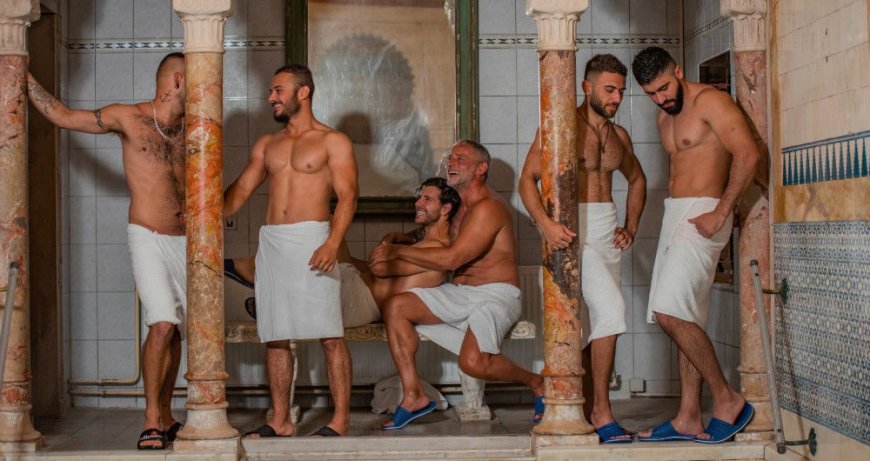
This is the tale of Kaiserbründl Men’s Sauna, a now-iconic feature of Vienna’s gay scene that has been facilitating sweaty sausagefests for over 135 years. Admired for its captivating, Moorish-inspired architecture and viscerally erotic paintings, it’s also known as a prime cruising destination in contemporary Vienna. That said, it didn’t officially come out as a gay sauna until relatively recently. When it first introduced its darkrooms to Viennese society in the 19th century, homosexuality was still illegal throughout the Habsburg Empire.
That brings us back to our unfortunate Archduke Ludwig Viktor, a.k.a. “Luziwuzi,” and the slap heard around the Habsburg world.
Pack your bags, we’re going on an adventure
Subscribe to our weekly newsletter for the best LGBTQ+ travel guides, stories, and more.
Subscribe to our Newsletter today

Despite being the younger brother of the ultra-conservative Emperor Franz Joseph I of Austria, Luziwuzi nevertheless loved to throw gay parties around Vienna. (Imagine a herd of male nobles wearing frillier shirts than usual, singing opera arias at the top of their lungs, then making out.) No commoner or lesser noble would have gotten away with such flagrant fabulousness; they would have been sent to prison. But Luziwuzi was the delusional queen of Season 1904 of the Habsburg dynasty, and he wielded his Emperor brother’s status as a shield against the law.

Luziwuzi also managed to keep his homosexuality out of both mainstream and fake news thanks to strict censorship policies that protected the royal family. Unfortunately, when Luzi got a little too handsy in a local bathhouse “one fine day” with a young male officer, the man slapped Luzi and “boxed his ears” until the Archduke fled the premises. The officer either hadn’t swung in Luzi’s direction or simply hadn’t been interested, but the scandal boiled over nevertheless. The bathhouse, which wasn’t called Kaiserbründl at the time, wasn’t yet an explicitly gay hookup site, so Luziwuzi came off looking like a predator. Luzi’s brother, the Emperor, opted to avert a city-wide gay panic by exiling his younger brother to a grand palace outside of Salzburg. Think Truman Capote being exiled from Midtown to Long Island, or Red, White & Royal Blue, directed by Terrence Malick.

Not a bad life, though, right? Even though Luzi couldn’t throw his Pride parties in Vienna, he could still sample the local goods in sizzling Salzburg. On top of that, his tale of failed seduction at the bathhouse hovered like a specter over the place for decades. Known as Zentralbad in Luzi’s heyday, the bathhouse continued to amass notoriety until it eventually morphed into what it is today.
Kaiserbründl Men’s Sauna is now a prime destination for LGBTQ travelers visiting Vienna’s city center. With its sauna, steam room, solarium, darkrooms, private massage areas, and three floors of dining, it’s already a top-notch bathhouse. But once you consider its hypnotic architecture and erotic paintings by Viennese artist Stefan Riedl, you understand why it’s a top destination in not just Vienna but Europe. Its baroque wall decorations, gold accents, marble columns, and vaulted halls conjure a disorienting atmosphere reminiscent of both Middle Eastern hammams and Roman baths.
As a bonus, its central location in Vienna grants access to both historical sites and beloved LGBTQ+ hangouts. The First District which surrounds Kaiserbründl is home to the imposing St. Stephen’s Cathedral and Kärntner Straße, a popular shopping street. It’s also within walking distance of both the Vienna Marriott Hotel and the Stephansdom metro station, the latter of which can ferry you to several places beloved by local gays.

For cruising, there’s Rathauspark, which converts from an innocent park and event space by day into a free-for-all “gay encounter locale” by night. The Danube Island and floodplains house several nudist areas, including the Toter Grund on the island itself and the Dechantlacke on the mainland, both of which are populated by titillated gay men. Even the bathroom of the Stephansplatz metro station remains a meetup spot, so visitors to Kaiserbründl don’t have to travel far to their next hookup. When it comes to decadent social gatherings, however, Café Savoy might be the crown jewel of Vienna’s gay scene. With its giant mirrors, sensational candelabras and scintillating chandeliers, this café-bar serves equally well for afternoon aperitifs as it does for Saturday night meet-cutes.
Moreover, its baroque decor evokes Habsburg splendor more than any other gay venue, whisking you to an epoch when gay parties were not acceptable — the epoch of Luzi. As you flirt and flounce, think of Luzi and how he would have loved this carefree bar, where even working classes can flaunt unbridled gayness. Maybe you’ll even invoke his spirit and momentarily return him to Vienna, where he so rightfully belongs.
Join the GayCities newsletter for weekly updates on the best LGBTQ+ destinations and events—nearby and around the world.