
Romance in the park: A sumptuous ‘Winter’s Tale’ shines at the Delacorte
To fully abandon yourself to revel and delight in the world of “The Winter’s Tale,” one of Shakespeare’s most beautiful late romances, “It is required that you do awake your faith,” as the character Paulina says to the King Leontes near the end of the play when she reveals a trick that she has played … Read More
 Mark
Mark
0
23
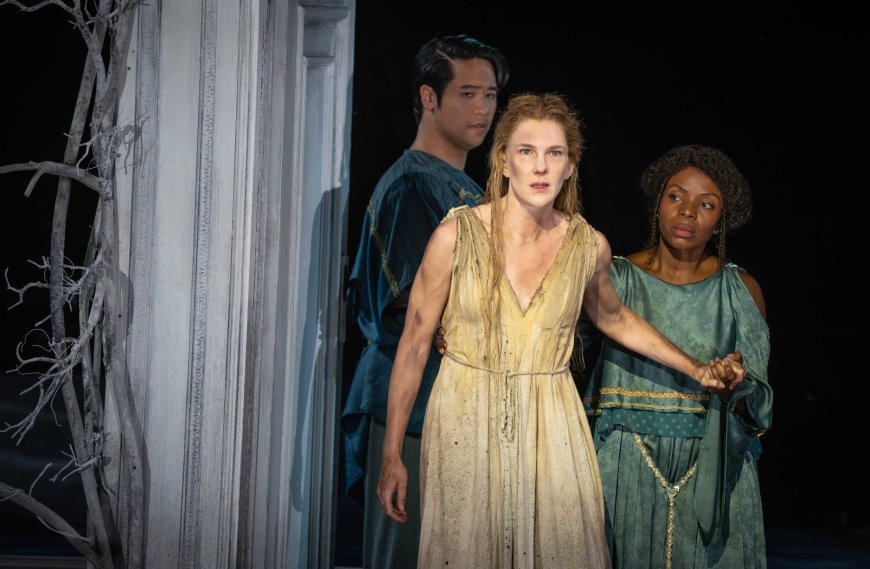
To fully abandon yourself to revel and delight in the world of “The Winter’s Tale,” one of Shakespeare’s most beautiful late romances, “It is required that you do awake your faith,” as the character Paulina says to the King Leontes near the end of the play when she reveals a trick that she has played over 16 years. In this case, it’s because the “Tale” is often seen as a “problem” play from a dramaturgical perspective. Ben Johnson, Shakespeare’s contemporary and competitor, reportedly referred to the play as a “mouldy tale” because of its largely implausible plot.
Yet, none of that matters in the hands of strong direction and a brilliant cast. The audience is simply swept into the world of the play and the swirling story of jealousy, revenge, grief, and redemption. Such a production is currently on stage for free at the Delacorte in Central Park.
Among the many smart choices director Daniel Sullivan has made in staging the play, easily one of the most satisfying is to trust the material, to lean into the language and the story, and to count on the audience to go with him into this complex world. In this consistently beautiful production, anyone with a functioning heart must go along gladly.
As for the tale itself, Leontes, the King of Sicilia, suddenly becomes convinced that his beloved wife Hermione has been unfaithful to him with Polixenes the King of Bohemia, Leontes’ childhood friend who is only convinced to prolong a 9-month visit at the request of Hermione, Leontes’ queen. Unable to contain his jealousy, Leontes forces Polixenes to flee, imprisons Hermione (who delivers a daughter while incarcerated), suffers the death of his beloved son, and watches as Hermione appears to die when she collapses at her trial.
Instead of killing the infant girl, Leontes banishes her. A lord Antigonus takes the baby to the shores of Bohemia, where he abandons her to the elements and in turn is killed by a wild bear. (One of Shakespeare’s most famous stage directions: “Exit pursued by bear.”) The scene shifts, and the girl, now named Perdita, is discovered by an old shepherd and his son, who raise her. In time, she falls in love with Prince Florizel, but their match is impossible due to their disparity in status. Unwilling to separate, they flee back to Sicilia to seek sanctuary. Polixenes follows. They discover that Perdita is Lenotes' daughter. Then, in what is easily one of the most famous coups de théâtre in Shakespeare, it is revealed that Hermione is alive. Not so fast, though. Paulina, Hermione’s waiting woman, has kept her in secret for 16 years and presents her as a statue to Leontes, who confronts his grief and guilt. Only when he is suitably chastened does the statue come to life, and we come to a bittersweet happy ending. Phew!
[caption id="attachment_64645" align="aligncenter" width="467"] Lily Rabe as Hermione and Raúl Esparza as Leontes.Joan Marcus[/caption]
Sullivan has also emphasized the role of time in the play. The scenes in Sicilia are staged on a giant sundial, wonderfully designed in a cold, gray counterpoint to the lush Central Park in the background by Maruti Evans. When the scene shifts to Bohemia, it is a riot of lush greenery, signaling rebirth after winter and emphasizing the possibility of redemption after the tragedies of jealousy and rage. When it all comes together at the end, it speaks to the possibility of redemption and healing — but it is not without its costs.
The phenomenal cast that brings this to life is led by Raul Esparza as Leontes. It’s a rich, and textured performance, and combines both terrifying rage and gentle lyricism. As Hermione, Lily Rabe is both fiercely powerful and delicate. The way these two actors embrace the dichotomies of their characters grounds the production and provides the centerpiece of the romance. The statue scene with Rabe sitting stonily draped and representing loss and mourning as Esparza endures Leontes’ grief is breathtakingly gorgeous.
In other roles, Chuck Cooper is wonderfully warm and sympathetic as the Old Shepherd who saved Perdita. As Camillo, the courtier who flees with Polixenes, Teagle F. Bougere is the picture of devotion and loyalty — with a little self-interest thrown in. Gilbert Owuor is fine as Polixenes as are Kattie Griffith and Daniel Kyri as Perdita and Florizel, respectively.
Marsha Stephanie Blake is simply fantastic as Paulina. The serving woman who stands up to the king, she gives the role a fiery focus that becomes the moral center of the tale. In berating Leontes, Paulina has nothing left to lose, and she defends Hermione against Leontes’ unfounded attacks and is the architect of the plan to hold Hermione in seclusion and stage manages Leontes’ transformation and forces him to “awake your faith.”
The only discordant performance is Steven Skybell as Autolycus, the opportunistic conman who cheats the simple people of Bohemia by selling them trinkets and ballads. His low comedy is a counterpoint to Paulina’s morality, and he plays a pivotal role in allowing Florizel and Perdita to flee, though he follows to enrich himself. Skybell, though, plays the role with a forced and manic energy that is tonally out of sync with the rest of the production.
This is a small quibble, though. The sweeping scope of this production, visual beauty, and emotional power leave us all in hope for the possibility of forgiveness and renewal. What a lovely experience for a late summer evening.
The Winter’s Tale | The Public Theatre at the Delacorte, Central Park | Tues-Sun 8 p.m. through August 23rd | Free | Information about ticket distribution and lotteries at PublicTheater.org | 3 hours, 20 mins, 1 intermission
Lily Rabe as Hermione and Raúl Esparza as Leontes.Joan Marcus[/caption]
Sullivan has also emphasized the role of time in the play. The scenes in Sicilia are staged on a giant sundial, wonderfully designed in a cold, gray counterpoint to the lush Central Park in the background by Maruti Evans. When the scene shifts to Bohemia, it is a riot of lush greenery, signaling rebirth after winter and emphasizing the possibility of redemption after the tragedies of jealousy and rage. When it all comes together at the end, it speaks to the possibility of redemption and healing — but it is not without its costs.
The phenomenal cast that brings this to life is led by Raul Esparza as Leontes. It’s a rich, and textured performance, and combines both terrifying rage and gentle lyricism. As Hermione, Lily Rabe is both fiercely powerful and delicate. The way these two actors embrace the dichotomies of their characters grounds the production and provides the centerpiece of the romance. The statue scene with Rabe sitting stonily draped and representing loss and mourning as Esparza endures Leontes’ grief is breathtakingly gorgeous.
In other roles, Chuck Cooper is wonderfully warm and sympathetic as the Old Shepherd who saved Perdita. As Camillo, the courtier who flees with Polixenes, Teagle F. Bougere is the picture of devotion and loyalty — with a little self-interest thrown in. Gilbert Owuor is fine as Polixenes as are Kattie Griffith and Daniel Kyri as Perdita and Florizel, respectively.
Marsha Stephanie Blake is simply fantastic as Paulina. The serving woman who stands up to the king, she gives the role a fiery focus that becomes the moral center of the tale. In berating Leontes, Paulina has nothing left to lose, and she defends Hermione against Leontes’ unfounded attacks and is the architect of the plan to hold Hermione in seclusion and stage manages Leontes’ transformation and forces him to “awake your faith.”
The only discordant performance is Steven Skybell as Autolycus, the opportunistic conman who cheats the simple people of Bohemia by selling them trinkets and ballads. His low comedy is a counterpoint to Paulina’s morality, and he plays a pivotal role in allowing Florizel and Perdita to flee, though he follows to enrich himself. Skybell, though, plays the role with a forced and manic energy that is tonally out of sync with the rest of the production.
This is a small quibble, though. The sweeping scope of this production, visual beauty, and emotional power leave us all in hope for the possibility of forgiveness and renewal. What a lovely experience for a late summer evening.
The Winter’s Tale | The Public Theatre at the Delacorte, Central Park | Tues-Sun 8 p.m. through August 23rd | Free | Information about ticket distribution and lotteries at PublicTheater.org | 3 hours, 20 mins, 1 intermission
Lily Rabe as Hermione and Raúl Esparza as Leontes.Joan Marcus[/caption]
Sullivan has also emphasized the role of time in the play. The scenes in Sicilia are staged on a giant sundial, wonderfully designed in a cold, gray counterpoint to the lush Central Park in the background by Maruti Evans. When the scene shifts to Bohemia, it is a riot of lush greenery, signaling rebirth after winter and emphasizing the possibility of redemption after the tragedies of jealousy and rage. When it all comes together at the end, it speaks to the possibility of redemption and healing — but it is not without its costs.
The phenomenal cast that brings this to life is led by Raul Esparza as Leontes. It’s a rich, and textured performance, and combines both terrifying rage and gentle lyricism. As Hermione, Lily Rabe is both fiercely powerful and delicate. The way these two actors embrace the dichotomies of their characters grounds the production and provides the centerpiece of the romance. The statue scene with Rabe sitting stonily draped and representing loss and mourning as Esparza endures Leontes’ grief is breathtakingly gorgeous.
In other roles, Chuck Cooper is wonderfully warm and sympathetic as the Old Shepherd who saved Perdita. As Camillo, the courtier who flees with Polixenes, Teagle F. Bougere is the picture of devotion and loyalty — with a little self-interest thrown in. Gilbert Owuor is fine as Polixenes as are Kattie Griffith and Daniel Kyri as Perdita and Florizel, respectively.
Marsha Stephanie Blake is simply fantastic as Paulina. The serving woman who stands up to the king, she gives the role a fiery focus that becomes the moral center of the tale. In berating Leontes, Paulina has nothing left to lose, and she defends Hermione against Leontes’ unfounded attacks and is the architect of the plan to hold Hermione in seclusion and stage manages Leontes’ transformation and forces him to “awake your faith.”
The only discordant performance is Steven Skybell as Autolycus, the opportunistic conman who cheats the simple people of Bohemia by selling them trinkets and ballads. His low comedy is a counterpoint to Paulina’s morality, and he plays a pivotal role in allowing Florizel and Perdita to flee, though he follows to enrich himself. Skybell, though, plays the role with a forced and manic energy that is tonally out of sync with the rest of the production.
This is a small quibble, though. The sweeping scope of this production, visual beauty, and emotional power leave us all in hope for the possibility of forgiveness and renewal. What a lovely experience for a late summer evening.
The Winter’s Tale | The Public Theatre at the Delacorte, Central Park | Tues-Sun 8 p.m. through August 23rd | Free | Information about ticket distribution and lotteries at PublicTheater.org | 3 hours, 20 mins, 1 intermission